Autonomous agents now ship faster than the controls meant to govern them: Gartner expects 40% of enterprise applications to embed task-specific AI agents by the end of 2026, up from under 5% a year earlier. That speed has a cost — GitGuardian’s State of Secrets Sprawl 2026 found AI-assisted commits leak secrets at roughly 2x the baseline rate. These AI agent security best practices turn the OWASP Agentic Top 10 into a checklist you can actually run, and most of them are easiest to enforce once — at a gateway in front of every model and tool call, which is exactly what OrcaRouter provides.
Quick take: You can’t make a model immune to manipulation, so constrain what a manipulated agent is allowed to do. The seven highest-leverage controls — least-privilege tool scoping, input/output validation, PII redaction, human approval for high-impact actions, guardrails with risk scoring, secrets management, and full logging — each neutralize a specific OWASP Agentic risk. Default-deny everything else.
The checklist at a glance (mapped to OWASP)
The OWASP Top 10 for Agentic Applications 2026, published in December 2025, is the first peer-reviewed taxonomy of agent-specific risks (codes ASI01–ASI10). Here is how each best practice maps to the risks it mitigates.
| # | Best practice | Primary OWASP risk(s) addressed |
| 1 | Least-privilege tool scoping | ASI02 Tool Misuse, ASI03 Privilege Abuse |
| 2 | Input validation & injection filtering | ASI01 Goal Hijack, ASI06 Memory Poisoning |
| 3 | Output validation & code sandboxing | ASI05 Unexpected Code Execution |
| 4 | PII & secret redaction at the boundary | ASI02 Tool Misuse, ASI03 Privilege Abuse |
| 5 | Human-in-the-loop for high-impact actions | ASI09 Human-Agent Trust Exploitation |
| 6 | Guardrails & risk scoring | ASI01 Goal Hijack, ASI10 Rogue Agents |
| 7 | Monitoring, logging & kill switches | ASI08 Cascading Failures, ASI10 Rogue Agents |
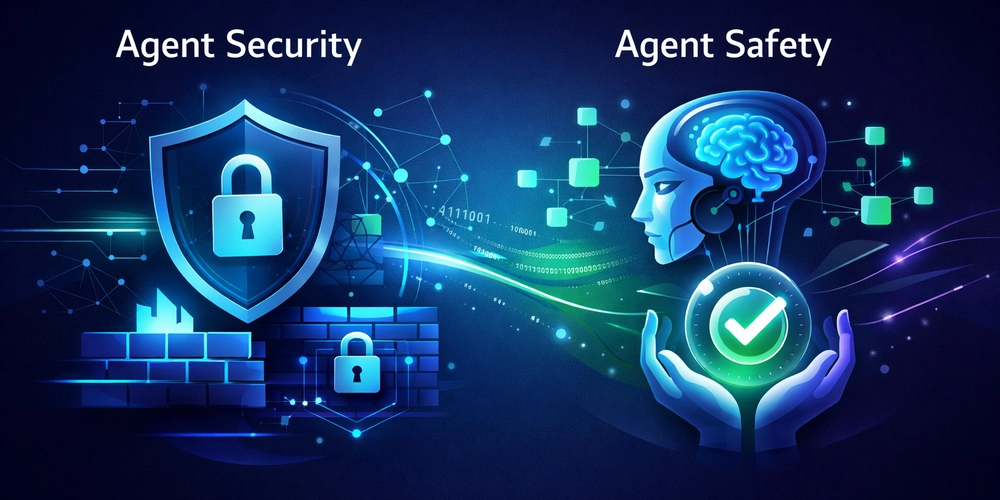
The seven controls every production agent needs. Enforce them at one boundary, not per agent.
1. Scope tools with least privilege
The most common real-world failure is over-permissioning. Scope each agent to a dedicated identity, a narrow tool allowlist, and time-bounded credentials that expire with the task. Default-deny: a tool an agent never receives can’t be abused. Planning agents often need no tools at all — only introspection. This is the single highest-leverage control because it caps blast radius regardless of how the agent is compromised, directly answering ASI02 and ASI03.
2. Treat every input as untrusted
Filter and scan all input — user prompts, retrieved documents, tool outputs, emails, web pages — for injection patterns before it reaches the model. Indirect prompt injection (payloads hidden in data the agent reads) is the dominant attack and maps to ASI01 Goal Hijack. Filtering ingested content also blocks ASI06 Memory Poisoning, where an attacker corrupts a RAG store or persistent memory that survives across sessions. Since no fully reliable defense against prompt injection exists, assume injection succeeds and rely on practices 1, 5, and 6 to contain it.
3. Validate outputs and sandbox generated code
Treat any code the agent generates as untrusted (ASI05). Remove direct eval-style execution, run generated code in a hardened sandbox, and require a preview/approval step before anything runs. Validate structured outputs against a schema so a hijacked agent can’t smuggle malicious tool arguments downstream.
4. Redact PII and secrets at the boundary
Every external model call can ship your data to a provider whose logs you don’t control. Strip PII and secrets before prompts leave your perimeter, not after. Open tooling makes this practical — Microsoft Presidio for de-identification and OpenAI’s open-weight Privacy Filter for high-throughput redaction. On the secrets side, the numbers are stark: GitGuardian found 28.6 million hardcoded secrets added to public GitHub in 2025 (a 34% YoY jump), including 24,008 secrets exposed in MCP config files, 8.8% of them live credentials. Never put long-lived keys in prompts or config — use short-TTL tokens (e.g., 60-minute OIDC federation tokens) and a generate-swap-revoke rotation pattern.
Each control closes a specific OWASP Agentic risk. Coverage, not a single silver bullet.
5. Require human approval for high-impact actions
Default-deny on irreversible operations. Gate payments, deletions, external sends, and privilege changes behind an explicit human confirmation with a clear risk indicator — a direct mitigation for ASI09 Human-Agent Trust Exploitation. The durable principle: authorization must track the agent’s purpose, not just its identity, because permissions can outlive the task. Pair each forced confirmation with an immutable log entry.
6. Add guardrails and risk scoring
Score every request for anomalies — unusual tool sequences, off-mission goals, data exfiltration patterns — and block or hold the ones that look like abuse, ideally before they’re billed. This catches ASI01 attempts that slip past input filters and surfaces ASI10 Rogue Agents drifting from their mandate. Content-policy guardrails on both prompts and responses keep a compromised agent from producing or acting on disallowed output.
7. Log everything and keep a kill switch
You can’t secure what you can’t see — yet teams without observability experience the same incidents and simply never detect them. Capture every request, model choice, tool call, argument, and latency. Add rate limits and circuit breakers to stop ASI08 Cascading Failures, and a kill switch to halt a ASI10 Rogue Agent instantly. Gartner warns that over 40% of agentic projects will be canceled by 2027 partly due to monitoring gaps — logging is what lets you find issues before users do.
The bottom line
Securing AI agents in 2026 is a governance problem, not a model problem. These seven AI agent security best practices map cleanly onto the OWASP Agentic Top 10, and the most efficient way to run them is at a single enforcement point: scope tools, validate input and output, redact data, gate high-impact actions, score risk, and log everything. Implement the controls once at a gateway and you get them everywhere — instead of re-bolting them onto each agent after the next incident.
Frequently asked questions
What are the most important AI agent security best practices? Least-privilege tool scoping, treating all input as untrusted, output validation, PII/secret redaction, human approval for high-impact actions, guardrails with risk scoring, and full logging.
What is the OWASP Agentic Top 10? The 2026 risk taxonomy (ASI01–ASI10) for autonomous agents — covering goal hijack, tool misuse, privilege abuse, memory poisoning, code execution, and rogue agents.
How do I implement least privilege for an agent? Give each agent a dedicated identity, a narrow tool allowlist, and short-lived task-scoped credentials that expire when the workflow ends. Default-deny everything else.
Can I fully prevent prompt injection? No. No reliable defense exists, so assume it succeeds and contain it with least privilege, human approval, and risk scoring.
Where should PII redaction happen? At the boundary, before prompts leave your perimeter — using tooling like Presidio or a gateway that redacts pre-billing.