
How Flexible Heating Technology Is Changing Cold-Weather Wearables

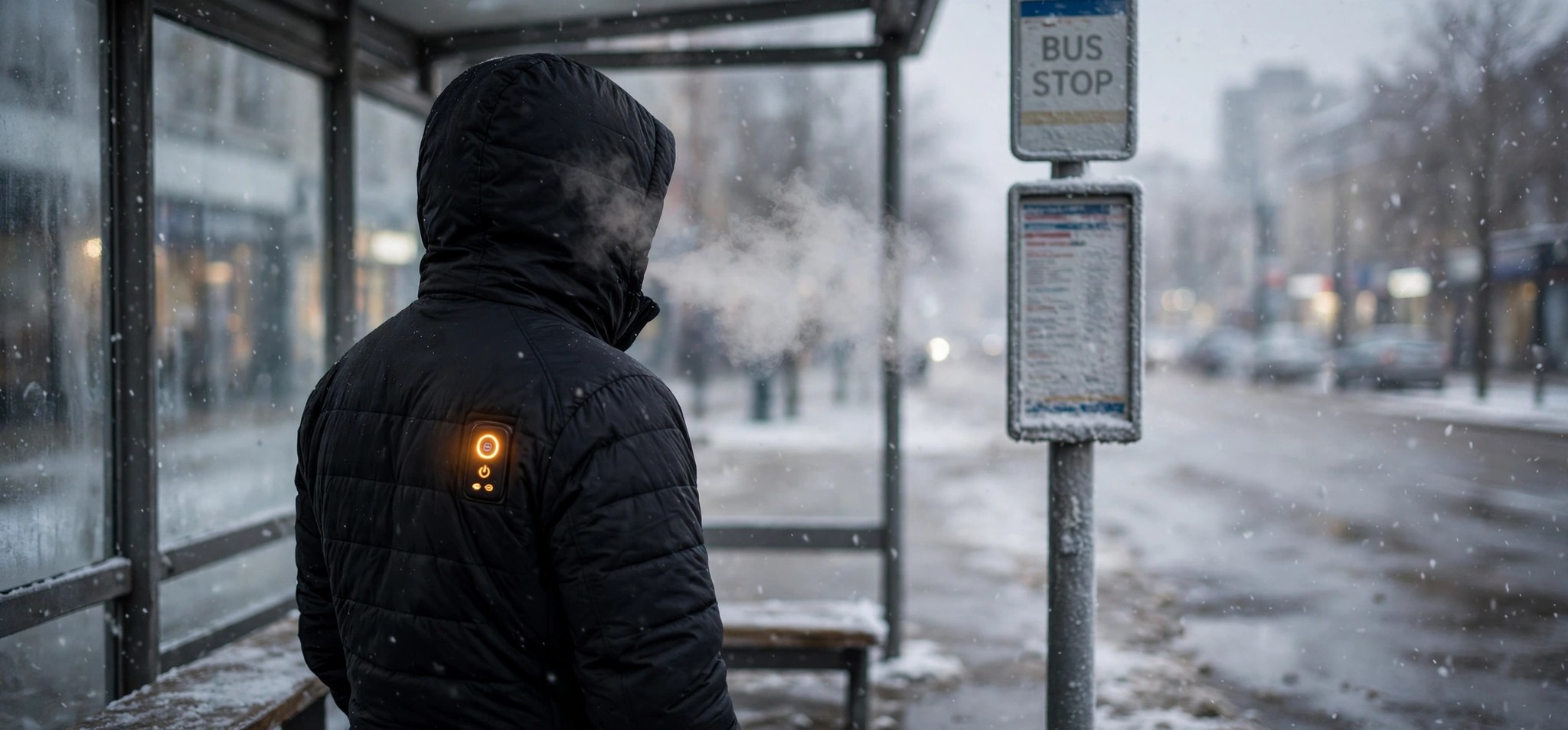
Every January, the same scene plays out at bus stops and station platforms up and down the country. People stand wrapped in their heaviest coats, scarves pulled tight, stamping their feet against the cold, and still the cold wins. Layers can only do so much. However carefully they are chosen, ordinary clothing works passively: it slows the escape of body heat, but it cannot produce any warmth of its own.
Heated clothing exists to solve exactly that problem. Thin heating elements are built directly into the garment, powered by a small rechargeable battery, so the clothing generates warmth instead of merely conserving it. Output can be adjusted at the press of a button, which means the wearer is no longer dressed for a single guess made at the front door, but can respond as the weather, and the day, changes around them.
As an idea, it is a simple one. Making it work in practice took considerably longer. A heating element inside a jacket has to survive being sat on, folded, rained on and washed, and it has to keep working through all of it, season after season. For many years, it did not, and the reasons why are where the story of modern heated clothing really begins.
The wire problem nobody talks about
Heated clothing isn’t new. Versions of it have been around for decades, and the early ones shared a flaw you’d spot within a week of ownership: the heating element was a metal wire, stitched in, and wire does not enjoy being clothing. It’s stiff. It kinks. Bend the same spot a few thousand times, an elbow, a shoulder, and the metal gives up, the circuit breaks, and one whole panel of the jacket goes permanently cold. Riders of a certain age still tell stories about heated waistcoats that warmed exactly one rib.
Modern panels don’t work like that, mostly because the “wire” isn’t wire any more.
What actually makes the heat now
Two material families account for most designs currently on the market. You don’t need to be an engineer to follow either.
Carbon fibre is the more established of the two, and it appears in everything from lightweight heated vests to heavy-duty workwear. Each element is a bundle of thousands of carbon filaments, each one thinner than a human hair. Pass a current through the bundle and it warms up (that’s electrical resistance doing its work), but because there are thousands of strands sharing the load, the heat comes off a surface, not a line. No hot stripe. No cold gaps between stripes. And it flexes, properly flexes, the way fabric does, without the strands snapping. In many designs, warmth can be felt within roughly half a minute of switching on, although the exact warm-up time depends on the element, the setting and the layers over it.
Then there's graphene, the second material, and the more expensive one to produce. Graphene itself is a sheet of carbon a single atom thick, and its conductivity, electrical and thermal, is exceptional by any standard. In laboratory terms it is close to a wonder material. Inside a jacket, though, you're rarely getting a pure sheet of it: graphene at garment scale is still too costly to produce that way, so what's in there is usually a film or a coating with graphene in the mix. What that delivers is a thinner panel and very even coverage. Brands also describe graphene elements as reaching operating temperature quickly, treat the speed claims gently. Published warm-up figures vary a lot between brands, and they are rarely measured under comparable conditions. What graphene does not provide, despite some marketing, is a different experience of being warm. Warm is warm. The honest differences are thinness, heat distribution and cost.
Whichever material is used, the significant point is this: the panel is so flat and flexible that, switched off, you’d struggle to find it by touch. A decade ago the element in a heated jacket could be located with your eyes shut. Now the jacket simply feels like a jacket.
Heat goes on the core. There’s a reason.
Zone layouts vary between manufacturers, but core coverage is the most common pattern: chest and back panels appear in most designs, with collar heating and heated pockets included in some. There's a physiological reason the core comes first. Get cold and the body starts rationing: blood flow to the fingers and toes is restricted, vasoconstriction is the technical term, because the vital organs matter more. That's why your fingers go numb while your torso still feels bearable. Warm the torso and the body doesn't need to ration as hard, so many wearers find their hands feel better too. Indirect, though. No heat travels from a chest panel to your fingertips, the effect isn't the same for everyone, and in severe cold the hands still need looking after themselves, gloves, or heated pockets where a design includes them.
The construction itself is unglamorous. Important, though. Panels are typically laminated or sewn between the outer shell and the lining; the cabling is routed where it won't press against the skin. The battery sits in a dedicated pocket, usually placed low and close to the body so its weight, often in the region of 100 to 200 grams, comparable to a phone, doesn't pull the garment to one side. Connectors unplug or seal away so the jacket can be washed, although "washable" usually comes with conditions: battery removed, gentle cycle, air dry.
One point that's easy to miss: the heating system is only half of modern heated clothing technology. Switch the power off and the garment still has to perform as ordinary outerwear, insulation trapping body heat, a shell keeping wind and rain out. The electronics add heat on top of that passive performance; they don't replace it. A heated garment is, in effect, two systems sharing one item of clothing, and the passive system works all day whether the battery does or not.
Low, medium, high and the maths nobody prints in big letters
Most heated garments offer a small number of heat settings, three is common, though some designs offer two, some more, and a minority are controlled through a phone app instead of a button on the garment. Manufacturers do publish temperature figures for their heating panels, but there is no shared test standard behind those numbers: measurement points, insulation and ambient conditions differ from one brand’s laboratory to another’s. For that reason, exact degree-by-degree comparisons between brands mean less than they appear to, and settings are best understood in relative terms, a lower setting intended for gentle, sustained warmth, a higher one for short periods in serious cold or for wearers who are standing still. Temperature limiting matters here: sustained contact with surfaces at the upper end of a panel’s range would be uncomfortable, which is one reason control electronics (below) are not an optional extra.
Activity level explains most of the variation in how those settings get used. A body standing still generates very little heat of its own, so the highest settings tend to be used by people who are stationary outdoors: on platforms, on touchlines, on winter building sites. Start walking with any purpose and the body begins producing its own warmth; the high setting becomes unnecessary, and wearers turn it down or unzip at which point the wind takes back what the battery provided.
Control methods, though, are anything but standard. One common approach is pulse-width modulation: instead of running the element flat-out, the controller flicks the power on and off, over and over, and shifts the balance more "on" than "off" for more heat. Done well, it holds a steadier temperature than leaving the element running. Overheating protection is the other half of the story. Many garments include a temperature sensor, or a thermal cut-off, whose job is to cut the power before things get too hot. Many, not all. How it is done, and whether it is done at all in a particular model, is down to the manufacturer. It matters, because these panels sit one layer of fabric from the skin, sometimes for a whole working day.
Now the battery. Because it’s always the battery.
Set the panel aside for a second. A heated garment, in engineering terms, is a battery with a jacket built around it. The pack decides how much heat there is, how long it lasts, and how much weight you're carrying to get it.
And there is no standard system, worth stating plainly, because round-ups often write as if there were. Some garments run off an ordinary 5V USB power bank, the same slab that charges a phone. Others use a proprietary lithium-ion pack: 7.4V is common, it isn't universal, and higher-voltage packs turn up too, especially in workwear, where some ranges borrow the interchangeable battery packs used by power tools. Dedicated packs sold for the garments themselves are part of the picture too, the Vulcan Graphene Power Bank is one: a 10,000mAh, 7.4V pack built specifically for heated apparel, rather than a general-purpose phone charger adapted to the job.
Then there's the numbers game. Milliamp-hours sound impressive on a listing and tell you very little, because what counts is energy, watt-hours. Run the numbers on one example: a 5,000mAh pack at 7.4V holds about 37 watt-hours. That is the whole tank. Several zones on high? A pack that size might give two or three hours. Low setting, core zones only, and the same tank can stretch past eight. Same battery, same spec sheet, which is why a runtime claim means nothing until someone tells you the setting it was measured at.
So the engineering effort goes into not wasting those watt-hours. Heat the zones that are switched on, not the whole garment. Run harder for the first minutes outside, then ease back once the wearer is warm. Stop before the pack drains into the range where lithium cells get damaged. One more structural quirk: most packs are proprietary, shaped for one maker's pocket and connector, so they don't swap between brands. The battery a garment arrives with is, nearly always, the battery it keeps.
Size pulls the other way. A bigger pack means a longer day and a heavier pocket. Most designs compromise on something small enough to forget about, and let a carried spare do the heavy lifting on the longest days.
And then winter attacks the battery itself
There is an irony at the centre of all this: the cold is exactly when the heat matters most, and exactly when a lithium-ion battery has least to give.
Inside the cell, lithium ions travel through a liquid electrolyte to do their work. Cold thickens the liquid. The ions slow down, resistance climbs, and the pack can deliver less of everything, less capacity, less power.
How much less? That depends on the chemistry, and on the load, and honest answers come with those caveats attached. One peer-reviewed study, published in the journal Batteries in 2025, measured a lithium iron phosphate (LiFePO4) module and found roughly 15% of its capacity gone at about −10°C, and around 35% gone at around −20°C, measured against room temperature. One chemistry. One test rig. Other cells will land elsewhere but study after study finds the same shape: performance slides as the temperature falls, and the slide gets steeper below freezing. The consolation is that the loss is mostly temporary. Warm the pack up and the capacity comes back. It just comes back indoors, afterwards not at seven in the morning on a frozen platform, mid-shift.
Charging is the part that can do permanent harm. Charge a lithium-ion cell below freezing and lithium can plate onto the anode as metal instead of entering it: capacity gone, for good. Battery University's charging guidance (BU-410) is blunt about this for standard lithium-ion cells, charging below freezing is not permitted. So a pack that comes in from a freezing car gets left to warm through first. Then charged.
Manufacturers fight the problem with position more than chemistry. The battery pocket usually sits inside the insulation layer, against the body, borrowing the wearer's warmth to keep the cells nearer their comfort zone and some pockets are insulated in their own right. Habits help at the margins: packs stored in the house rather than an unheated garage, a spare kept in an inside pocket rather than an outer rucksack compartment. And a runtime measured on a mild day in October tells you almost nothing about January.
Where this goes next
Don't expect dramatically hotter jackets. Expect ones that ask less of the wearer.
The serious work is going into control that looks after itself: sensors reading skin temperature, or the air, and adjusting each zone without anyone fumbling through gloves for a button. A thermostat, basically, worn as a coat. Versions of it exist in some premium garments already; whether it spreads depends on cost as much as cleverness. Batteries should change shape, too, thinner, more flexible cells disappearing into a hem or a collar instead of riding in a pocket and handle the cold somewhat better, though chemistry improves on a timescale of years, not product cycles.
Energy harvesting? Keep expectations in check. Sunlight and movement generate a trickle; heating consumes watts. As a top-up, plausible. As a replacement for the battery, no, not for the foreseeable future.
The least glamorous development might end up the most important. Electronics make a garment harder to mend and harder to recycle, and regulators have started to notice buyers too. Panels that can be replaced. Electronics that come out before a wash, or before disposal. Spare packs that stay on sale for years rather than a season. Manufacturers building that way are preparing for where the rules are heading; the sealed, disposable approach is getting harder to justify.
So where does that leave the January bus stop?
You're still standing in the wind. That part hasn't changed, and no jacket fixes weather.
What has changed is who holds the controls. A thick coat is a bet placed at the front door: too much by ten o'clock, not enough by four, and nothing to be done about it either way. Heated clothing hands the decision back, hour by hour. Panels that bend instead of snapping. Heat where the body actually uses it. Controls that ration power rather than burning it, and a battery kept warm enough to last the day. Get those right and the technology disappears into the garment which, for clothing, is precisely where it belongs.
Sources and further reading
“Experimental Evidence on the Effect of Temperature on the Performance of a Lithium-Ion Battery”, Batteries (MDPI), 2025, laboratory measurements of capacity loss at low temperatures for a lithium iron phosphate module.
Battery University, “Charging at High and Low Temperatures” (BU-410), guidance on charging lithium-ion cells at low temperatures and lithium plating.






Comment