
Ishihara Color Test: How Does It Work?

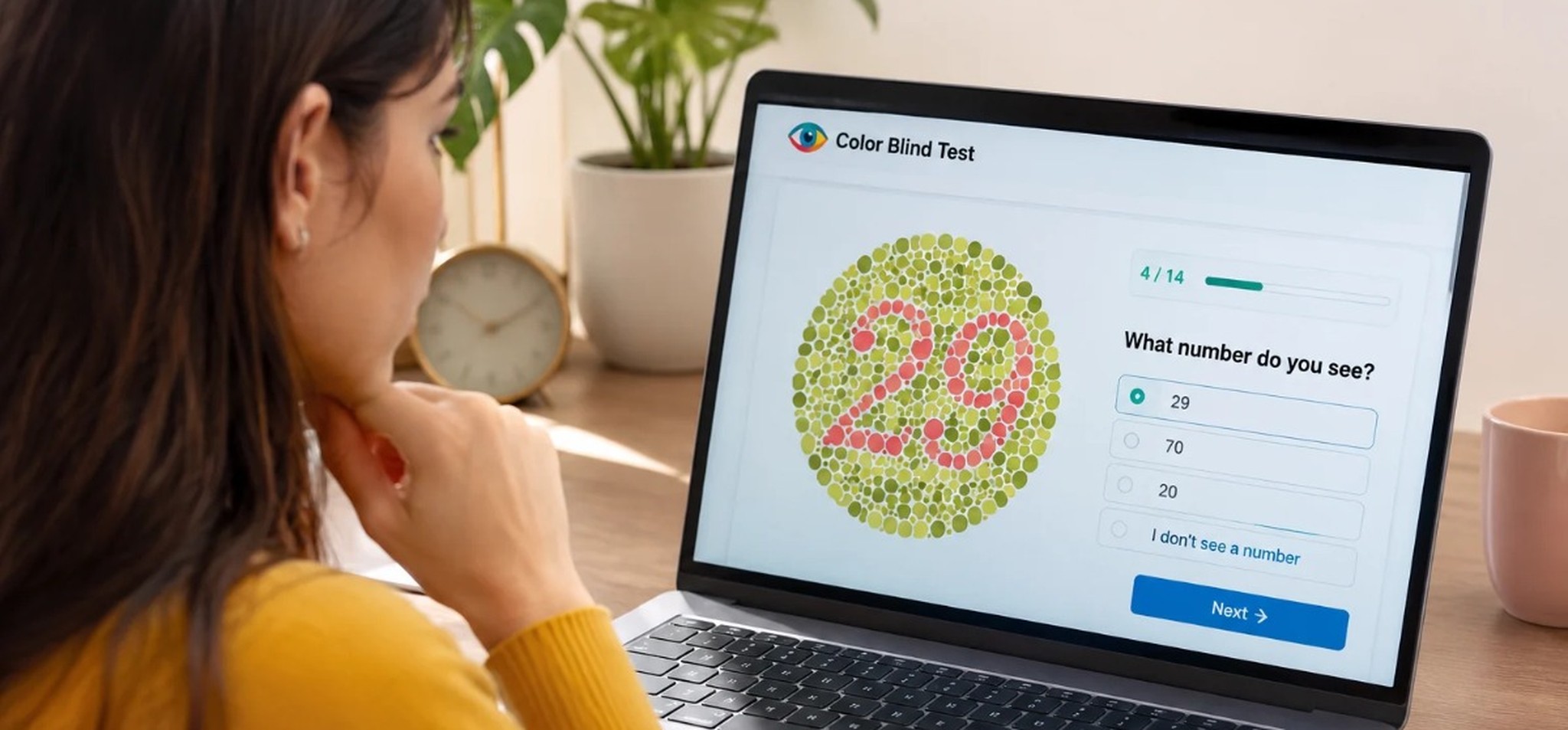
The way people perceive colors can vary, and some may struggle to distinguish certain shades of red and green without realizing it. The Ishihara Color Test offers a simple way to screen for these differences using specially designed visual patterns.
It is commonly used in eye examinations and color vision assessments. Understanding how this test works, what its results indicate, and where its limitations lie can help you make better decisions about your color vision.
What Is the Ishihara Color Test?
The Ishihara Color Test is a color vision screening method developed by Japanese ophthalmologist Dr. Shinobu Ishihara in 1917. It is widely used to identify red-green color vision deficiency (CVD), a condition that affects how people distinguish certain shades of red and green.
The test uses specially designed images called pseudoisochromatic plates, which contain colored dots arranged to form hidden numbers, letters, or patterns. People with typical color vision can usually identify these figures, while those with color vision deficiencies may see different figures or have difficulty recognizing them.
The test helps screen for conditions such as protanopia and protanomaly (red color vision deficiencies) and deuteranopia and deuteranomaly (green color vision deficiencies). However, color vision deficiency does not mean a person sees everything in black and white. Most affected individuals can see colors but have difficulty distinguishing particular shades.
How Does the Ishihara Test Work?
The Ishihara Color Test works by presenting specially designed colored dot patterns that help identify difficulties in distinguishing red and green shades. Its method is based on how the human eye detects and processes different colors.
The Science Behind Colored Dots
The human retina contains specialized cells called cone cells, which help us recognize colors. There are three main types of cones, each responding to different ranges of light wavelengths. People with red-green color vision deficiency may have altered or missing cone photopigment functions, affecting how they distinguish certain colors.
How Hidden Numbers and Patterns Are Created
Each Ishihara plate contains dots of different sizes, brightness levels, and carefully selected colors. Some dots form hidden numbers, letters, or shapes, while others create the background. The color differences between these areas make the figures easier or harder to recognize depending on a person's color vision.
Why Do People See Different Numbers?
People with typical color vision can generally distinguish the intended figures. However, individuals with protan or deutan deficiencies may perceive different numbers or struggle to identify them because certain color differences appear less noticeable.
What Are Ishihara Test Plates?
Ishihara test plates are specially designed circular images containing colored dots of different sizes and shades. Each plate uses specific color combinations to create numbers, letters, or hidden patterns that help screen for red-green color vision deficiency. Different editions of the Ishihara test contain varying numbers of plates, commonly 14, 24, or 38, with different designs and testing purposes.
- Demonstration Plates – These introductory plates help people understand the testing process by showing figures that most individuals can recognize.
- Transformation Plates – People with different types of color vision may identify different numbers or figures on these plates.
- Vanishing Plates – These plates contain figures that may be visible to people with typical color vision but difficult to recognize for those with certain color deficiencies.
- Hidden Digit Plates – These designs help identify differences in color perception by presenting figures that may be visible to specific color vision groups.
- Tracing or Pathway Plates – Instead of identifying numbers, users follow a colored path, making these plates useful for children and people who cannot read numbers.
What Does the Ishihara Test Detect?
The Ishihara Color Test primarily screens for red-green color vision deficiency. It helps identify differences in how people perceive certain colors, particularly those involving red- and green-sensitive cone cells. The test can help screen for four common types of color vision deficiency.
Protanopia (Red Color Vision Deficiency)
Protanopia is a type of red-green color blindness in which functional long-wavelength-sensitive cone pigment is absent. People with this condition may have difficulty distinguishing red shades from certain other colors.
Protanomaly (Red Color Vision Anomaly)
Protanomaly occurs when long-wavelength-sensitive cone function is altered rather than completely absent, making some red shades harder to distinguish.
Deuteranopia (Green Color Vision Deficiency)
Deuteranopia involves the absence of functional medium-wavelength-sensitive cone pigment, affecting the ability to distinguish certain green and red shades.
Deuteranomaly (Green Color Vision Anomaly)
Deuteranomaly involves altered medium-wavelength-sensitive cone function. It is a common form of red-green color vision deficiency.
Can the Ishihara Test Detect Blue-Yellow Color Blindness?
Standard Ishihara plates are designed primarily for red-green deficiencies. They cannot reliably detect blue-yellow deficiencies, such as tritanopia and tritanomaly. Other specialized color vision tests may be needed to identify these conditions.
How Is the Ishihara Color Vision Test Performed?
The Ishihara Color Vision Test is usually performed by an eye care professional in a controlled testing environment. The examiner presents a series of colored plates and observes how the person identifies the numbers, symbols, or patterns. The standard procedure involves the following steps:
Step 1 – Prepare the Testing Environment -The test is conducted under suitable, consistent lighting. The plates should be clean and clearly visible, without glare or reflections that could affect color perception.
Step 2 – View the Ishihara Plates – The examiner shows each plate individually and asks the person to identify the hidden number, symbol, or pathway.
Step 3 – Record and Evaluate Responses – The examiner records correct, incorrect, or missed responses and compares them with the scoring instructions for that particular test edition.
Step 4 – Determine Whether Further Testing Is Required – A qualified eye care professional interprets the results and may recommend additional color vision assessments to understand the type of deficiency more clearly.
How to Take an Ishihara Color Test Online
You can explore your color perception using an online color vision screening tool from your computer, tablet, or smartphone. Before starting, follow a few simple steps to improve your testing experience.
Prepare Your Screen
Use a reasonably calibrated display with comfortable brightness. Avoid direct sunlight, screen glare, and display filters such as Night Shift or blue-light filters, as they may affect how colors appear.
Look at Each Color Plate Carefully
Observe each image individually and try to identify the hidden numbers, shapes, or patterns. Avoid guessing or repeatedly checking the expected answers.
Review Your Screening Results
After completing the screening, review your results to understand whether you may have difficulty distinguishing certain colors. You can try this online color blind test to explore your color perception. Remember, digital screening results are preliminary and cannot replace a professional eye examination.
How to Interpret Ishihara Test Results
Ishihara test results help identify possible difficulties in distinguishing red and green colors. The examiner evaluates the figures a person identifies and compares their responses with the scoring guidelines for the specific test edition.
What Does a Normal Result Mean?
Correctly identifying the expected figures suggests that the screening did not detect an obvious red-green color vision deficiency. However, it does not rule out every type of color vision problem.
What Does an Abnormal Result Mean?
Missing or misidentifying certain numbers, symbols, or patterns may indicate difficulty distinguishing particular color combinations. However, an abnormal result alone does not confirm color blindness.
Can You Determine the Severity of Color Blindness?
The number of incorrect answers alone cannot reliably determine the severity or exact type of color vision deficiency. A qualified eye care professional may recommend additional tests for a more detailed assessment.
How Accurate Is the Ishihara Color Test?
The Ishihara Color Test is widely used by eye care professionals because it provides a practical way to screen for red-green color vision deficiency. Its accuracy depends on the quality of the test plates, testing conditions, and the person's ability to recognize the figures. However, it cannot reliably detect every type of color vision deficiency or replace a comprehensive eye examination.
Factors That Can Affect Test Accuracy
Several factors may influence the results, including:
- Screen quality: Poor color calibration can change how plates appear.
- Brightness and lighting: Excessive brightness, dim lighting, or glare may affect color perception.
- Viewing distance: Incorrect distance can make figures harder to recognize.
- Image quality: Compression or altered colors may affect digital plates.
- Visual acuity: Difficulty recognizing numbers or symbols can influence responses.
- Familiarity: Knowing the expected answers may affect results.
- Test format: Digital reproductions may not match standardized printed clinical plates.
Ishihara Test vs. Other Color Vision Tests
The Ishihara Test is commonly used to screen for red-green color vision deficiency, but other tests are available for assessing different aspects of color perception. Each method serves a specific purpose and may be recommended depending on a person's symptoms and testing requirements.
| Color vision test | Primary purpose |
|---|---|
| Ishihara Test | Screens primarily for red-green deficiencies. |
| Farnsworth D-15 | Evaluates color discrimination through color arrangement. |
| Farnsworth-Munsell 100 Hue Test | Measures color discrimination in greater detail. |
| HRR Test | Screens for red-green and blue-yellow deficiencies. |
| Anomaloscope | Provides a detailed assessment of certain color vision defects. |
Which Color Vision Test Is Best?
The most suitable test depends on the purpose of the examination. The Ishihara Test is useful for general red-green screening, while the HRR Test can assess a broader range of color deficiencies.
Farnsworth tests provide more detailed information about color discrimination, and an anomaloscope offers specialized clinical assessment. An eye care professional can recommend the appropriate test based on individual needs.
When Should You See an Eye Doctor?
Consider visiting an eye doctor if you or your child repeatedly struggle to distinguish certain colors. Children who have difficulty identifying colors at school may benefit from a professional color vision assessment, particularly if there is a family history of color vision deficiency.
You should also seek medical advice if color perception changes later in life or differs between your two eyes. Unlike inherited color vision deficiency, which is often present from birth, acquired color vision changes may be associated with eye conditions, optic nerve problems, certain medications, or other medical conditions.
Important: Sudden or worsening changes in color perception require prompt medical assessment. Do not rely solely on an online color blindness test to evaluate these changes. An eye care professional can examine your vision and recommend appropriate testing.
FAQs
1. What is the Ishihara Color Test used for?
The Ishihara Color Test is primarily used to screen for red-green color vision deficiency. It uses colored dot plates containing hidden numbers or patterns to identify difficulties distinguishing certain color combinations.
2. Can I take the Ishihara test online?
Yes. Several online color vision screening tools are available. However, screen quality, brightness, and color calibration can affect the results. Online screening cannot replace a standardized clinical examination.
3. How many plates are in the Ishihara test?
The number of plates depends on the test edition. Common versions include 16, 24, and 38 plates, each containing different designs for screening color vision deficiencies.
4. Is the Ishihara test 100% accurate?
No screening test is 100% accurate. Results depend on the test edition, lighting conditions, plate quality, and individual visual characteristics.
5. Can the Ishihara test detect all types of color blindness?
No. The Ishihara test primarily screens for red-green deficiencies. It is not designed to reliably identify blue-yellow color vision deficiencies, which require other specialized tests.
6. Can children take the Ishihara test?
Yes. Children who understand the instructions can take the test. Some editions include pathway plates that allow children to trace patterns instead of identifying numbers.
7. Does color blindness affect eyesight?
Color vision deficiency affects how people distinguish colors, not necessarily how clearly they see objects. Many people with inherited color vision deficiency have otherwise normal visual acuity.
8. Can color blindness develop later in life?
Yes. Acquired color vision deficiency can develop due to certain eye conditions, optic nerve problems, medications, or other medical conditions.
9. Can color blindness be cured?
Inherited color vision deficiency generally has no established cure. However, specially designed apps, visual aids, and practical adaptations can help people manage everyday challenges.
10. What should I do if I fail the Ishihara test?
An abnormal screening result does not automatically confirm color blindness. Consult an eye care professional for a comprehensive color vision assessment and appropriate medical guidance.
Final Thoughts
The Ishihara Color Test is a widely used screening method for identifying red-green color vision deficiency. By using colored dot patterns with hidden numbers and figures, it helps reveal potential differences in color perception.
However, it cannot diagnose every type of color vision deficiency. If you notice difficulties distinguishing colors, consult an eye care professional. You can also try ColorBlindTest.ai to explore your color vision through an online screening tool.






Comment