
Talk to Your Books: What AI Reading Assistants Mean for Readers, Authors, and Publishers

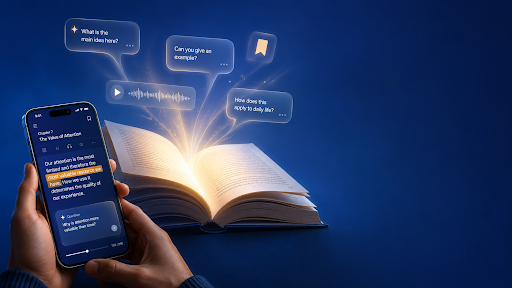
You can now ask a book a question and get an answer back in seconds. An AI reading assistant sits inside an ebook or audiobook and explains a character, a term, or a chapter you skimmed. The change reaches well beyond readers.
For authors, an AI reading assistant changes how their work gets read and raises consent questions. For publishers, it opens new formats and new rights to protect. Interactive book platforms like Praxis AI Media are built on author and publisher permission. Below is what is live today and who gets paid.
What Is an AI Reading Assistant?
An AI Reading Assistant is a chatbot that is linked to a specific book. When the user highlights a passage or asks a question, it can answer based on that book’s contents rather than a general search engine. Even better, many hide spoilers and quote the section. In effect, it is an AI book reader that can answer questions.
How to Read Books with AI
Launch a supported book in an AI reading app like Kindle, Google Play Books, ElevenReader, or Praxis. Highlight a passage or tap the ask button. Ask a question about it, like “Why does she refuse?” Then check the answer against the page.
How It Differs from a Regular Chatbot or Summary Tool
A general chatbot answers based on its training data, making it prone to invent information. A summary tool will replace the book with a summary, while a reading assistant answers based on one book and keeps the text open for verification.
Who Is Already Building AI Reading Assistants?
The first wave came from the biggest names in books and audio, and startups followed within months. The products differ in three ways that matter: which books they cover, where answers come from, and whether authors agreed. Here is how the main ones work as of October 2026.
| Assistant | How it works | Where answers come from | Rights approach | Best for |
| Praxis AI Media | Read, listen and ask questions inside the book, all in one app | The book’s own content | Authors and publishers add their own books | Nonfiction readers, and authors who want reader insight and a next step |
| Kindle “Ask this Book” and Audible “Ask a Question” | Highlight a Kindle passage, or tap Ask a Question while an Audible title plays | Kindle: the book up to where you are. Audible: the audiobook plus historical context | Kindle: no license and no opt-out. Audible: out-of-copyright classics only | US Kindle iOS readers and classics listeners |
| ElevenLabs ElevenReader Voice Chat | Speak or type questions while listening, and hear replies in the narrator’s voice | The book’s context, current chapter and current paragraph | Its own audiobook catalog plus files users upload | Hands-free listeners |
| Startups: Sinai.ai, My Smart Book, and iChatbook | Chat apps tied to ebooks. Sinai.ai is still in testing | Sinai.ai and My Smart Book: the book only. iChatbook: key ideas, without direct quotes | Sinai.ai: public domain or approved titles, and it pays rights holders. My Smart Book: sold through the publishing supply chain | Readers who want licensed chat, and students (iChatbook) |
Kindle AI Reading Assistant: “Ask this Book” and Audible “Ask a Question”
Amazon’s experimental feature Ask this Book reached the US iOS app on Dec. 11, 2025. By selecting a passage, the AI provides spoiler-free answers about the plot and characters. Audible’s Ask a Question feature beta does a similar function for out-of-copyright classics while the narration continues.
Google Play Books: Book Insights and Expert Intelligence
Google Play Books announced the addition of Book Insights to their services in July 2026, a spoiler-free reading companion that authors can turn off. In August, Expert Intelligence delivered more than 100,000 eligible ebooks to Gemini Notebook, where owners receive cited answers, quizzes and audio overviews.
ElevenLabs ElevenReader Voice Chat
ElevenReader Voice Chatbot uses conversational AI voice so you can question a book aloud and hear replies in the narrator’s voice. ElevenLabs reports a 24% rise in listening time, and 78% completion for users with five or more sessions.
Startups: Sinai.ai, My Smart Book, and iChatbook
Sinai. AI only provides public domain or approved titles and remunerates rights holders through its “AI rights.” The My Smart Book venture only launched in France in April 2026 and only responds with the book’s input. Finally, iChatbook provides explanations without directly quoting from the book.
What AI Reading Assistants Mean for Readers
With such an assistant, confusion no longer stops a reader. The reader asks, gets an answer, and moves on. This is helpful for students, for busy professionals, and for those learning to read in a second language. But it also presents a new opportunity to offload thinking that the reader was intending to do themselves.
Better Understanding and Retention
Answering questions helps you to remember what you have read, which is what makes it stick to you. A good assistant can quiz you on a chapter or explain a term in context. That is AI reading comprehension help that adds to the page.
Listening, Asking, and Translating
An AI reading assistant does more than answer typed questions on a screen. It can turn a book into something you hear, talk to, and understand in your own language.
- Listening: An AI audiobook reader lets you keep listening to a book on the way to work, with your hands and eyes free.
- Asking: You can ask a voice chatbot a question mid-chapter without stopping the story or taking your eyes off the road.
- Translating: Some tools explain a passage in simpler words or translate it into another language, which helps non-native speakers and people with poor eyesight.
The Risk of Leaning on AI Instead of Your Own Interpretation
An AI answer is an interpretation, which can be wrong. If you ask before you think, you skip the part of reading where your own view forms.
- ElevenLabs still labels Voice Chat a beta that can make mistakes
- Short answers can flatten tone and irony, which matter most in fiction
- Form your own take on a chapter before you ask
- Use the assistant to check facts or definitions, then compare its reading with yours
- Go back to the page whenever an answer surprises you
What AI Reading Assistants Mean for Authors
For authors, a chat window inside the book is both a tool and a worry. It can show what readers struggle with and point them to more of your work. It can also put words in your mouth. Whether it helps depends on who runs the assistant, and on what terms.
Seeing What Readers Care About
Reader questions are feedback authors never had before. They show which chapters confuse people, which ideas land, and where readers stop. When a platform shares these signals, they can shape the next edition, a talk or a course.
Guiding Readers to the Next Step
Most marketplace sales end at the receipt. When the author shapes the reading experience, a reader who just finished a key chapter can be offered a course, a coaching call, or a community while interest is highest.
Copyright, Consent, and Compensation
Kindle’s Ask this Book is always on, and authors and publishers cannot opt out. Amazon calls it an extension of search needing no license.
- Copyright: Amazon treats the feature as an upgrade to Kindle search. The Authors Guild argues it creates a new derivative use, closer to an annotated edition that needs its own rights deal.
- Consent: The feature switches on by default. Authors and publishers can’t opt their books out, and they were never asked to opt in.
- Compensation: Authors earn nothing extra when readers use it. The Guild wants Amazon to move to a model that asks permission and pays.
What AI Reading Assistants Mean for Publishers
Publishers face two pressures at once. Interactive editions could add value to every title in a catalog. The same technology, used without permission, could take that value away. Publishers who set clear terms for AI for books now will shape how it pays, instead of reacting to a retailer’s decision later.
New Interactive Formats and Revenue Paths
An interactive version could include audio, recaps, study questions, and guided prompts. Google already turns eligible titles into quizzes and audio overviews. Nonfiction, education, and professional catalogs stand to benefit the most from this since readers in these categories are looking to implement what they read.
Direct Reader Relationships and First-Party Data
A traditional retail sales report offers a publisher third-party data about copies distributed and sold, but nothing about readership or retention. A branded readership experience with opt-in consent provides a publisher with actionable first-party data, including finished works and reader questions. This reader data is valuable intellectual property for the publisher.
Licensing and Protecting the Catalog
Most publishing contracts were drawn up before in-book chatbots existed, and publishers need terms to protect them. This includes things like opt-in by title, payment by title or per use, limitations on quoting, and a ban on training outside models with the text.
Who Gets Paid? The Permission Question Behind AI Reading
Every AI reading tool needs a book’s text to answer questions. The real difference between them is consent. Some ask authors first and pay them. Some stick to public domain titles. Amazon says no license is needed because its feature is search. Others let anyone upload any file at all.
Licensed vs. Unlicensed Tools
The table arranges the tools by how they use rights. At the bottom of the list is the most comprehensive category, which includes all the others: a tool that uses any uploaded information and lets you ask questions about it, with no distinction between a pirated ebook and a work report.
| Tool | How it handles rights | Author or publisher control |
| Praxis | Authors and publishers upload their own books | The author or publisher decides |
| Sinai.ai | Public domain titles, or books approved by the author, estate or publisher; pays through its “AI rights” system | Opt-in |
| My Smart Book | Sells ebooks through the normal publishing supply chain; answers come only from the book | Set by publisher agreements |
| Google Play Books Expert Intelligence | 100,000+ titles from participating publishers; the reader must own the book | Participating titles only |
| Google Play Books Book Insights | On by default for Play Books titles | Opt-out per title or whole catalog |
| Audible Ask a Question | Beta limited to out-of-copyright classics | Not needed |
| Kindle Ask this Book | Amazon treats it as search; no license | No opt-out |
| iChatbook | Explains ideas without quoting the text | Unclear |
| Open upload tools (Myreader, BookWorm AI, Gemini Notebook uploads) | No copyright screening of uploaded books | None |
What the Authors Guild Criticism Tells Us
In its December 23, 2025 statement, the Guild said Ask this Book was unlicensed, earned authors nothing, and offered no opt-out. Given Amazon’s share of ebook sales, it called this a “dangerous precedent.” Its request is a permissioned, paid model.
What Responsible AI Reading Should Look Like
A responsible assistant requires permission to use a book. After that, a few practical checks show whether it treats readers and authors fairly.
- The author or publisher has opted in, or the book is in the public domain
- Answers come only from that book, not the open web
- Each answer points to the passage it used
- Spoilers stay hidden past your reading position
- Rights holders get paid when their work is used
- Readers know what is stored, and authors can see how their book is discussed
Readers, Authors, and Publishers Compared
Each group benefits greatly from interactive reading, but each takes on different risks. The table shows these comparisons based on the products described above. It can help you decide whether to adopt an AI book reader or license your titles to one.
| Group | Main benefit | Main risk |
| Readers | Instant answers in context, better recall, audio and voice options | Letting the AI’s interpretation replace their own thinking |
| Authors | Insight into what readers care about, plus a direct path to their next offer | Loss of control over how the book is used, and no pay from unlicensed tools |
| Publishers | New interactive formats and engagement data across titles | Contract gaps and unlicensed use of the catalog |
How Praxis Brings Read, Listen, Ask, and Apply Together
Praxis takes the permission-based route. Books come onto Praxis from their authors or publishers, and Praxis does not sell reader data. Readers read, listen, ask, and apply in one app. Authors and publishers keep their existing distribution, including Amazon, and add a direct reader relationship on top.
For Readers
Praxis gives readers an AI reading buddy powered by the book they’re reading. Everything happens in the Praxis app on iPhone and Android.
- Ask questions inside the book and get answers based on its text
- Switch to audio narration when you can’t read
- Save notes, bookmarks, and key insights as you go
- Respond to reflection prompts the author placed at key points
- Take the next step the author recommends, such as coaching or a community
- Create a free account to start
For Authors
Authors see how long readers read, which sections hold attention, and what readers ask. Praxis keeps the reader relationship going after the sale.
- See who your readers are, how long they read and which sections hold their attention
- Learn what readers ask and which ideas get the strongest response
- Place a course, coaching, consulting or community offer inside the book
- Connect book sales to your CRM
- Create audiobooks, translations and marketing assets from your manuscript
For Publishers
Praxis adds an interactive layer to a publisher’s catalog without replacing Amazon or other retail channels. Every publisher tier supports unlimited titles.
- Launch co-branded storefronts that carry your own brand
- Manage titles, revenue, engagement, and author relationships in one dashboard
- Use QR codes in print and ebook titles to bring existing readers into Praxis
- Track reader engagement and CTA performance across titles
- Earn a share of author subscriptions, depending on the partnership model
The Future of Reading Is a Conversation
The book is not going to turn into a chat window. The text still has to do its work. What’s going to change is that readers can ask, authors can answer, and publishers can collect cash. The most successful AI reading assistant will be the one that asked first.
A book should keep working after the last page, for the reader and for the person who wrote it. Praxis AI Media is built around that idea. Every title comes from its author or publisher, answers stay grounded in the book, and every reader has a clear next step.
Frequently Asked Questions
What is an AI reading assistant?
An AI reading assistant is a chatbot built into an ebook or audiobook. It answers questions about characters, terms, context or arguments using that book’s text.
Can you really talk to a book?
Yes. Praxis AI Media Voice Chat lets you ask questions out loud and hear answers in the narrator’s voice.
Are AI reading assistants legal for copyrighted books?
It depends on permission. Tools licensed by authors or publishers are on solid ground.
How can authors use AI reading tools to connect with readers?
Pick a platform where you control the book and see reader activity. Use readers’ questions to learn what matters to them, add reflection prompts, and offer a relevant next step.
What do publishers gain from interactive books?
Publishers gain new formats to sell, engagement data across titles, and a direct reader relationship that retail sales do not give them.
Can I upload my own documents and ask questions?
Yes. ElevenReader and Gemini Notebook both accept uploaded files, so a report or a set of notes becomes a talking document you can question.
Is ElevenReader free?
ElevenReader is free to download, with in-app purchases for extra features, according to its App Store listing. Voice Chat is still marked as a beta, so expect the odd mistake. Check the app for current plans and limits.






Comment