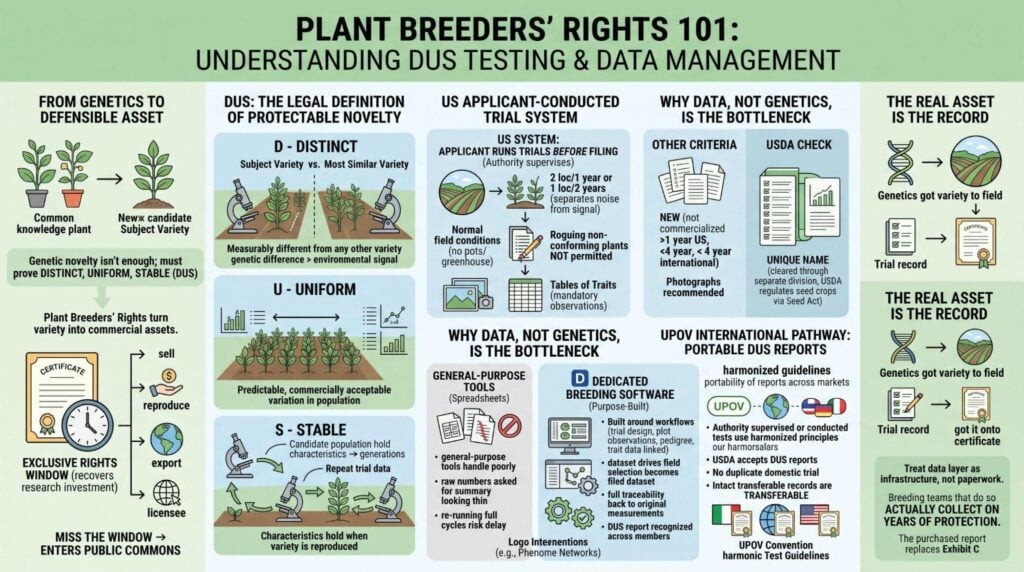
Plant breeders’ rights turn a living organism into a defensible asset, but only after a variety proves it is Distinct, Uniform and Stable through a DUS test. In the United States that test is run by the breeder, not the government, which makes the trial dataset the actual product filed with the USDA Plant Variety Protection Office. A breeding team that cannot produce clean, repeatable measurements across two years of side-by-side trials will lose protection regardless of how good the genetics are.
The economic stakes explain why the paperwork matters. A certificate gives the owner 20 years of exclusive rights, 25 for trees and vines, during which nobody else can sell, reproduce or export the protected variety without a license. For a commercial breeding program, that window is where the research investment is recovered. Miss it, and the new line enters the public commons the day it ships.
What DUS testing actually checks
A variety clears DUS when it is measurably different from any variety of common knowledge, sufficiently uniform across the planted sample, and stable over successive generations. The three letters are not a formality. They are the legal definition of protectable novelty, and the examiner checks each one against the trial record.
Distinctness is the criterion that sinks most applications. The candidate variety, called the Subject Variety, must be grown side by side with a Most Similar Variety under identical conditions, so that any observed difference is genetic rather than environmental. Uniformity requires that variation inside the candidate population is describable and commercially acceptable. Stability requires that those characteristics hold when the variety is reproduced again.
| DUS criterion | What the examiner looks for | What the trial must show |
|---|---|---|
| Distinct | A measurable difference from any common-knowledge variety | Side-by-side data against the Most Similar Variety |
| Uniform | Predictable, commercially acceptable variation | Statistics on the candidate population |
| Stable | Characteristics hold across generations | Repeat trial data over two cycles |
DUS is only three of the five criteria the examiner checks. The variety must also be new, meaning not yet sold commercially in the United States, or sold for less than a year, and less than four years internationally. It must also carry a unique name that does not conflict with an existing protected variety. For seed crops regulated under the US Federal Seed Act, name clearance runs through a separate USDA division before the protection office will issue a certificate.
The applicant-conducted trial system
The United States runs an applicant-conducted trial system, and that is the part that catches foreign breeders off guard. Under the Plant Variety Protection Office rules, the breeder, an agent or a contracted party runs the field trials before the application is filed, and submits the results as part of the package. In many other jurisdictions the authority runs the trials after filing.
The trial itself has to cover two locations in one year, or one location over two years, so that environmental noise can be separated from genetic signal. The breeder selects the Most Similar Variety, normally the closest variety of common knowledge in the same species, and grows both under normal field conditions, not in pots or a greenhouse. Roguing out plants that do not conform is not permitted, because the trial has to reflect the real population.
Every characteristic recorded has to follow the UPOV Test Guideline for that species, which lists the traits and the asterisked mandatory observations. The USDA Exhibit C form mirrors that Table of Characteristics, and Exhibit D carries the statistics: mean, range, standard deviation and the number of plants or parts measured. Photographs are recommended. None of this is optional, and none of it is forgiving.
Why trial data, not the variety, is the bottleneck
A breeding program can spend a decade producing a variety that clears DUS on the genetics, and then lose a year of protection because the trial data is incomplete, inconsistent or stored in spreadsheets that nobody can reconstruct. Two years of side-by-side measurements across multiple locations generate a volume of records that a general-purpose tool handles badly, and the examiner will ask for the raw numbers if anything in the summary looks thin.
This is where purpose-built software earns its place. A platform like Phenome Networks, built around plant-breeding workflows, holds trial design, plot-level observations, pedigree and trait data in one structure that maps cleanly onto the Exhibit C and Exhibit D requirements. The point is not aesthetics. The point is that the same dataset that drove selection decisions in the field becomes the dataset filed with the application, with full traceability back to the original measurements.
The cost of getting this wrong is paid in years. A rejected application means re-running trials, which means another full cycle before protection can even be reconsidered. For a program releasing varieties on a fixed cadence, that delay is the real risk, not the filing fee.
UPOV and the international DUS report
The international layer is what makes DUS portable. The 1991 Act of the UPOV Convention sets the standard that member authorities use, and the harmonized Test Guidelines are the reason a DUS report from one country can be accepted in another. That matters for breeders who want protection in multiple markets without running the same trial twice.
Under the growing-trial examination guidance maintained by the International Union for the Protection of New Varieties of Plants, the authority responsible for granting plant breeders’ rights carries out the DUS test, or supervises an applicant-conducted test, using harmonized principles so that descriptions are recognized across members. The UPOV examination guidance sets out the principles and international standards that keep DUS testing harmonized across members. The USDA office accepts DUS reports produced by other UPOV authorities for all asexually reproduced varieties and for many sexually reproduced crops, provided the report follows the UPOV Test Guideline for the species. The purchased report replaces the Exhibit C form, and the applicant still files Exhibits A, B and E unless the report already contains them.
For a breeding program operating across borders, that pathway is faster and cheaper than a duplicate domestic trial. It still requires the underlying records to be intact and transferable, which is the same data discipline the domestic route demands.
The asset is the record
Plant breeders’ rights protect a variety, but they are granted on the strength of a dataset. The genetics gets the variety into the field. The trial record gets it onto the certificate. Breeding teams that treat the data layer as infrastructure, not paperwork, are the ones that actually collect on the years of protection they earned.