
Understanding the Barbell Horn® Design: Why Transducer Geometry Affects Emulsification Results

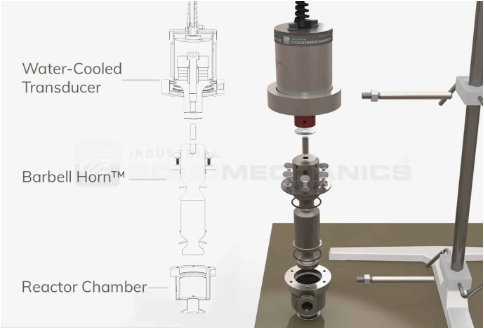
Power and frequency are often the first specifications compared when evaluating ultrasonic equipment. They do not tell the full story. The geometry of a Barbell Horn® can affect how ultrasonic vibration reaches the liquid. That can influence the ultrasonic field, cavitation, and liquid movement near the processing surface. These effects can then influence emulsification.
That is why barbell horn ultrasonic technology is relevant when evaluating ultrasonic processing. Geometry is only one part of the process. Amplitude, frequency, formulation properties, and operating settings also affect the final result.
Let’s understand how horn geometry affects vibration delivery, how it differs from tip geometry, and why those differences matter for emulsification.
How Does the Barbell Horn Design Transfer Ultrasonic Energy?
An ultrasonic processing system uses several components to deliver energy into a liquid. The transducer converts electrical energy into mechanical vibration. The horn assembly transfers that vibration toward the liquid.
A Barbell Horn® uses changes in cross-sectional dimensions along the vibrating component. These dimensions are designed around the system’s resonant operating frequency. The geometry can influence how vibration moves through the component. It can also affect displacement amplitude at the output end.
A peer-reviewed study of barbell ultrasonic transducer geometry found that geometric dimensions affect displacement amplitude magnification, and resonance behavior. The researchers also linked optimized horn geometry with improved acoustic energy transfer.
This gives horn geometry an active role in the ultrasonic system. It is not simply a connection between the transducer and the processing setup.
Its geometry helps determine how mechanical vibration is transferred toward the liquid and how that vibration behaves along the component.
The final result still depends on the complete system. Material properties, frequency, amplitude, and process settings can also affect performance.
How Does Horn Geometry Change the Ultrasonic Field?
Changes in horn geometry can alter how an ultrasonic component behaves. For ultrasonic transducer design, relevant factors can include:
- Resonance behavior
- Vibration amplitude
- Horn dimensions
- Output geometry
- Tip diameter
- Energy delivery into the liquid
These factors can influence the ultrasonic field created near the vibrating surface.
A 2025 study of acoustic pressure distribution in ultrasonic reactors examined horn position, reactor geometry, frequency, power, horn diameter, immersion depth, and liquid properties. The researchers found that these parameters affected acoustic pressure distribution and flow behavior under the tested conditions.
This helps explain why two systems with similar power ratings may not create the same ultrasonic field. Power describes the energy supplied to the system. It does not fully describe how that energy behaves after it reaches the liquid.
Horn geometry is one part of what shapes the ultrasonic field. Research on sono-reactor geometry and acoustic pressure also found that horn geometry and reactor design affect the distribution of acoustic pressure and cavitation zones.
The more useful question is therefore not simply: How much power does the equipment have? It is: How does the system deliver ultrasonic energy into the formulation?
How Does Sonotrode Tip Geometry Affect Cavitation and Liquid Movement?
The overall horn geometry and the geometry of the liquid-contacting tip are related design factors. They can still affect the ultrasonic field in different ways. Cavitation occurs when ultrasonic pressure changes cause microscopic bubbles to form and collapse within a liquid.
The conditions around a sonotrode tip can change with the system design and operating settings.
A peer-reviewed study of cavitation beneath ultrasonic horn tips examined how ultrasonic amplitude, fluid rheology, and sonotrode tip size affected acoustic streaming and flow behavior.
Tip shape can also change liquid movement. A peer-reviewed comparison of sonotrode tip geometries examined plane, truncated, and conical tips on dumbbell-shaped sonotrodes. The study found that tip shape significantly changed acoustic streaming. It also affected cavitation treatment efficiency.
This matters for sonotrode geometry in emulsification. The shape of the vibrating surface can influence more than the cavitation zone. It can also affect how liquid moves near the horn. That may change:
- How material enters the processing zone?
- How liquid circulates near the vibrating surface?
- How droplets move through the cavitation field?
- How often droplets pass through the most active processing zone?
Cavitation creates intense localized forces and pressure changes. Acoustic streaming moves liquid through and around the active zone. The exact result depends on the horn design, tip geometry, formulation, and operating settings.
How Can Geometry Affect Emulsification Results?
Horn geometry does not reduce droplet size on its own. Instead, geometry can influence the ultrasonic field near the horn. That field can affect cavitation and liquid movement. Those conditions can then affect how effectively droplets are exposed to ultrasonic energy.
This creates a direct connection between equipment geometry and emulsification performance. Emulsification results can also depend on:
- Vibration amplitude
- Processing time
- Horn position
- Operating frequency
- Formulation composition
- Emulsifier system
- Liquid viscosity
- Temperature
For example, one study found that increasing ultrasonic amplitude did not always continue to reduce droplet size. Under its tested conditions, excessive amplitude produced larger average droplets and higher polydispersity. The lesson is simple.
More ultrasonic energy does not automatically mean better emulsification. The equipment and process must be matched to the formulation.
What Should You Consider Beyond Power Ratings?
Power matters, but it does not describe the complete ultrasonic field inside the liquid. A better equipment evaluation considers the entire system.
| Factor | Why it matters |
| Horn geometry | Can affect vibration behavior and energy transfer |
| Tip shape | Can influence cavitation and liquid movement |
| Tip diameter | Can affect local flow and acoustic behavior |
| Vibration amplitude | Influences the intensity of ultrasonic processing |
| Operating frequency | Affects the ultrasonic field |
| Liquid properties | Can change flow and cavitation behavior |
| Horn position | Can affect interaction with the processing zone |
| Reactor geometry | Can influence acoustic pressure distribution |
| Scale-up requirements | Help determine whether key ultrasonic conditions can be reproduced at larger volumes |
Before comparing ultrasonic systems, ask:
- What droplet characteristics are required?
- How does the formulation respond to ultrasonic processing?
- What ultrasonic conditions are needed?
- How much material must be processed?
- Can those conditions be reproduced as production volume increases?
Scale-up deserves particular attention. Scaling an ultrasonic process is not simply a matter of increasing equipment size. The acoustic field must still provide the conditions needed by the process.
The transducer, horn geometry, output surface, reactor, formulation, and operating settings all contribute to the final result.
Closing Thoughts
The Barbell Horn® design highlights why horn geometry should not be treated as a simple mechanical detail. Geometry can influence how vibration behaves within the horn and how ultrasonic energy reaches the liquid. That can affect the ultrasonic field, cavitation, and liquid movement near the processing surface. These factors can then influence how droplets are exposed to ultrasonic energy.
Research on barbell ultrasonic transducer geometry shows that horn dimensions can affect resonance and displacement amplitude. Research on sonotrode tip geometry shows that tip shape can affect acoustic streaming and cavitation behavior.
Still, geometry is only one part of the equation. Amplitude, frequency, tip dimensions, formulation properties, temperature, reactor design, and process settings also influence the final result.
For emulsification, the right ultrasonic design is the one that can consistently create the ultrasonic conditions required for the specific formulation and production process.





Comment