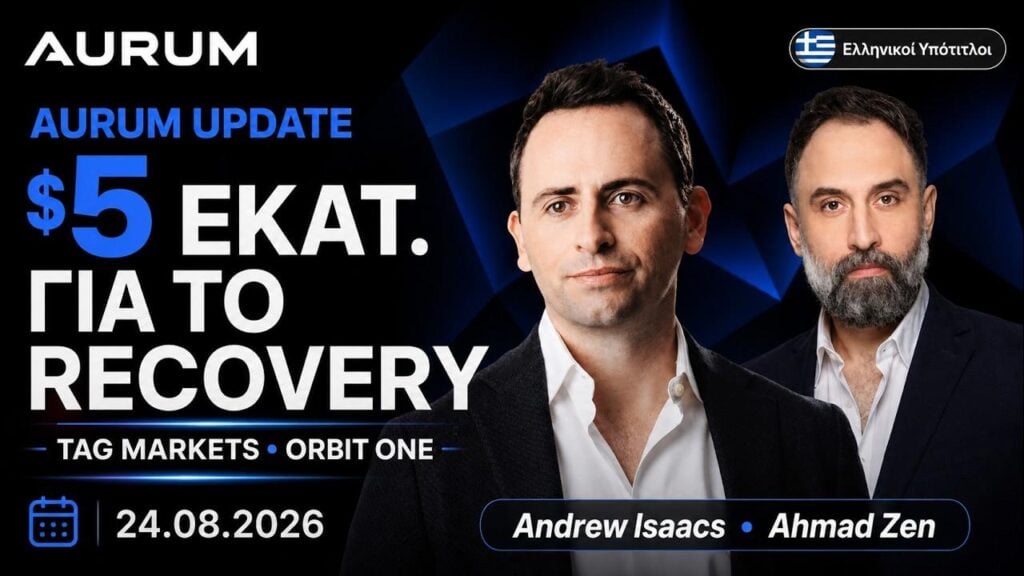
“As part of the partnership, Tag Markets will allocate a dedicated $5 million trading account for AURUM.”
I had to read that sentence twice.
After everything I have investigated about AURUM and NEYRO — the extraordinary AI trading claims, the smart contracts, the movement of millions of dollars across the blockchain, the regulatory warnings and then the supposed security incident that left investors unable to access their money — AURUM has now unveiled what it is presenting as one of the first major pieces of its recovery strategy.
Another trading account.
AURUM Update 24.08.2026 | TAG Markets, $5M Recovery Plan & Orbit One | Ελληνικοί Υπότιτλοι
I watched the latest “AURUM Audit Update” from beginning to end. The presentation identified Andrew Isaacs as the key speaker, and much of what he discussed sounded reassuring on the surface: an audit supposedly nearing completion, frozen centralized exchange accounts apparently being recovered, a new strategic partnership with TAG Markets and repeated assurances that the objective remains a “full recovery” of investor losses
Then came the headline announcement. According to AURUM’s own presentation, TAG Markets “will allocate a dedicated $5 million trading account for AURUM.” Importantly, the next sentence explained exactly what AURUM intends to do with it: “The account will be used for trading as part of the strategy to support the compensation of losses.”
This wasn’t $5 million being returned to investors. It wasn’t an announcement that investigators had recovered another $5 million of missing assets. It wasn’t a compensation fund sitting there waiting to be distributed.
It was a trading account.
That immediately raised questions for me, because the central issue throughout my investigation has never been whether AURUM can produce another presentation, another product or another promise. It has been whether the extraordinary trading activity used to sell this opportunity can actually be demonstrated against independently verifiable evidence. My previous investigation examined AURUM and NEYRO’s published smart contracts and followed millions of dollars across BNB Smart Chain and TRON. The independent forensic findings raised serious questions about the supposed AI trading activity and showed investor funds moving through operator-controlled infrastructure rather than the transparent non-custodial trading model people had been sold.
I don’t intend to repeat that entire investigation here. The blockchain evidence hasn’t changed. What has changed is AURUM’s explanation of what happens next.
And this latest presentation gives us something new to investigate.
AURUM isn’t simply talking about recovering assets anymore. It is talking about TAG Markets, a $5 million trading account, Orbit One, new trading infrastructure, a new back office and, remarkably, an interface for what its own presentation calls “the new ecosystem.”
Before anybody starts building the new ecosystem, however, there is some unfinished business with the old one.
Where is the money? Where are the original trades? And why should investors believe that more trading is going to recover losses from an operation whose previous trading claims remain at the centre of the investigation?
The $5 Million Announcement
The centrepiece of Andrew Isaacs’ presentation was the new relationship between AURUM and TAG Markets. The slide introducing it described TAG Markets as an “international regulated FX & CFD broker” and said the partnership would support the next stage of AURUM and NEYRO, including new trading infrastructure, Orbit One, a new back office and resources for the recovery process.
Isaacs certainly didn’t undersell it. He described the partnership as something he was “incredibly excited” about and repeatedly returned to the capital that would supposedly become available through the arrangement. He told the audience this was an “actual real physical capital infusion into the business” and presented it as the first of what he expected would be multiple injections of capital.
Then the presentation put a number on it: $5 million.
“As part of the partnership, Tag Markets will allocate a dedicated $5 million trading account for AURUM.”
But the wording on AURUM’s own slide is much more interesting than the headline number. It doesn’t say TAG Markets has transferred $5 million to AURUM for distribution to investors. It says:
And directly underneath:
“The account will be used for trading as part of the strategy to support the compensation of losses.”
That is a very different proposition from a $5 million recovery fund.
Isaacs reinforced this verbally. He explained that the $5 million would be “dedicated into [a] trading account” and “used for trading initially”, with the money and resulting profits intended to support compensation and recovery. At another point he described the arrangement as a “significant infusion of capital to assist in the recovery process.”
The distinction matters because investors hearing “$5 million capital infusion” could reasonably come away believing that another $5 million has been secured to repay them. But AURUM’s own slide describes something considerably more specific: a dedicated trading account that TAG Markets “will allocate,” which AURUM intends to use for trading.
There was no repayment schedule displayed. No percentage recovery for individual investors. No date for the first distribution. No breakdown showing how the $5 million relates to total outstanding losses.
Instead, the proposed mechanism appears to require successful future trading.
That creates an obvious risk that wasn’t meaningfully explored during the presentation. Trading FX and CFDs can produce profits, but it can also produce losses. If this $5 million account is genuinely going to become part of the mechanism for compensating investors, then its risk profile matters enormously. What happens to the recovery plan if the trading loses money?
Isaacs nevertheless went considerably further than simply saying the account might help. He told the audience:
This is saying we will recover funds.”
He also spoke about making every effort to restore “every single dollar”, described the objective as a “full recovery”, and later said the TAG arrangement was “100% happening.”
Those are powerful assurances to give a community containing people desperate to recover their money.
But there is a difference between announcing an intention to allocate a $5 million trading account and demonstrating that victims are going to be made whole.
The presentation established the claim. It did not establish the recovery.
Amendment — TAG Markets Denies AURUM’s $5 Million Recovery Claim
UPDATE — 27 AUGUST 2026: Since publishing this investigation, I have obtained a notice attributed to T.M. Financials Ltd, trading as TAG Markets, dated 25 August 2026. Its subject could hardly be clearer: “False Claims by Aurum that it collaborates with Tag Markets.”
This is significant because AURUM’s latest presentation did not describe TAG Markets as a company it merely hoped to work with. COO Andrew Isaacs presented TAG Markets as a new strategic partner. AURUM’s own presentation material stated that the partnership would support its recovery process and, most importantly, that “Tag Markets will allocate a dedicated $5 million trading account for AURUM.” Investors were told that account would be used for trading as part of a strategy to compensate losses.
TAG Markets tells a completely different story.
According to the notice, AURUM did contact TAG Markets and discussions took place. However, TAG Markets states that following those conversations it “decided to not move forward with any kind of collaboration.” It further states that AURUM announced the purported collaboration without TAG Markets’ knowledge and that “no due-diligence or agreement was ever concluded.”
The notice then makes three unequivocal statements: TAG Markets says it has no relationship with AURUM of any kind, has entered into no partnership or commercial agreement, and has “not allocated, committed, or agreed to allocate any funds to Aurum or to any recovery, compensation, or loss-remediation program.”
That last statement goes directly to the heart of this investigation.
AURUM didn’t merely suggest that $5 million might become available sometime in the future. Its presentation put a specific figure on the screen — $5,000,000 — DEDICATED TRADING ACCOUNT — and attributed that account to TAG Markets as part of the recovery strategy. TAG Markets is now saying that it never allocated, committed or even agreed to allocate those funds.
I had already contacted TAG Markets independently seeking validation of AURUM’s claims because I wanted evidence that the partnership and $5 million account actually existed. This notice makes those questions considerably more serious.
If this notice is confirmed as authentic by TAG Markets, the issue is no longer simply that AURUM failed to provide evidence for its $5 million recovery claim. The company it named as the source of that money is expressly denying the claim.
That leaves AURUM’s leadership — and particularly the people responsible for presenting this announcement to investors — with some very straightforward questions.
Who authorised the claim that TAG Markets would provide AURUM with a $5 million trading account? What evidence did Andrew Isaacs rely upon when presenting it? Why was a “strategic partnership” announced when TAG Markets says no agreement had been concluded? And if AURUM could present something this significant before it actually existed, what confidence should investors place in the other recovery claims still awaiting independent verification?
Those questions now require answers.
What Exactly Has TAG Markets Provided?
The presentation gives us a name, a number and a proposed purpose, but it leaves unanswered one of the most important questions in this entire announcement: what exactly is this $5 million?
AURUM’s slide does not say TAG Markets has transferred $5 million in cash to AURUM. It says TAG Markets “will allocate a dedicated $5 million trading account for AURUM.” The use of will allocate is important. Based on what was presented, I have not seen independently verifiable evidence establishing that $5 million has already been transferred, deposited or placed under AURUM’s control.
There are several possibilities, and I am not going to guess which one applies. A $5 million trading account could potentially represent deposited capital, proprietary broker funds, credit, margin, leveraged trading capacity or some other commercial arrangement. Those are materially different things, particularly when the account is being presented to people waiting for compensation.
The ownership matters as well. If TAG Markets owns the capital and merely permits AURUM or its trading technology to operate against it, that is very different from TAG giving AURUM $5 million that can ultimately be distributed to victims. If AURUM owns the capital, investors deserve to know where it came from. If the arrangement involves leverage or credit, that needs to be explained too.
Then there is the obvious question of the principal itself.
AURUM says the account “will be used for trading as part of the strategy to support the compensation of losses.” Does that mean the actual $5 million can eventually be used to compensate investors, or does the $5 million remain trading capital while only whatever profits are generated become available for recovery? What happens if the account produces a loss instead? Who carries that loss, and does it reduce the amount potentially available to victims?
None of those details appeared in the slides I reviewed.
There was also no executed partnership agreement displayed, no brokerage statement showing a funded $5 million balance, no account ownership documentation and no independently verifiable proof presented demonstrating that the dedicated account already exists with $5 million sitting inside it. That doesn’t prove the arrangement is fictitious. It means the evidence presented so far isn’t enough to establish precisely what the arrangement is.
That distinction becomes particularly important because Isaacs described this as “actual real physical capital infusion into the business.” If that is literally what has occurred, it should be straightforward to document.
For investors, the question therefore isn’t simply whether the number $5 million appeared on a PowerPoint slide.
The question is whether $5 million of real, accessible capital has actually been committed to recovering their losses — and under what terms.
They Don’t Even Know How Much Recovery Requires
One line buried in AURUM’s own presentation may be more revealing than the $5 million headline itself.
That creates an obvious problem.
Throughout the presentation, Andrew Isaacs repeatedly spoke about “full recovery,” restoring “every single dollar” and getting the business “back to black.” Those phrases sound reassuring, but AURUM’s own slide appears to acknowledge that the exact amount needed to achieve that recovery is still being worked out.
If the total liability is not yet established, then nobody can meaningfully assess whether a $5 million trading account is significant, inadequate or largely symbolic.
That matters because recovery planning starts with numbers. How much money was deposited? How much remains accessible? How much is allegedly frozen on exchanges? How much has been lost? How much is recoverable? How much is owed to individual investors?
Without those figures, “full recovery” is not a financial plan. It is an aspiration.
That context makes the $5 million figure even harder to evaluate.
If AURUM wants investors to believe this account is a meaningful part of a genuine recovery, then the company needs to publish the basic numbers behind that claim. Until then, the audience is being shown a headline figure without the denominator needed to understand what it actually means.
Before Trading Again, Show Me The Original Trades
This is where the latest recovery story collides with the evidence from the earlier investigation.
AURUM is now asking investors to believe that a new trading account can help repair the damage. But before anyone accepts that proposition, there is a much more basic question that still needs answering: where is the independently verifiable evidence that the original trading happened in the way AURUM and NEYRO represented it?
Aurum’s Damage Control Zoom: Promises, Reassurance And The Questions That Remain
That was the core issue in my Previous Investigation. That was the core issue in my Previous Investigation. The marketing described NEYRO as a non-custodial AI trading system operating on-chain, with users supposedly retaining control of their capital. The independent blockchain forensic analysis, including CryptoG’s detailed examination of AURUM and NEYRO, found something very different. On BNB Smart Chain, the verified contract contained no user withdrawal function and no observable trading logic capable of doing what was being advertised. On TRON, the contract contained a function that swept the entire USDT balance to an external operator-controlled wallet.
The blockchain also showed where money moved. The earlier investigation documented large flows into operator-controlled infrastructure and traced substantial amounts out through cash-out wallets. That evidence is public, timestamped and independently verifiable.
So before investors are asked to put their faith in another trading strategy, AURUM needs to show the historical trading records that support the claims it made in the first place.
Show the exchange accounts. Show the orders. Show the entries and exits. Show the realised profits and losses. Show how those profits reconciled with the returns credited to investors. Show which entity controlled the accounts and which assets were being traded.
If the original AI trading was real, there should be a trail.
Until that trail is produced, saying “we’ll trade $5 million and use the profits for recovery” doesn’t solve the central evidential problem.
It simply asks investors to believe in trading again before the original trading has been proven.
The Audit That Still Isn’t Finished
Full Audit Report — Finalization In Progress
AURUM also used the presentation to reassure investors that its audit process is progressing. One slide was titled “Full Audit Report — Finalization In Progress” and stated that a “comprehensive audit report is currently being finalized” and would be published once the full review process had been completed.
Another slide said the DEX products audit was nearing completion, but the wording there was more specific: it referred to technical and security reviews. That distinction matters, because a technical review of decentralized products is not the same thing as a forensic financial audit tracing investor money from deposit to destination.
The presentation also separated the recovery process into several moving parts: restoring access to centralized exchange accounts, completing the audit of decentralized products, and finalizing the wider report. What remains unclear is whether the final report will actually answer the financial questions investors need answered.
Will it reconcile investor deposits against actual trading activity? Will it identify where funds were held, moved and withdrawn? Will it establish how much money remains, how much is allegedly frozen, and how much is owed? Will it explain whether the returns shown to investors came from genuine trading profits?
Those are the questions that matter.
Aurum DEX Products
A cybersecurity review can tell you whether systems were vulnerable. A smart-contract review can assess code. Neither automatically proves that historical trading occurred or explains where investor funds went.
Until the full report is published and its authors, scope, methodology and evidence can be examined, the audit remains another unfinished part of the recovery story rather than proof that AURUM’s explanation is correct.
The Supposedly Frozen Exchange Accounts
Another part of the presentation deserves closer attention because it potentially concerns money that already exists rather than money AURUM hopes to generate in the future.
Under “CEX Accounts — Access Restoration In Progress,” AURUM states:
The presentation says the team is “currently completing the required procedures with the relevant platforms to restore access to these accounts.” If substantial assets genuinely remain frozen on centralized exchanges, that could obviously be important to investors. But the presentation provided very little information that would allow anyone outside AURUM to assess the claim.
Which exchanges are involved? When were the accounts frozen? Why were they frozen? Which AURUM entity owns them? What assets are supposedly held there, and what are the balances? Have the exchanges confirmed that the accounts remain intact and that access can potentially be restored?
Most importantly, how much of the money required for investor recovery is supposedly sitting inside these frozen accounts?
Those figures would provide far more meaningful information about the prospects of recovery than another headline about future trading profits. If AURUM has millions of dollars sitting safely on identifiable centralized exchanges awaiting an administrative process to restore access, then documenting that position should be a priority.
Instead, investors were given another promise that the process is underway.
I am not saying the accounts do not exist or that they were not frozen. I am saying AURUM has not yet presented enough evidence in this update for investors to independently verify the claim or understand its financial significance.
If transparency really is the objective, naming the exchanges, documenting the balances and ultimately reconciling those assets in the promised audit would be a good place to start.
From Recovery To A “New Ecosystem”
What struck me next was how quickly the presentation moved away from simply recovering investor funds and towards building the next version of AURUM.
One slide announced “AURUM × Tag Markets” and said the partnership would support “the next stage of the AURUM and Neyro development” through new trading infrastructure, Orbit One, a new back office and additional resources for recovery. Another slide stated that “Orbit One will be launched on the infrastructure of Tag Markets.”
Then came another revealing phrase.
New BackOffice — Powered by Tag Markets Infrastructure
A slide titled “New BackOffice — Powered by Tag Markets Infrastructure” said the new environment would provide users with “an updated interface for accessing the new ecosystem.”
That wording matters.
Investors are still waiting for clear answers about what happened inside the old ecosystem, yet the presentation is already talking about new infrastructure, new interfaces, new trading systems and a new ecosystem. That does not automatically prove anything improper, but it does show where a significant part of the company’s attention appears to be heading.
Andrew Isaacs also suggested that the TAG Markets relationship effectively validated AURUM’s technology. I do not think a commercial partnership, by itself, proves that. If TAG Markets has independently reviewed Orbit One, tested the algorithms, verified historical trading performance or conducted technical due diligence, then that evidence should be published and examined on its merits.
A partnership announcement is not the same thing as independent validation.
For me, this is where the recovery story starts to look increasingly like a continuation strategy. Instead of focusing only on locating assets, establishing liabilities and returning funds, AURUM is simultaneously laying out a pathway for the business to keep operating under new infrastructure.
That may be part of their commercial plan, but investors are entitled to ask a simpler question first:
Why are we already building the new ecosystem before the old one has been properly accounted for?
Ahmed Returns And Shane Morand Steps Down
Towards the end of the presentation, Ahmed appeared and addressed the community directly. He acknowledged that people had been asking where he had been during the previous few weeks and explained that his own responsibility was focused on marketing and community development, not cybersecurity, infrastructure, custody, trading operations or auditing.
That distinction is important because Ahmed has been a visible figure around the community, and in this update he made a deliberate effort to separate his role from the technical and financial issues now at the centre of the investigation. He said he had remained in contact with leaders, had been pushing for clearer communication from the company, and wanted official information to come through official channels rather than private discussions.
Ahmed also addressed Shane Morand, saying that he respected the fact that Morand had stepped down. He did not suggest that Morand’s departure changed the technical background of what had happened, but the statement is still worth documenting because leadership changes matter when an operation is under this level of scrutiny.
He then spoke at length about Bryan Benson, describing him as someone he trusted and as an important figure in keeping the project moving forward. Much of Ahmed’s contribution focused on preserving confidence in the possibility of a solution and keeping the community together while waiting for the promised audit and recovery process.
For me, this part of the call matters for a different reason.
The public record should preserve who was speaking, what role they claimed to hold, what they told the community and when they said it.
Companies can rebrand. Websites can disappear. Telegram groups can be deleted. People can step away from projects and later minimise their involvement.
The record should not disappear with them.
Recovery Or Continuation Strategy?
By the end of the presentation, the pattern was difficult to ignore.
AURUM is still talking about audits, frozen accounts and restoring losses, but at the same time it is actively presenting new trading infrastructure, Orbit One, a new back office, a TAG Markets integration and what it openly calls a “new ecosystem.” That combination changes the character of the recovery story.
A traditional recovery process would normally centre on identifying assets, calculating liabilities, preserving whatever funds remain and returning money to those entitled to it. What AURUM is describing is broader than that. It appears to involve keeping the business alive, rebuilding its infrastructure and using future commercial activity as part of the mechanism for compensating people who have already lost access to funds.
That does not prove a deliberate exit strategy. Intent is something that would require evidence I do not currently have.
But the observable strategy looks much more like continuation than closure.
Investors are being encouraged to remain patient while the company works on the next stage of AURUM and NEYRO. The message is not simply “we are recovering your money.” It is also “we are rebuilding, relaunching and moving forward.”
That is exactly why the evidence matters so much now.
If AURUM genuinely has recoverable assets, it should show them. If centralized exchange balances remain frozen, document them. If the $5 million TAG Markets account exists and is funded, prove it. If historical AI trading occurred, show the trades. If the audit is comprehensive, publish it in full.
Until those things happen, investors are being asked to accept a future-facing business plan before the past has been properly accounted for.
And that is the central problem with this latest update.
You cannot rebuild trust by asking people to believe in the next version of the story before you have proven what happened in the last one.
The Recovery Story Keeps Changing
There is another reason I believe this latest presentation deserves to be documented carefully. AURUM’s recovery story is changing, and the people making these statements need to remain accountable for what they have previously told the community.
Audit and Recovery Process
In the earlier recovery presentation, the message was considerably more direct. AURUM published a four-phase “Recovery Roadmap.” Phase One promised to identify affected assets and finalise a recovery and compensation strategy. Phase Two said the company would “recover compromised assets wherever possible,” “restore user balances through recovery and compensation measures,” and implement what it described as a fair and transparent compensation framework. Another slide separated AURUM Recovery from NEYRO Development and specifically listed “Recovery of affected assets” and “Compensation strategy” as priorities.
The company went further. In its previous update, AURUM told the community that only “a portion of company and user funds was compromised,” while claiming “the majority of assets remain secure.” Its stated commitment was to recover affected funds, restore the platform and protect the community.
Those statements matter enormously now.
If the majority of assets remained secure, where are they? What was the value of those assets? How much was actually compromised? How much has been recovered? How much remains frozen? And what happened to the assets that previous presentations suggested would form part of the recovery?
Because the latest presentation introduces a noticeably different proposition. The headline recovery announcement is now a $5 million dedicated trading account associated with TAG Markets, with the account supposedly being traded and future profits used to support compensation.
That is not the same thing as recovering existing investor assets.
It potentially transfers the recovery narrative from finding and returning money that already existed to trying to generate new money through future trading. And if that is genuinely what has happened, AURUM needs to explain why the strategy changed.
There is also an accountability issue running through these changing explanations. Andrew Isaacs delivered the latest announcement and described the $5 million arrangement as “100% happening,” while senior figures publicly continued to express confidence in the recovery process. These weren’t insignificant comments buried in a Telegram chat. They were made during an official AURUM presentation to a community waiting to learn what happened to its money.
These aren’t insignificant comments buried in a Telegram chat. They were made during an official AURUM presentation to a community waiting to learn what happened to its money.
What struck me most was the atmosphere surrounding the announcement. A situation involving inaccessible investor funds, an unfinished audit and unanswered questions was being presented almost as a corporate turnaround story. There was excitement about partnerships, new infrastructure, Orbit One, a new back office and the future of the ecosystem.
But this isn’t a victory lap.
Before celebrating what comes next, AURUM still needs to account for what came before.
The independent blockchain investigation already raised serious questions about the original trading narrative. The verified BSC contract examined in that report contained no user withdrawal function and no observable AI trading functionality of the kind investors had been led to expect. The TRON implementation examined in the same investigation contained a function capable of sweeping the contract balance to an operator-controlled external wallet.
Against that background, telling investors that the latest hope for recovery involves another trading account and another trading strategy deserves considerably more scrutiny than applause.
AURUM cannot simply move from “we will recover the affected assets” to “we have $5 million that we’re going to trade” without explaining what happened in between.
The previous statements remain part of the record.
So do the names of the people who made them.
And if the recovery story changes again, this investigation will have a record of what investors were told at every stage.
While investigating AURUM’s latest recovery claims, I discovered another website I had not previously encountered:. What immediately caught my attention wasn’t simply its content, but its apparent age.
A URLScan capture dated August 25, 2026 records the domain as having been created on July 10, 2026. The Wayback Machine currently shows no archived history for the URL. Yet despite apparently being only weeks old, the website already presents an extraordinarily comprehensive and professionally organised history of AURUM stretching back years.
The homepage describes itself as a “curated media archive” of articles, interviews, videos, events and public mentions involving AURUM Foundation and its representatives. Its own index claims 51 sources and 95 published items.
And this isn’t simply a collection of recent news.
The archive reaches backwards to AURUM coverage from November 2024, including syndicated press releases, Bryan Benson’s appointment, the claimed $12 million investment at a $100 million valuation, interviews, conference appearances, AI-trading stories, NEYRO coverage, audits, partnerships and promotional material.
That makes the timing interesting.
A website apparently created in July 2026 has rapidly assembled what amounts to a carefully organised historical record of AURUM’s public narrative — precisely as the organisation is dealing with questions surrounding inaccessible investor funds, a claimed security incident, frozen accounts, leadership departures and an evolving recovery story.
The site even contains a section headed “TRANSPARENCY — Follow Aurum Foundation’s Public Journey,” encouraging visitors to return for newly published coverage and stating that its purpose is to make publicly available information easier to discover and verify.
But buried at the bottom is an important disclosure.
The website states that “AURUM in the News is an independent resource operated by an independent AURUM affiliate.” It says it is not owned, operated or endorsed by AURUM Foundation or its corporate entities and acknowledges that the operator may receive referral compensation when people connect with AURUM through the site. It also acknowledges that some cryptocurrency media coverage contained in the archive may be sponsored or paid placement.
That context matters when assessing a website presenting itself as an archive of AURUM’s media credibility.
It also makes the timing worth preserving. A domain apparently created only in July 2026 has already assembled an extensive retrospective record presenting AURUM’s executives, media appearances, partnerships, conferences, audits and favourable coverage going back years.
Perhaps it is simply an enthusiastic affiliate building an archive.
But with AURUM’s recovery story still unfolding, leadership changes already being discussed publicly and investors waiting for answers about their money, I am not going to assume that this material will remain online forever.
So I have preserved it.
Because websites can disappear. Job titles can change. Biographies can be rewritten. And people who were once prominently presented as responsible for trading, blockchain, strategy, operations and executive leadership can later become considerably harder to find.
The internet may forget. This investigation won’t.
And Then There Is The Leadership Page
AURUM’s leadership structure and the responsibilities attributed to the people
The website also provides something particularly useful for this investigation: a public record of AURUM’s leadership structure and the responsibilities attributed to the people involved.
It doesn’t simply display photographs and names. It assigns specific executive positions and publishes substantial biographies explaining what these people supposedly brought to AURUM.
Bryan Benson is presented as Chief Executive Officer, described as a Web3 pioneer with 27 years of experience who previously served as Director of Latin America at Binance. The website says that at AURUM he “drives strategic growth and access to digital assets.”
Andrew Isaacs is presented as COO, Aurum Foundation, with claimed experience involving $23 billion in executed deals and $2 billion in digital asset transactions, alongside previous experience at Galaxy Digital, Evercore and Morgan Stanley. This is particularly relevant because Isaacs is the person who delivered the latest $5 million TAG Markets recovery announcement.
Shane Morand is identified as Chief Network Development Officer, responsible for network development, system scalability and long-term ecosystem growth. His name now carries additional significance because Ahmad Zen confirmed during the latest presentation that Morand had stepped down.
Ahmad Zen is presented as Co-Founder & Marketing Director, responsible for brand development and audience growth. His biography says his goal at AURUM was to build a community of “hundreds of thousands of people” and provide them with financial tools for what he called “true financial freedom.” In the latest presentation, Zen sought to distinguish his marketing and community responsibilities from cybersecurity, custody, trading operations and auditing.
Leonardo Galindez is identified as CEO, AURUM Exchange. His biography describes experience in regulated crypto and payment infrastructure and says he leads AURUM Exchange with a focus on “institutional-grade execution and AI-driven infrastructure.”
Nicholas Kelland is presented as Head of Partnerships, supposedly leading AURUM’s global partnerships strategy and developing institutional collaborations. That responsibility becomes particularly relevant as the company now presents its relationship with TAG Markets as a central component of its future.
Al Rizqi is listed as Director of Strategy, responsible for product strategy, market expansion and digital financial solutions.
Dr Bryan is presented as Chief Blockchain Officer, with the website stating that he “oversees the development and integration of blockchain solutions” across the AURUM ecosystem.
And perhaps one of the most important names in light of everything this investigation has uncovered is Drei Menza — Co-Founder & Director of Trading Operations.
His biography says Menza combines expertise in algorithmic trading and market analysis to develop trading systems and that, by leading AURUM’s trading operations, he supposedly ensures “precision, efficiency, and sustainable growth.”
Finally, Brent Fulfer and Tobias Bauer are both presented under VC Advisory. Fulfer is associated with institutional fundraising and capital-markets strategy, while Bauer is associated with venture strategy and startup partnerships.
These titles matter.
If AURUM had a Chief Blockchain Officer, what was his involvement with the blockchain infrastructure investors were told supported the ecosystem?
If AURUM had a Director of Trading Operations supposedly developing algorithmic trading systems, where are the records demonstrating the trading?
If AURUM had a CEO of AURUM Exchange responsible for institutional-grade execution and AI-driven infrastructure, what infrastructure existed and what role did it play?
If AURUM had a COO with billions of dollars of claimed transaction experience, what controls existed around the operation and investor funds?
And if AURUM had people specifically responsible for strategy, partnerships, marketing, blockchain, trading operations, exchange operations, venture capital and executive management, those publicly claimed responsibilities become relevant when trying to establish who was responsible for what as the operation unravelled.
None of these titles proves that any individual committed wrongdoing, knew about wrongdoing or bears personal responsibility for investor losses. Individual responsibility must be established through evidence, not job titles.
But these biographies do establish something important: this is how the AURUM promotional ecosystem publicly presented its leadership.
People can resign. Websites can disappear. Corporate structures can change. Biographies can be rewritten.
The names, titles and responsibilities being publicly claimed today should remain part of the record tomorrow.
What AURUM And TAG Markets Need To Prove
After watching the presentation from beginning to end, I am left with more than a recovery announcement. I am left with a series of claims that should now be capable of verification.
AURUM says TAG Markets will allocate a dedicated $5 million trading account. Then show that the account exists, explain who owns the capital, whether it is cash, credit, margin or proprietary trading funds, who controls it, and whether the principal itself can ever be used to compensate investors. If the arrangement is already at the stage Andrew Isaacs described as “100% happening,” there should be documentation capable of supporting that confidence.
AURUM says several centralized exchange accounts are frozen. Identify the exchanges, document the balances and explain how much recoverable investor money is supposedly sitting inside them.
AURUM says the audit is approaching completion. Publish it in full when it is finished, identify the parties responsible for conducting it and clearly explain its scope. Most importantly, show whether it actually follows investor money and reconciles deposits, withdrawals, exchange accounts, trading activity, remaining assets and liabilities.
And if TAG Markets has conducted the level of due diligence implied during this presentation, I believe TAG should also clarify its position. Has TAG independently verified AURUM’s historical trading? Has it examined NEYRO or Orbit One? Has it reviewed the blockchain activity? What exactly is the nature of the $5 million arrangement, and has that trading account already been funded?
These aren’t hostile questions. They are the basic questions that arise when a company tells people who are waiting for their money that a new financial partnership will help deliver a “full recovery.”
I have spent this investigation following evidence rather than presentations. When the marketing said investor funds were being managed through sophisticated on-chain AI trading, I went to the blockchain. What I found raised serious questions that still haven’t been answered by another PowerPoint presentation or another promise of what is supposedly coming next.
If AURUM can produce evidence that contradicts those findings or materially changes the picture, I will examine it. If TAG Markets can independently substantiate this latest arrangement, I want to see that evidence too.
Until then, investors should distinguish very carefully between money recovered and money promised, trading capital and compensation, an audit underway and an audit published, and a partnership announcement and independently verified proof.
AURUM has spent months asking its community for patience.
At this stage, patience isn’t what is missing.
Evidence is.
Disclaimer: How This Investigation Was Conducted
This investigation relies entirely on OSINT — Open Source Intelligence — meaning every claim made here is based on publicly available records, archived web pages, corporate filings, domain data, social media activity, and open blockchain transactions. No private data, hacking, or unlawful access methods were used. OSINT is a powerful and ethical tool for exposing