
AI in Clinical Decision Support System: A Game Changer for Modern Health

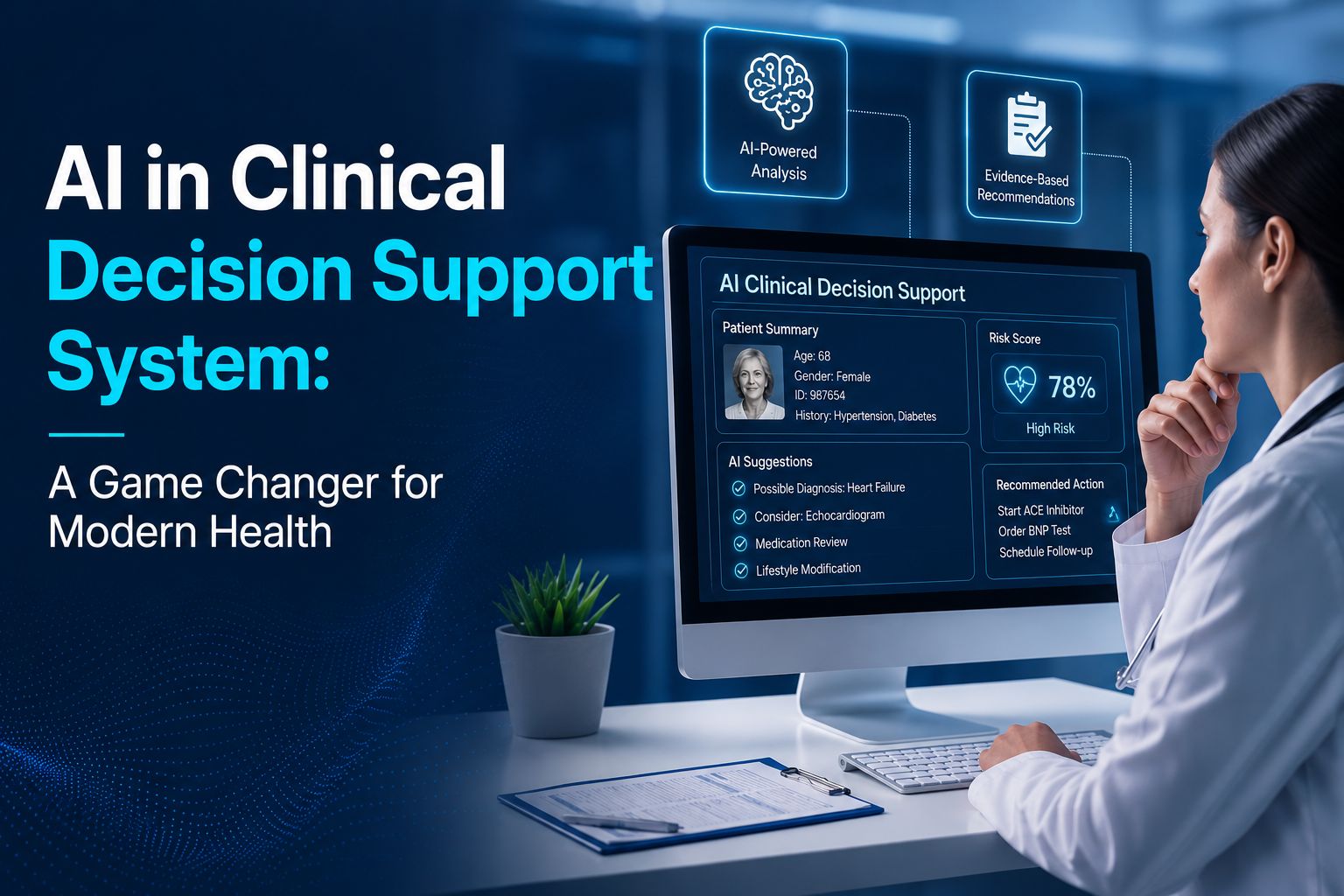
Hospitals generate a lot of new patient data every day, and most clinical teams cannot realistically review it all in real time. That mismatch between how much data there is and what clinical bandwidth can handle is exactly the spot where AI in clinical decision support systems is starting to shift results across modern healthcare.
AI can help clinicians spot emerging risks earlier and then make more informed decisions from patient history data, lab signals, and also real time monitoring inputs. In this blog, we will go through how AI-powered CDSS really works, what makes it a safe option, where it still faces resistance, and how healthcare teams can adopt it without disrupting existing workflows.
What Makes an AI-Powered CDSS Safe and Effective?
- Human oversight: Every AI-generated suggestion should go through a clinician first; if something goes wrong, it will be easier to take responsibility with trained medical staff, not the system.
- Transparent recommendations: Clinicians need to keep an eye on the why behind every alert, not merely the alert by itself, so they can trust it and move with confidence.
- High-quality clinical data: Reliable outputs mostly start with clean, complete, and accurately labeled patient information flowing into the system from day one.
- Continuous model monitoring: Models must be checked regularly for drift, since patient populations and treatment protocols change faster than static algorithms can account for.
- Strong privacy controls: Every patient data point used for AI analysis needs tight access permissions, encryption, and audit trails, so it stays aligned with healthcare rules and doesn’t spill away.
- Clear escalation mechanisms: When the system flags a high-risk case, there needs to be a clear fast lane route for clinician review and response.
- Evidence-backed outputs: Recommendations should connect to current clinical guidance and peer-reviewed research, not only older statistical patterns, which can become misleading over time.
- Integration into existing clinician workflows: A CDSS really works only if it fits into how doctors already document, prescribe, and reassess cases every day.
How Does AI in Clinical Decision Support Work?
In a clinical decision support system, AI will analyze patient data to spot odd patterns to help clinicians make better and faster decisions, with better context, while still staying in the background and leaving the final judgment to them.
Patient Data Collection
It starts by pulling structured and unstructured data from electronic health records, lab systems, imaging reports, and even from connected devices. All that raw data basically becomes the ground layer the model will analyze later, so if completeness and accuracy are imperfect, this will affect the quality.
Data Processing and Contextualization
All the data is collected, cleaned, and linked to clinical terminologies, so the system can interpret. Then contextualization adds patient history, comorbidities, and the current medication list. That way, the model has a more rounded picture before any real analysis happens.
AI-Based Analysis
Machine learning models sift through the contextualized data to find signals, risk indicators, and anomalies that a routine review might miss. They compare the current situation with huge collections of past cases in similar clinical scenarios and outcomes.
Clinical Recommendation
Based on the analysis, the system generates a recommendation, alert, or risk score along with supporting evidence. Recommendations are designed to inform, not replace, clinical judgment, and are typically ranked by urgency or confidence level.
Clinician Review and Action
The treating physician analyzes the recommendation, compares it to their own clinical view, and chooses the next step. This final human checkpoint makes sure the system helps with decision-making instead of just telling people what to do.
Benefits of AI in Clinical Decision Support Systems
| Benefit | Description |
|---|---|
| Faster diagnosis | Flags potential conditions earlier by cross-referencing symptoms with large clinical datasets |
| Reduced medical errors | Catches drug interactions, dosage issues, and overlooked risk factors before they reach the patient |
| Personalized treatment paths | Adjusts recommendations based on individual patient history rather than generic protocols |
| Lower clinician workload | Automates routine data review so staff can focus on complex cases |
| Improved consistency | Applies the same evidence-based logic across every case, reducing variation in care quality |
| Better resource planning | Predicts patient risk levels to help hospitals allocate beds, staff, and equipment more efficiently |
Challenges of Implementing AI-Based CDSS
Implementing AI-based CDSS, requires a lot of attention due to data quality and security, integration, and clinical accuracy in a real way. On the other hand, healthcare organizations must handle AI bias, follow regulatory expectations, and build clinician trust before deployment.
Data Quality and Interoperability
Many hospitals still operate with fragmented systems where patient records are split up, like each department keeps its own format. If the data pipelines aren’t clean and interoperable, then even a really good AI model is going to have trouble producing consistent, dependable recommendations for the whole organization, not just in one ward.
AI Bias and Model Reliability
If the models are trained on unrepresentative data, they can end up with skewed recommendations for certain patient groups. That’s why regular auditing against diverse populations is required to catch bias early, so the system stays reliable across multiple demographics and care settings.
Explainability of AI Recommendations
Clinicians are unlikely to act on a recommendation they can’t really understand. Black-box models give outputs, but there is no reason behind them. It can create real hesitation, so explainability still ends up being one of the biggest adoption barriers in clinical settings right now.
Privacy and Healthcare Data Security
Patient data is extremely sensitive, so any AI system that touches it has to meet strict regulatory requirements. Breaches or simple mishandling can end up damaging patient trust and also expose healthcare organizations to major legal and financial fallout.
Integration With Existing EHR Systems
Older EHR software wasn’t designed with AI integration in mind. When you try to connect a modern CDSS to legacy infrastructure, it often requires custom APIs and middleware, plus careful testing; otherwise you risk workflow disruptions during the rollout.
Clinician Trust and Adoption
Even if the system is technically solid, it can still fail if clinicians don’t trust it or don’t actually use it. Trust doesn’t appear instantly; it takes time, clear and transparent messaging, and consistent evidence that the tool truly improves patient outcomes, not just adding extra effort on top.
AI in CDSS vs Traditional CDSS: What’s the Difference?
| Aspect | Traditional CDSS | AI-Powered CDSS |
|---|---|---|
| Logic type | Rule-based, fixed if-then conditions | Learns patterns from data and adapts over time |
| Data handling | Limited to structured inputs | Processes structured and unstructured data, including notes and images |
| Accuracy over time | Stays static unless manually updated | Improves as more clinical data is fed into the model |
| Personalization | Generic, based on broad protocols | Tailored to individual patient history and risk profile |
| Alert relevance | Higher rate of false alerts | Better contextual filtering, reducing alert fatigue |
| Scalability | Requires manual rule updates for new conditions | Scales faster across specialties with retraining |
How Can Bacancy Technology Help With AI-Powered CDSS?
Since 2011, Bacancy Technology has worked with healthcare organizations to design and deploy Clinical Decision Support software that fits real clinical workflows, not just generic templates. From data architecture to model integration and EHR connectivity, the team builds systems that clinicians can really trust and use every day. And if an organization is looking into broader healthcare AI solutions, Bacancy also supports interoperability, compliance and long term model maintenance, so the whole system stays reliable as patient data and clinical needs evolve.
Conclusion
The role of AI in clinical decision support systems is not just some experimental technology or an add-on for hospitals. It is turning into a working layer that helps with faster diagnosis and fewer errors, and also assists clinicians in handling the rising patient loads, without dropping quality. The major part is, it relies on clean data, models that are explainable or at least transparent, and systems that are designed around how clinicians actually work, not around the tech alone. Most of the organization spent money early on reliable clinical decision support software and paired it with solid data governance and real clinician buy-in, will likely end up in a better place to deliver safer, more consistent patient care. As adoption continues to grow, healthcare AI solutions will play an increasingly important role in shaping smarter and more efficient healthcare delivery.






Comment