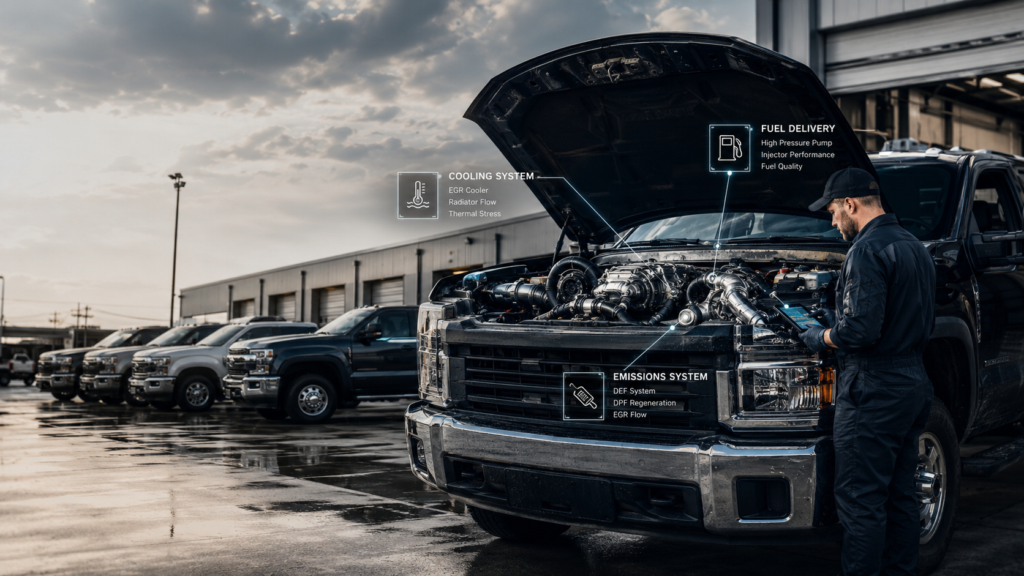
The 6.6L L5P diesel engine is one of the most talked-about powerplants in the heavy-duty truck world. It delivers impressive horsepower and serious towing capability. It also offers a level of refinement that appeals to both working professionals and diesel enthusiasts.
But for owners who push these engines hard in demanding conditions, the factory configuration has clear limitations. That is why demand for quality L5P performance parts has grown steadily. However, the topic of an off-road L5P emission delete is different. It matters most to fleet managers, agricultural operators, and off-road professionals. For them, repeated emissions-system failures directly threaten productivity.
Understanding the factory’s weak points is essential. So is recognizing your specific use case. And you must choose the right strategy within legal boundaries. That is what separates owners who struggle with costs from those who get the most out of every mile.
The Engine That Almost Has It All
When the L5P arrived, it was widely celebrated as a significant step forward in diesel engineering. Stronger internals, improved fuel injection, greater power output, and a more sophisticated overall design made it an instant benchmark in its class. Compared to its predecessors, it felt like a more complete, more capable machine right out of the box.
But “almost” is doing a lot of work in that sentence.
Modern diesel engines, including the L5P, are engineered under strict emissions regulations. To meet those requirements, manufacturers layer multiple emissions control systems on top of an already complex powertrain.
You end up with an Exhaust Gas Recirculation system, a Diesel Particulate Filter, a Selective Catalytic Reduction system, and a Diesel Exhaust Fluid system, all working simultaneously, each one adding components, complexity, and potential failure points to the equation.
For a truck that’s used lightly on the street, these systems may go largely unnoticed for years. But for a truck that works hard every single day, towing heavy loads, operating in extreme temperatures, running long hours under consistent strain, these emissions systems become a recurring source of mechanical problems and unexpected costs.
Breaking Down the Factory Weak Points
EGR System
The Exhaust Gas Recirculation system is arguably the most problematic component in the L5P’s emissions package. Its function is to redirect exhaust gases back into the intake manifold. This lowers combustion temperatures and reduces nitrogen oxide emissions. In theory, it is a clean solution.
In practice, it means dirty, carbon-laden exhaust gases are pushed back through the intake system. The L5P’s EGR design is better than earlier Duramax generations. It has improved cooler geometry and better PCV separation.
But the fundamental issue remains. Under sustained high-load operation, extended idling, or repeated heavy towing, carbon deposits build up. They accumulate on the EGR valve, the cooler, and the intake passages. Over time, this buildup causes the EGR valve to stick open or closed. It also clogs the EGR cooler.
The result is reduced airflow into the engine. Symptoms include rough idling, power loss, and increased fuel consumption. Eventually, a check engine light appears and refuses to go away.
Repair costs for EGR-related failures on the L5P can range from several hundred to several thousand dollars. The final cost depends on how far the problem has progressed.
DPF and Regeneration Cycle
The Diesel Particulate Filter captures fine soot particles from the exhaust stream. It keeps them from being released into the atmosphere. It is an effective emissions reduction tool. But it comes with its own set of headaches.
The filter accumulates soot over time. It must periodically undergo a regeneration cycle. This process burns off trapped particles using high exhaust temperatures. The problem usually does not start with regenerations happening too often. Instead, it begins when regenerations fail to complete properly.
This happens often in trucks used for short trips, frequent idling, or stop-and-go work. In these conditions, exhaust temperatures rarely stay high enough for long enough. The system cannot complete a passive or active regeneration cycle.
The engine control module may force an active regeneration. But if the duty cycle is interrupted, like when the driver shuts off the engine, the soot only burns partially. Over time, these incomplete cycles overwhelm the DPF.
Backpressure increases. Engine performance drops. A cascade of fault codes appears. In severe cases, the filter must be replaced completely. That repair is very expensive.
DEF System Complexity
The Diesel Exhaust Fluid system adds another maintenance burden. Fleet managers and individual owners quickly grow tired of managing it. DEF fluid requires regular replenishment. The injector is prone to clogging and failure. The SCR catalyst can degrade over time. In colder climates, DEF fluid can freeze.
This is a normal physical property. The system includes heaters to thaw it. But the freeze-thaw cycle still adds management complexity. It consumes battery power. It can delay system readiness during cold starts. That is exactly when reliable performance matters most.
For operations running multiple trucks, the logistics add up. You must manage DEF levels across the fleet. You must monitor the heater status. You must check for crystallized injector deposits. You must address DEF-related faults. All of this takes time and money.
Restricted Factory Intake and Exhaust
Beyond the emissions systems, the factory intake and exhaust configurations have other priorities. They are built for regulatory compliance. They are also built for noise, vibration, and harshness (NVH) control. And they are built for cost efficiency.
Maximum airflow and performance are not the primary goals. As a result, the engine breathes with measurable restriction. This is especially true in the mid-to-high RPM range. The restriction limits combustion quality. It leaves real performance potential untapped.
Upgrading With L5P Performance Parts
For owners who want to address these factory limitations and unlock what the L5P is truly capable of, the aftermarket offers a well-developed range of solutions. Upgrading with quality L5P performance parts is one of the most effective strategies for improving both reliability and output, whether your primary goal is better towing performance, improved fuel economy, or simply reducing the frequency of costly repairs.
Cold-Air Intake Systems
An upgraded intake system replaces the restrictive factory airbox with a free-flowing design that draws cooler, denser air into the engine. More air means better combustion, and better combustion means more power and efficiency. It’s one of the most accessible entry points into L5P modification and delivers noticeable real-world results.
Performance Exhaust Upgrades
Factory exhaust systems are engineered to minimize noise and meet emissions standards, not to optimize exhaust flow. Aftermarket exhaust components reduce backpressure, allow the engine to expel gases more efficiently, and contribute to improved power delivery under load. In combination with intake upgrades, the difference in how the engine breathes is immediately apparent.
Engine Tuning and Calibration
Among all available L5P performance parts, a professionally developed engine tune is often the single most impactful upgrade. Tuning recalibrates the engine’s fuel delivery, injection timing, turbo boost targets, and transmission shift points. These adjustments work in harmony with supporting hardware upgrades.
The result is an engine that feels more responsive. It pulls stronger under load. It runs more efficiently across the entire RPM range.
However, the tune must match your emissions hardware. This is critical. If the factory DPF, SCR, and DEF systems remain in place, use an “emissions-compliant” calibration. Avoid aggressive fuel delivery. Aggressive tuning can overwhelm the DPF with soot. It can also raise exhaust temperatures beyond safe limits for the aftertreatment system.
For vehicles legally operated off-road with emissions hardware removed, a dedicated performance tune is appropriate. It can safely unlock the engine’s full potential. If the tune does not match the hardware, you will create new problems. You will not solve existing ones.
Cooling System Enhancements
Under sustained heavy use, long towing sessions, steep grades, and high ambient temperatures, the L5P’s factory cooling system can be pushed toward its limits. Upgraded intercoolers, transmission coolers, and auxiliary cooling components help manage heat more effectively, protecting critical engine components and maintaining consistent performance even when conditions get demanding.
The Off-Road and Agricultural Reality
For some L5P owners, these trucks never see a public road. They operate on private land. They work in agricultural settings. They compete in off-road events or motorsports. In these environments, emissions regulations apply differently. They may not apply at all.
For these owners, repeated EGR, DPF, and DEF failures are more than frustrating. They are a real operational liability. Downtime on a farm during harvest season is costly. A mechanical failure mid-competition is unacceptable.
Sometimes, conventional performance upgrades are not enough. You may install improved intercoolers, high-flow intakes, and optimized exhausts. But emissions-system faults can still cause downtime. In these specific, legally permissible contexts, an off-road emission delete becomes a technical last-resort solution.
An off-road L5P emission delete removes all emissions control systems. This includes the EGR, DPF, DEF, and related components. Purpose-built hardware replaces them. The engine can then operate without the burden of these systems. These systems were not designed for sustained, high-demand use.
Operators who have pursued this approach in eligible environments report clear benefits. They see cleaner intake systems. They see more stable engine temperatures. They see reduced maintenance costs. They see stronger and more consistent power delivery. They see a dramatic reduction in unplanned downtime. Removing the EGR system alone eliminates one of the most persistently problematic components in the drivetrain.
But there are trade-offs. You must also consider legal realities.
Under U.S. federal law, the Clean Air Act, it is illegal to remove or disable emissions control devices on any vehicle driven on public roads. Even for agricultural or off-road use, the EPA has strict definitions and exemptions. You must verify that your specific application qualifies. If it does not, you face substantial fines and penalties.
Deleting emissions hardware also increases exhaust noise. It increases visible particulate output: black smoke. This may create operational nuisances on the job site. It may void your factory powertrain warranty. And the vehicle becomes permanently ineligible for legal street use. To make it street-legal again, you would have to reinstall all systems. That is very expensive.
That said, one point is essential. An off-road L5P emission delete is legal only for vehicles operated exclusively off public roads. Even then, it is only legal if it complies with all federal, state, and local regulations. Using a deleted vehicle on public streets is a violation of federal EPA regulations. It also violates equivalent laws in other jurisdictions.
Every owner considering this path must thoroughly research all applicable laws. You must comply with them before proceeding.
Thinking Long-Term
The 6.6L L5P is a fundamentally strong engine. It has a robust internal architecture. It is more than capable of delivering exceptional performance and longevity. Its factory’s weak points are not the result of poor engineering. They are the unavoidable consequence of designing a commercial engine to meet strict modern emissions standards.
The good news is that those weak points are well understood. The solutions are well established. A thoughtful combination of quality L5P performance parts can help. And where legally applicable, an off-road L5P emission delete is an option.
For owners in eligible use cases, these tools can build a truck that is genuinely more capable, more reliable, and more cost-efficient than anything that rolled off the factory floor. In the end, overcoming the modern fleet dilemma is not about rejecting what the factory built. It is about understanding its limitations. It is about making informed, strategic decisions to go beyond them.
But you must always stay within the law. You must have a clear-eyed view of your specific operating environment. For the vast majority of on-road users, one strategy is the most rational and sustainable.
Maintain your emissions system properly. Combine it with smart, compliant performance upgrades. That will serve you best over the long term.