
How to A/B Test Landing Page Personalization Campaigns in 2026

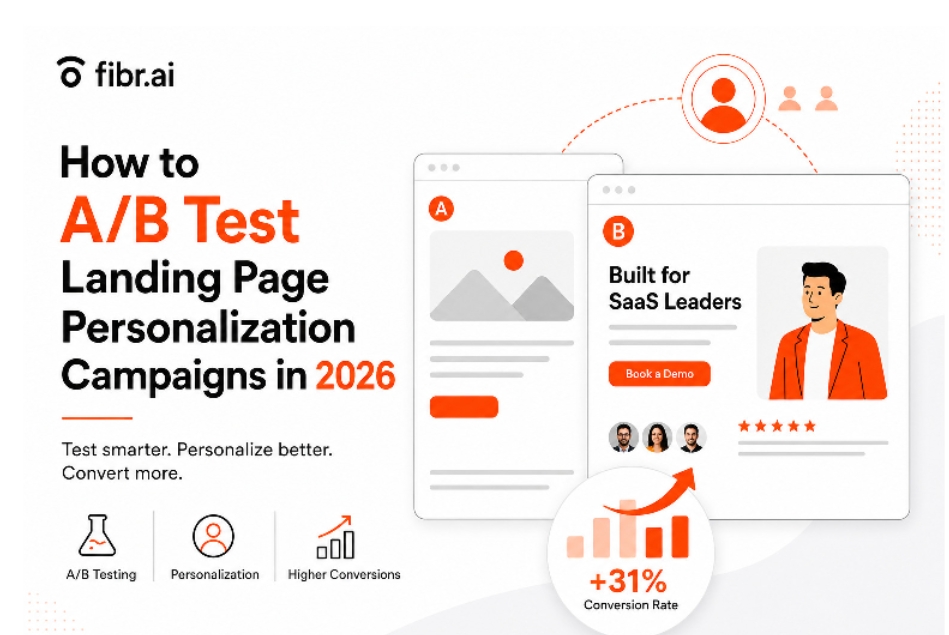
Most personalization campaigns fail for a simple reason: teams launch personalized experiences but never validate whether they actually improve conversions.
You update the headline, tailor the messaging to a specific audience, and customize the page experience. Everything looks more relevant. Yet when you check the results, conversion rates remain unchanged or worse, decline.
That’s where testing comes in.
In 2026, the most successful growth teams aren’t just personalizing landing pages. They’re using A/B test landing page personalization strategies to prove what works, eliminate assumptions, and scale winning experiences with confidence.
What Is Landing Page Personalization?
Landing page personalization is the practice of adapting page content based on visitor attributes, intent, or behavior.
Examples include:
- Showing industry-specific messaging based on ad targeting
- Displaying different customer stories for different audience segments
- Personalizing CTAs for first-time versus returning visitors
- Matching page content to campaign keywords or traffic sources
The goal is simple: make the page feel more relevant to each visitor.
However, relevance alone doesn’t guarantee conversions. A personalized experience may feel better while producing the same or even worse results than a generic page.
That’s why testing matters.
Why Personalization Needs Testing
Many marketers assume that a personalized version will automatically outperform a standard landing page.
Unfortunately, that’s not always true.
A tailored headline may resonate with one audience but fail with another. An industry-specific testimonial may create trust in one segment while adding friction in another.
Without testing, you’re making decisions based on assumptions.
Running an A/B test landing page personalization campaign allows you to:
- Validate whether personalization improves conversions
- Understand which audience segments respond best
- Prevent wasted ad spend on underperforming variants
- Build a repeatable optimization process
As many growth teams have learned, personalization becomes truly valuable only when it’s backed by data.
A Real-World Example
Consider a B2B SaaS company running campaigns for three industries:
- Healthcare
- Fintech
- Logistics
The company created personalized landing pages for each segment using tailored headlines, testimonials, and messaging.
Instead of assuming success, they tested each personalized version against a generic control page.
The results were revealing:
- Healthcare visitors generated a 31% increase in demo requests
- Fintech visitors showed no significant improvement
- Logistics visitors converted 14% lower than the control page
Without testing, the company would have invested heavily in all three variants.
Because they tested, they were able to:
- Scale healthcare campaigns confidently
- Pause ineffective versions
- Develop stronger hypotheses for future experiments
What Should You Test?
Not every page element has the same impact on conversion rates.
Focus on areas most likely to influence visitor decisions.
Headlines and Subheadlines
The headline is often the first thing visitors see.
Test:
- Industry-specific messaging
- Role-based messaging
- Problem-focused copy
- Outcome-focused copy
Calls-to-Action
Small CTA changes can create meaningful conversion improvements.
Consider testing:
- CTA wording
- CTA placement
- CTA frequency throughout the page
Examples:
- Start Your Free Trial
- Book a Demo
- See It in Action
Social Proof
Different types of proof resonate with different audiences.
Test:
- Customer testimonials
- Case studies
- Brand logos
- Industry awards
- Analyst mentions
Hero Section Content
The hero section strongly influences first impressions.
You can test:
- Product screenshots
- Customer imagery
- Video demonstrations
- Static visuals versus interactive elements
Offer Positioning
Sometimes the offer matters more than the messaging.
Examples:
- Free trial
- Personalized demo
- Free consultation
- Product tour
How to Set Up an Effective Test
A successful A/B test landing page personalization campaign follows a structured process.
Start With a Clear Hypothesis
Avoid testing random ideas.
Instead, create a specific statement such as:
“Showing enterprise visitors a CFO-focused headline will increase demo requests compared to a generic headline.”
A clear hypothesis makes results easier to interpret.
Define Your Audience
Personalization only works when audience segments are clearly defined.
Common segmentation methods include:
- Industry
- Company size
- Traffic source
- Geographic location
- User behavior
Calculate Sample Size
Before launching, estimate how much traffic you need to reach statistical significance.
Ending a test too early often leads to misleading conclusions.
Run Tests Long Enough
Allow tests to cover complete business cycles.
A few days of data rarely tell the full story.
Factors that influence results include:
- Day-of-week behavior
- Seasonality
- Campaign fluctuations
- Traffic quality
Analyze Segment-Level Results
Aggregate data can hide valuable insights.
A variation may perform similarly overall while significantly outperforming within a specific audience segment.
Always evaluate performance by segment before making decisions.
Metrics That Matter
Focus on metrics tied directly to business outcomes.
Primary Conversion Rate
Examples include:
- Demo bookings
- Trial signups
- Lead form submissions
- Purchases
Micro-Conversions
Helpful supporting metrics include:
- Scroll depth
- Video engagement
- Pricing page visits
- CTA clicks
Revenue Metrics
For revenue-focused campaigns, monitor:
- Revenue per visitor
- Average order value
- Customer acquisition efficiency
Bounce and Exit Rates
These metrics can indicate whether the personalized experience is capturing visitor interest.
Personalization Testing Tools in 2026
Several platforms support experimentation and personalization initiatives.
Popular options include:
- VWO
- Optimizely
- Mutiny
- Fibr AI
- AB Tasty
- Statsig
- GrowthBook
Choose the platform that fits your team’s maturity level, budget, and experimentation goals.
The best tool is the one your team consistently uses.
How AI Is Changing Personalization Testing
AI is helping teams run more experiments, generate ideas faster, and analyze performance more efficiently.
Some of the biggest trends include:
AI-Powered Test Suggestions
Modern platforms can identify user behavior patterns and recommend new testing opportunities.
Dynamic Traffic Allocation
Instead of splitting traffic evenly, AI can gradually direct more visitors toward higher-performing variants.
Predictive Personalization
Teams can now test AI-generated experiences against manually created versions to identify the strongest performers.
Automated Winner Rollouts
Some platforms automatically increase traffic to winning variants once significance thresholds are reached.
AI improves speed, but strategy still requires human judgment.
Common Testing Mistakes
Avoid these common errors:
- Ending tests too early
- Testing too many variables at once
- Making changes during an active experiment
- Ignoring statistical significance
- Relying only on overall averages
- Drawing conclusions from insufficient data
These mistakes often create false positives and poor optimization decisions.
Best Practices for Long-Term Success
The strongest experimentation programs treat testing as an ongoing process.
Some best practices include:
- Maintain a backlog of testing ideas
- Document every experiment
- Share learnings across teams
- Learn from failed tests
- Continuously refine audience segments
Every experiment should create insights that improve future campaigns.
Frequently Asked Questions
How long should a personalization test run?
Most tests should run for at least two full business cycles. Lower-traffic segments may require four to six weeks to achieve reliable results.
How much traffic do I need?
Traffic requirements depend on your current conversion rate and expected lift. Use a sample-size calculator before launching the experiment.
Should I test individual elements or entire experiences?
Start with larger changes that can create meaningful impact. Once you’ve identified a winning direction, test individual elements to refine performance.
Can I test multiple audience segments at once?
Yes, but ensure each segment receives enough traffic to reach statistical significance.
Final Thoughts
Personalization can improve relevance, engagement, and conversion rates—but only when it’s validated through testing.
An effective A/B test landing page personalization strategy removes guesswork and replaces it with evidence. Instead of relying on assumptions, you gain clear insights into what actually drives results for each audience.
Start with a single audience segment, one clear hypothesis, and one meaningful change. Measure the outcome, document what you learn, and continue iterating.
In 2026, the companies seeing the biggest conversion gains aren’t necessarily personalizing more. They’re testing more intelligently.
Author bio
Ankur Goyal is the founder of Fibr, leading its vision of an agent-led web where every page adapts like a smart assistant. A Stanford and IIT Delhi graduate, he combines technical expertise with deep insights into marketing and consumer behavior. In his second entrepreneurial journey, Ankur is focused on building AI-powered tools that help brands personalize experiences, accelerate experimentation, and drive better conversions at scale.







Comment