Organizations increasingly recognize that workforce performance is directly connected to business performance. Skills shortages, changing employee expectations, new technologies and evolving operating models are forcing leaders to reconsider how they attract, develop and retain talent. Human capital management provides a structured approach to managing these priorities, while Business advisory helps organizations connect workforce decisions with broader enterprise strategy.
Together, these capabilities enable organizations to move beyond administrative workforce management toward a more strategic approach that aligns talent, skills, technology and organizational design with business objectives.
This article explores the role of human capital management, how Business advisory supports workforce transformation, key focus areas, business benefits and practices for building a future-ready workforce.
What is human capital management?
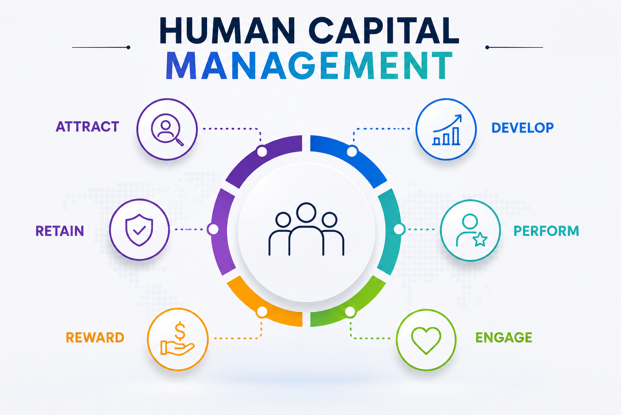
Human capital management is a strategic approach to managing an organization’s workforce throughout the employee lifecycle. It brings together processes related to workforce planning, talent acquisition, onboarding, performance management, compensation, learning, employee experience and succession planning.
The objective is not simply to manage employees efficiently. Human capital management helps organizations ensure they have the right capabilities, skills and organizational structures required to execute business strategy.
Technology, workforce data and analytics increasingly support these activities by giving leaders greater visibility into workforce performance, talent requirements and emerging skills gaps.
What is Business advisory?
Business advisory provides organizations with strategic guidance to address complex operational, financial and organizational challenges. Advisors evaluate current performance, identify improvement opportunities and help leadership teams translate business priorities into practical transformation initiatives.
In a workforce context, Business advisory can connect talent strategy with enterprise objectives. Advisors may assess workforce capabilities, organizational structures, operating models, technology environments and performance measures to determine where change is required.
This broader perspective helps organizations ensure workforce investments contribute directly to business performance rather than operating as isolated HR initiatives.
Why human capital management matters
People represent one of the largest investments for many organizations. Yet workforce strategies do not always evolve at the same pace as business models, technology or customer expectations.
Effective human capital management helps leaders understand whether workforce capabilities are aligned with current and future business requirements. It provides a foundation for answering strategic questions about talent availability, workforce capacity, productivity, skills and leadership succession.
Business advisory strengthens this process by connecting workforce decisions with financial priorities, operational requirements and enterprise transformation goals.
Core areas of human capital management
Organizations can improve workforce performance by addressing several interconnected areas.
Workforce planning
Workforce planning helps organizations determine the number, location and capabilities of employees required to support future business demand. Scenario modeling and workforce analytics can help leaders anticipate gaps before they affect execution.
Talent acquisition
A structured talent acquisition strategy aligns recruiting with business requirements, critical skills and long-term workforce priorities rather than focusing only on filling immediate vacancies.
Learning and skills development
Continuous learning enables organizations to respond to changing technology and business requirements. Skills intelligence can help identify capability gaps and direct development investments toward strategically important areas.
Performance management
Modern performance management connects individual goals with organizational priorities while providing employees with timely feedback and development opportunities.
Compensation and rewards
Compensation strategies help organizations balance workforce costs, market competitiveness and employee retention while reinforcing desired performance.
Succession planning
Succession planning identifies critical roles and develops internal talent pipelines to reduce leadership risk and support business continuity.
Together, these capabilities create an integrated approach to managing workforce performance.
How Business advisory strengthens workforce strategy
Business advisory can help leadership teams evaluate human capital decisions through an enterprise performance lens.
Aligning workforce and business strategy
Advisors help organizations translate strategic priorities into workforce requirements, identifying the capabilities, roles and organizational structures needed to execute the strategy.
Improving organizational design
Business advisory can assess spans of control, management layers, decision rights and organizational structures to identify opportunities to improve agility and efficiency.
Optimizing workforce costs
Workforce analysis can identify opportunities to improve productivity, optimize staffing models and redirect investment toward higher-value capabilities.
Supporting technology decisions
Advisors can help organizations evaluate HR technology requirements and determine how automation, analytics and artificial intelligence can improve workforce processes.
Measuring workforce performance
Benchmarking and performance metrics provide leadership teams with objective insights into workforce cost, productivity, service delivery and organizational effectiveness.
Business benefits of human capital management
A strong human capital management strategy can create value across both workforce and enterprise performance.
Improved workforce productivity
Clear roles, effective processes and appropriate technology help employees spend more time on activities that contribute directly to business priorities.
Better talent decisions
Workforce data and analytics provide leaders with greater visibility into hiring requirements, skills gaps, retention risks and succession needs.
Stronger employee experience
Simplified processes, effective development opportunities and accessible workforce services can improve important interactions throughout the employee lifecycle.
Greater organizational agility
A clear understanding of workforce capabilities enables organizations to redeploy talent and respond more quickly when business priorities change.
More effective workforce investment
Business advisory helps leaders determine where investments in people, technology and organizational capabilities are most likely to improve enterprise performance.
The role of AI and analytics
Artificial intelligence and advanced analytics are expanding the capabilities of human capital management. Predictive analytics can help organizations anticipate workforce demand, identify retention patterns and understand future skills requirements.
Generative AI can support employee communications, summarize workforce information and improve access to organizational knowledge. AI agents can potentially coordinate routine workforce processes across multiple systems while escalating decisions requiring human judgment.
However, workforce applications of AI require strong governance. Organizations need appropriate controls for employee privacy, security, transparency and bias, particularly when technology influences decisions related to hiring, performance or compensation.
Best practices for human capital management
Organizations can strengthen workforce performance by following several principles:
- Align workforce priorities with enterprise strategy and expected business demand.
- Use objective workforce data and external benchmarks to understand current performance.
- Develop a skills-based view of workforce capabilities and future requirements.
- Simplify processes before introducing new technology or automation.
- Connect talent, organizational design and workforce planning rather than managing them independently.
- Establish clear measures for workforce productivity, cost, experience and business contribution.
- Use Business advisory expertise to connect workforce transformation with broader operational and financial priorities.
These practices help organizations build a workforce strategy based on business requirements rather than isolated HR programs.
The future of human capital management
Human capital management will increasingly focus on skills, workforce intelligence and dynamic talent deployment. Organizations will need greater visibility into available capabilities and the ability to rapidly match those capabilities with changing business priorities.
AI and automation will also change how work is distributed between employees and technology. As routine activities become increasingly automated, workforce strategies will need to account for redesigned roles, new skill requirements and different operating models.
Business advisory will remain important in helping leadership teams understand these changes, evaluate workforce implications and align investments with enterprise strategy.
Conclusion
Human capital management provides organizations with a strategic framework for aligning workforce capabilities with business objectives. By connecting workforce planning, talent management, skills development, organizational design and technology, organizations can improve productivity while preparing for future business requirements.
Business advisory adds an enterprise perspective by helping leaders connect workforce decisions with operational performance, financial priorities and transformation objectives. Organizations that manage human capital as a strategic business asset will be better positioned to build adaptable workforces, strengthen execution and support sustainable growth.