Profee, a Cyprus-based fintech service best known for international money transfers from Europe, has recently carried out a survey about remittance security among its clients. The company wanted to explore how much do its’ customers know about staying safe online – and discovered that confusing communication can be more scary than technical mishaps.
About Profee
Profee is an international money transfer platform designed to make sending funds abroad fast, safe, and hassle-free, covering more than 90 destinations with a particular emphasis on Africa, Asia, and Eastern Europe. Accessible through a website as well as dedicated apps for both Android and iOS, Profee makes cross-border remittances straightforward. The service is especially tailored for expats, offering favourable exchange rates across more than 40 currencies, flexible local payout methods, and an easy-to-use interface. As of July 2026, Profee had over one million customers. The company continues to evolve by rolling out new capabilities, such as digital accounts, digital cards and more payout methods. Find out more: https://www.profee.com/
Why money transfer security is paramount
Finance-related scams have been on the rise recently, making regular customers more vulnerable. According to the State of Scams Germany 2026 Report, two of three people encountered scam in the previous year, with estimated losses making up to 12 billion EUR annually. Dutch De Nederlandsche Bank (DNB) reported over 658,000 financial scam cases in 2025 – meaning that seven of every 100,000 transactions involved fraud. And scam is on the rise not just in Europe: in the United Kingdom, Cifas reported 444,000 cases of scam in 2025 – 6% higher than the previous year. Scams have been becoming more advanced, and were created with the help of artificial intelligence, according to officials.
“Our data and intelligence show how fraud is being industrialised, with AI accelerating crime that is increasingly digital, organised and international”. — Mike Haley, CEO of Cifas
Expats moving to Europe come across many challenges, including excessive paperwork and managing a budget in two or more currencies. The adaptation complexities together with scam methods evolving make them a likely target for fraudsters seeking to access their data and money. That is why Profee decided to ask its clients what they know about transfer security and if they need any assistance on that matter. In September 2026, Profee questioned over 1,000 of its clients – expats from various countries residing in the EU – about transfer-related scams and online security. The survey was 100% anonymous to ensure that the clients’ data stays private.
What expats in the EU know about money transfer scams
According to Profee’s survey, 53% of respondents are well aware of the risks related to online transfers, with 29.4% knowing a bit and 17.6% being unaware at all. Just a few of expats in the EU who completed the questionnaire admitted they have ever been affected by online fraud; 28.9% claimed to have spotted a scam, 23.9% preferred not to answer, and 46.9% noted that they have never spotted a scam. Those expats in the EU who have confessed losing their data, money, or both due to online fraud make less than 0.5% of the respondents.
“At Profee, we understand that scammers cause much stress even for those who do not fall for their schemes. In particular, they pretend to be representatives of banks or official services to trick people into providing sensitive data. We keep Profee clients informed through Profee blog posts about common scam schemes and online security and carry out research – from mass questionnaires to detailed interviews – to find blind spots and give relevant advice. And of course, our antifraud department are doing their best to keep our clients’ money and data safe.” — Ilya Bunin, CMO, Profee
How expats in the EU detect money transfer scams
Profee asked its clients about the way they keep their data safe and how do they check if a transfer service is secure: 2FA, unique passwords and official security markers were among the top responses.
According to Profee’s research, most expats in the EU trust two-factor authentication to be the primary guarantee of securing their data and money, followed by using unique passwords for various services and sticking to licenced services and apps for international money transfers.
How expats in the EU keep their transfers safe (multiple choice)
| option | Share |
| Using two-factor authentication | 54.15% |
| Using unique passwords and PINs for different services | 38.18% |
| Never save sensitive information on websites or apps | 23.88% |
| Using licensed services and apps only | 35.46% |
| Keeping software and devices up to date | 12.14% |
| F) I’ve never really thought about it | 11.10% |
These answers go inline with 2026 cybersecurity trends: an official confirmation of an online service’s safety helps avoid malware, and unique passwords help expats stay protected from identity theft. As for 2FA, Microsoft calls it “a baseline security measure for individuals and organizations alike.”
Why communications matters for online security
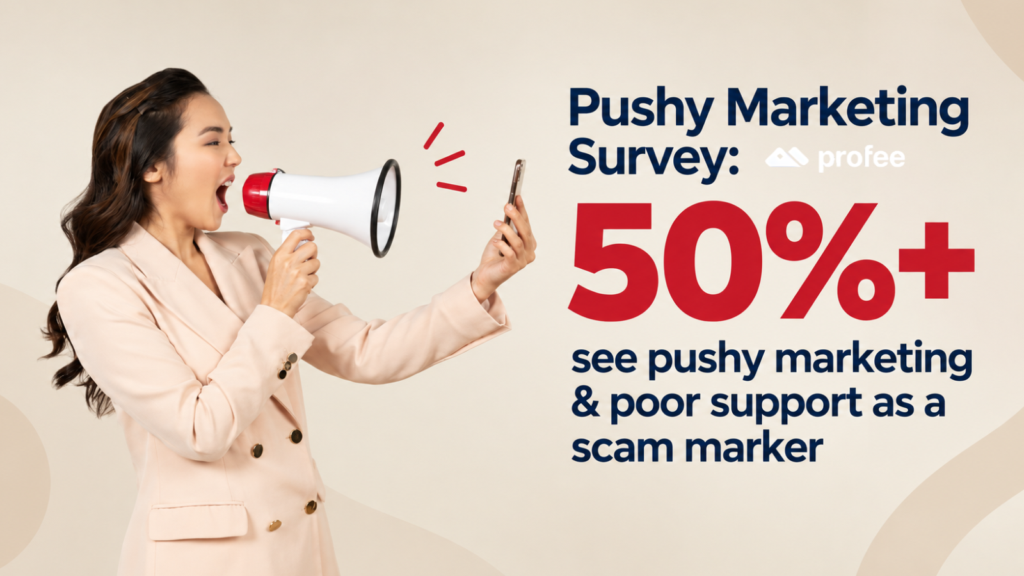
When asked about transfer scam markers, expats in the EU who took part in Profee’s survey put communication first. 53.7% chose poor or unresponsive client support as a suspicious sign; 53.5% voted for pushy marketing, and 47.6% indicated unprofessional communication in general. An absence of an official licence or regulatory information only got 35.9%, followed by an unclear transfer process and an offer that looks too generous. Changing fees and FX rates or delayed transfers got less than 25% each.
“At Profee, we put security first and follow international standards in accordance with laws and regulations. However, we understand that the services that offer cross-country transfers from Europe follow the same standards. Transparency and communication strategy are what make a real difference on the market. Our clients are not always tech-savvy from the get-go, but they face a necessity to learn more about transfer terms and processes. The awareness helps them keep calm – and we respect that and try to have all their questions answered simply and transparently. We make our terms more transparent and explore opportunities to bring answers that our clients are looking for. Miscommunication being a main scam alert is completely understandable, and we are continuing to reveal more about the way Profee works to stay transparent”. — Ilya Bunin, CMO, Profee
How Profee keeps its clients’ data and money safe
Profee is a registered trade name under Sibilla Solutions LTD, an Electronic Money Institution regulated by the Central Bank of Cyprus. Therefore, the company complies with all the respective rules and legislation. Profee is PCI DSS certified, uses a Tier 4 data centre for data storage, and follows strict AML and KYC protocols. Even though the company has been growing rapidly over the past few years, it manages to keep its security standards high. According to Profee’s survey, 83.3% of its clients feel “very confident” that their money is safe with the service, with a further 10.6% feeling fairly confident. These numbers reflect the trust Profee has built with its clients over time. The company continues to balance regulation, client-friendliness and, most importantly, earning that trust.