Nikolay Zirchyk is the CEO of Red Lanterns, the latest innovative startup bringing more romance and education into Blockchain and Cryptocurrency with their REDL Token. A little entertainment will do here, and this shows how universal the power of blockchain technology is. Nikolay will tell us more in this interview on the REDL Token Sale and ICO. – http://ico.red-lanterns.com/
Hi Nikolay! Please could you tell us about yourself?
Nikolay: Thank you for interviewing me today. My name is Nikolay Zirchyk and I am the CEO at Red Lanterns.
I started red Lanterns because of the taboo that remains around sex and sexual education. My team developed the idea of a dynamic platform that helps people bridge the gaps, find sex experts, receive sex coaching, and vice versa. Using our app, clients can find experts or content that aligns with their individual interests, mental characteristics, and geolocation. Then, depending on the request, our app helps clients draft smart contracts, use augmented confidentiality masks during video chats, and integrate peer to peer or artificial intelligence to answer sex related questions.
What is the Meaning of Red Lanterns?
Nikolay : The name Red Lanterns was inspired by “De Walletjes”. This is the largest and most-known red-light district in Amsterdam. Located at the heart of Amsterdam’s sex industry, it is filled with entertainment, shops, and bars with the spirit of sexual freedom.
How did you get the idea to launch a Blockchain and cryptocurrency business around Red Lanterns?
Nikolay : Fresh innovative approaches rule the modern world, and they are considered to be the formula of success for every start-up. Being a constantly developing platform, Red Lanterns is taking the leading position and keeping up to date with the latest technologies. It is based on blockchain, which presupposes existence of cryptocurrency – REDL tokens. The word “blockchain” becomes more and more popular nowadays as it is the thing of the future – all the transactions made in blockchain are fair and transparent. Owing to blockchain, everybody can send something valuable to everybody.
Smart-contracts implemented in blockchain ensure all the payments conducted through the platform in a conflict-free decentralized way. This means that you do not have to worry about paying for the consultation, getting profit and converting it into cash. There are no mediators between the parties of the contract, and it means that you do not have to pay intermediaries and waste your time. All the participants of the community are anonymous although blockchain is a public ledger – hundreds of people witness the agreement between two sides, therefore, its success is assured.
Smart contracts not only define the rules and penalties around an agreement in the same way that a traditional contract does, but also automatically enforce those obligations. According to Vitalik Buterin, the 22-year-old programmer of Ethereum, “it automatically determines whether the asset should go to one person or back to the other person, or whether it should be immediately refunded to the person who sent it”.
We are happy to have a personal sex coach on blockchain, how does this work and What Value is Red Lanterns adding to the world to end harassments and sexual abuse?
Nikolay : During our time developing Red Lanters, we identified a number of problems relating to individual sex education. This included difficulties in finding qualified experts, low level of confidentiality when using existing online services, high commissions or lack of guarantees in mutual agreements, and a lack of clear sexual service rules.
The modern person is no longer limited by physiology, we can now focus on the psychological aspect of sexual fulfilment. Our personal sex coaches and sex experts are on team to help individuals avoid low self-esteem based on sexual dissatisfaction, and to curb the effects of dissatisfaction such as isolation and poor mental health, as well as the effects of a lack of sex education including unsafe sex, unwanted pregnancy, and the spread of diseases.
As you noted above, our experts are specialists in the field of sexual literacy, sexology, and psychology. They work to promote the fourth item of the World Association for Sexual Health program (WAS) – being, ensuring universal access to comprehensive sexual information and education.
Probably, everybody who reads the news and tries to keep informed is aware of the social roles change and the problem of gender inequality, which is still marked in the modern society. These issues give rise to a new stir – a movement against sexual harassment that is reflected in numerous campaigns around the globe. The list of victims of sexual harassment keeps getting longer, and the popular #MeToo campaign has given women a chance to speak up. The percentage of women who have been sexually assaulted or harassed differs in various countries and cultures, but there is no escaping the fact that sexual harassment has left an indelible mark on millions of lives. Sometimes it is difficult to differentiate between good-natured rear-patting and sexual misconduct, therefore, some people just keep silent or do not even consider this gesture as something inappropriate.
The tide of accusations has swept many famous and powerful men, but is it possible to prove guilt of all the alleged? Influential figures have always been slandered by haters and enviers, and this is not surprising. In order to protect both sides and dismantle the gender stereotype which claims that woman is a victim and man is an offender, Red Lanterns team comes up with an idea of creating a smart-contract which will serve as a deal between two partners.
Why do people make contracts with each other even when it goes about daily trifles, but do not negotiate the conditions of the intimate relationships? To put it mildly, it is strange that the physical side of sex matters, but the emotional one recedes into the background. In most cases people being either in relationship or not discuss their desires and preferences in sex, however, not everybody and not always.
The solution to the problem is a smart-contract embedded in blockchain that provides legal protection of the partners in case one of them does not follow the terms of contract. Owing to blockchain technology anonymity of both partners is guaranteed, and the deal will be transparent and fair; both the partners can pay for the particular service. The smart-contract can be realized through Red Lanterns platform by means of REDL tokens; it does not bind the sides by an obligation but protects the rights and prevents from sexual harassment as it is. Our platform is ready to enter the struggle against one of the most pressing problems of these days. Everybody will be legally protected with RL!
What makes Red Lanterns Crypto ICO different from the others?
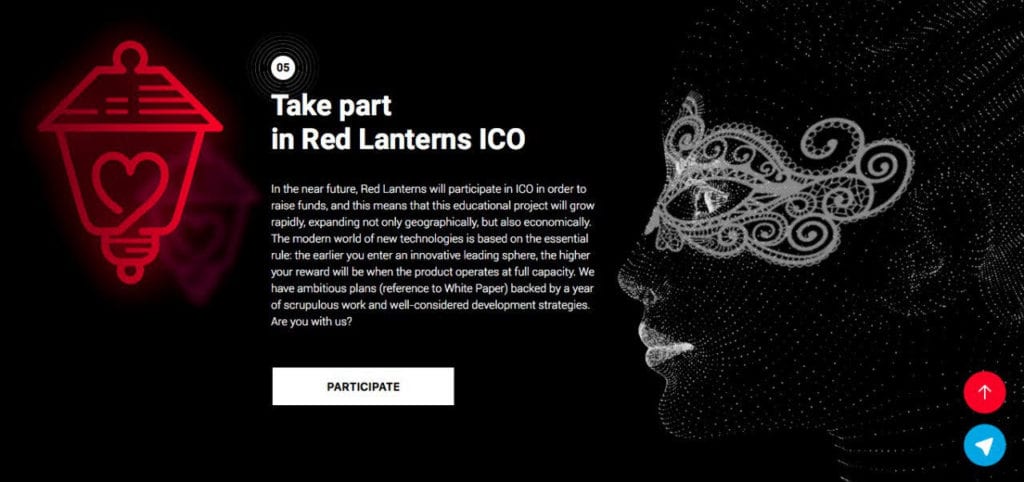
Nikolay : We are issuing an ICO for the purpose of developing its product, establishing a community, and expanding participants. Our token, REDL, will allow the user to pay for services via the Red Lanterns app and exchange tokens with other users.
Presently, there are more than 40 million potential experts ready to share their experience in sexual instruction and coaching, a market which we think we can really tap into.
How much do you intend to raise in the RDL Token Sale?
Nikolay : We intend to release 15,937,500 crypto-tokens for Red Lantersn service, of ERC20 standard. The estimated cost will be 1 EUR per token, and the token is called REDL.
12,750,000 of all issued REDL tokens will be available during the sale.
Our ICO will be considered successful if $1,500,000 EUR is raised; with the ultimate financial goal being $10,000,000 EUR.
How can RDL Token Holders Profit from Red Lanterns if they invest now?
Nikolay : The purpose of our ICO is to develop the product, establish a community, and expand the participants using our application. ICO community members can directly participate in the development of our product, depending on funds collected and in accordance with our ICO rules.
Our cryptotoken, REDL, is being introduced on the Ethereum blockchain. It allows individuals to pay for services without disclosing personal data or details, and participate on our platform via interactive masks that hide identity during chat or video calls.
- What are the steps for investing in RDL Token?
- Would you like to share the exchanges where RDL Token will be traded?
REDL tokens can be carried out in exchange for EUR, BitCoin, and Ethereum.
- Where do you see RDL Token after ICO and in the next 5 years?
From our research and additional sources, such as Statita.com we know that more than 15% of Americans visit dating apps and online dating sites. For example, Statista provides interesting data that adults “Americans with higher incomes tend to use online dating more than those with lower incomes.”( https://www.statista.com/statistics/274144/most-popular-us-dating-websites-ranked-by-monthly-visitors/) and they visit web pages such as match.com, meanwhile Match Group has surpassed 1Billion U.S. dollars in revenue.
This number gives us the exact goal where Red Lanterns should be in 5 years. We see ourselves a multinational multibillion company in next 5 years. We see Red Lantern’s Smart Contracts protecting people from sexual and other related issues in personal and professions environments.
According to our projections dating apps and web pages have more the 300 millions downloads and around 50 million active users in next 5 years.
We see red lantern as a platform that united suppliers on the market of sexual education and sexual services and products with more than 300 millions downloads of users.
What are your marketing and sales strategies to achieve that?
Nikolay : According to market research, there are more than 40 million sex experts in the world ready to share their experience. The volume of sexual instruction and sex coaching services is estimated at $150 billion EUR per year.
It is quite possible, therefore, that we can establish a community in which 150,000 people will take part, 55% of whom will be involved daily.
For more information on the REDL Token Sale , please visit: http://ico.red-lanterns.com/