NEW YORK, NY
Lineup Spans Gold, Silver, Copper, Nickel, Rare Earths, Phosphate, Uranium and Royalties, and Every Session Ends With Audience Q&A
From Early-Stage Exploration to Producing Mines, Management Teams Take Investor Meeting Requests
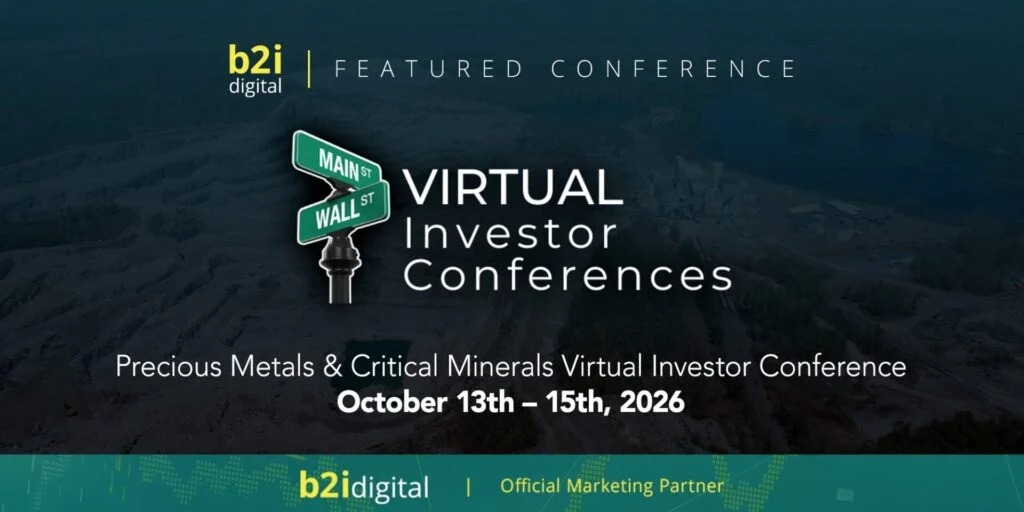
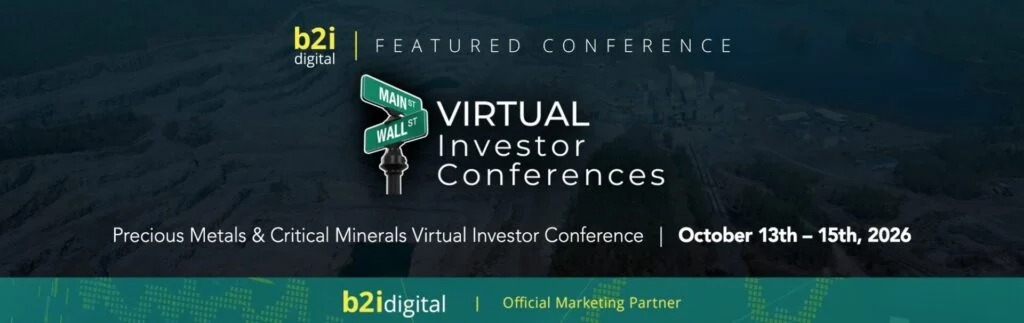
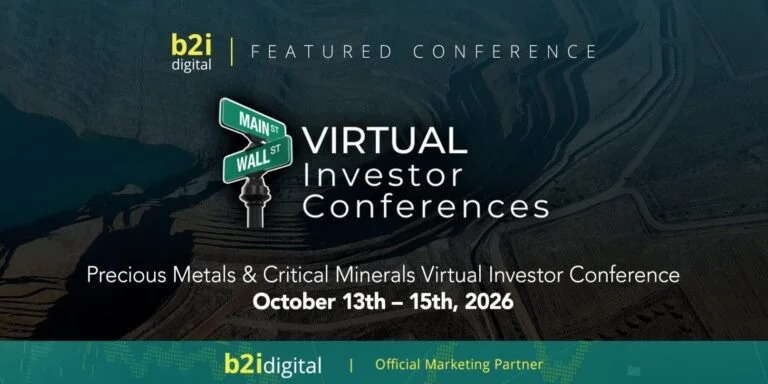
B2i Digital, Inc. invites investors to the Precious Metals & Critical Minerals Virtual Investor Conference, a B2i Digital Featured Conference, taking place online from Tuesday, October 13, to Thursday, October 15, 2026, and hosted by Virtual Investor Conferences.
As the Official Marketing Partner, B2i Digital brings the conference and every presenting company into an ecosystem built since 2021 and proven at over 130 investor conferences: 1,200+ news, broadcast and trade outlets with a 330 million+ monthly audience, and a community of 1.7 million+ investors and market participants. No single channel carries the day. It is the compounding effect of all online and offline channels, working before, during and after the event, that turns attention into meetings. The Capital Markets Matchmaker℠ takes every story From Marketing to Meetings℠.
Two B2i Digital Featured Companies present: Canadian Phosphate Limited on October 13 and Renforth Resources Inc. on October 15.
Event details and presenting company profiles: https://b2idigital.com/oct-13th-15th-precious-metals-and-critical-minerals-virtual-investor-conference.
Register at https://www.virtualinvestorconferences.com/wcc/eh/4814904/lp/5225899/register-for-virtual-investor-conferences/.
Request a meeting with management at https://app.axleaccess.com/public/events/eb448888-aaeb-491c-9e0d-2fbecb147128?token=9fc954d5-9bda-4a81-970e-09d9a1b7032e.
Any registered investor can request a virtual meeting with the management team of a presenting company through the meeting link above.
Each company presents live with audience Q&A. Replays will be available on the B2i Digital and OTC Markets YouTube channels.
“The lineup keeps growing, which tells you mining companies want the market’s attention and the market wants to hear from them. They’re called critical minerals for a reason. Find out why, and who is best equipped to deliver them. Then request your one-on-one meetings. As I’ve said before, that’s the unique opportunity the VIC offers,” said David Shapiro, Chief Executive Officer of B2i Digital, Inc.
Presenting Companies as of October 9, 2026 (subject to change):
Tuesday, October 13
10:00 AM ET: NeoTerra Group Plc (OTCQB: ANRCF | LSE: TERA), rare earths, fluorspar and gallium project in Mozambique.
10:30 AM ET: Copper Intelligence Inc. (OTCID: CUAI), copper exploration in the Democratic Republic of Congo (DRC).
11:00 AM ET: Arizona Eagle Mining Corp. (OTCQB: AZEMF | TSXV: AZEM), gold and silver exploration at the past-producing McCabe Mine, Arizona.
11:30 AM ET: Lion Copper Corp. (OTCQB: LCGMF | CSE: LCU), copper projects at Yerington, Nevada, with Rio Tinto’s Nuton.
12:00 PM ET: Ivanhoe Mines Ltd. (OTCQX: IVPAF | TSX: IVN), copper, zinc and platinum group metals mines in the DRC and South Africa.
1:00 PM ET: ONGold Resources Ltd. (OTCQB: ONGRF | TSXV: ONAU), gold and tungsten exploration in Northern Ontario and Manitoba.
1:30 PM ET: Viva Gold Corp. (OTCQB: VAUCF | TSXV: VAU), Tonopah Gold Project, Walker Lane, Nevada.
2:00 PM ET: Bravada Gold Corp. (OTCID: BGAVF | TSXV: BVA), Wind Mountain gold and silver project, Nevada.
2:30 PM ET: First Phosphate Corp. (Nasdaq: PHOS | CSE: PHOS | OTCQX: FRSPF), mine-to-market phosphate for lithium iron phosphate batteries, North America.
4:00 PM ET: Canadian Phosphate Limited (OTCQB: CPHOF | ASX: CP8), a B2i Digital Featured Company, phosphate projects in British Columbia and Utah.
Wednesday, October 14
9:00 AM ET: Royal Road Minerals Limited (OTCQB: RRDMF | TSXV: RYR), copper and gold exploration in Colombia and Saudi Arabia.
9:30 AM ET: Atomic Eagle Ltd. (OTCQX: AEUXF | ASX: AEU), Muntanga uranium project, Zambia.
10:00 AM ET: Japan Gold Corp. (OTCQB: JGLDF | TSXV: JG), gold exploration and project generation across Japan.
10:30 AM ET: Honey Badger Silver Inc. (OTCQB: HBEIF | TSXV: TUF), silver projects across Canada, including the permitted PC Silver Mine.
11:30 AM ET: Heliostar Metals Ltd. (OTCQX: HSTXF | TSX: HSTR), gold producer in Mexico, developing Ana Paula.
12:00 PM ET: Denarius Metals Corp. (OTCQX: DNRSF | Cboe Canada: DMET), gold and silver production at Zancudo, Colombia, plus projects in Spain.
12:30 PM ET: Dryden Gold Corp. (OTCQX: DRYGF | TSXV: DRY), high-grade gold exploration in the Dryden District, Ontario.
1:00 PM ET: Kootenay Silver Inc. (OTCQX: KOOYF | TSXV: KTN), silver exploration in Mexico’s Sierra Madre.
1:30 PM ET: Star Gold Corp. (OTCQB: SRGZ), Longstreet gold and silver project, Nevada.
2:00 PM ET: Silverco Mining Ltd. (OTCQB: SICOF | TSXV: SICO), silver producer at La Negra, Mexico, with the Cusi complex.
3:30 PM ET: Deep Isolation Nuclear, Inc. (OTCQB: DBHL), deep borehole nuclear waste disposal, piloting in Texas.
4:00 PM ET: Walhalla Gold Corp. (OTCQB: WAUXF | CSE: WAU), Walhalla Gold Project, Victoria, Australia.
Thursday, October 15
9:00 AM ET: Novo Resources Corp. (OTCQB: NSRPF | TSX: NVO), gold exploration in the Pilbara and Victoria, Australia.
10:30 AM ET: Koryx Copper S.A. (OTCQX: KRYXF | TSXV: KRY), Haib Copper Project, Namibia.
11:00 AM ET: Gold Terra Resource Corp. (OTCQB: YGTFF | TSXV: YGT), Yellowknife gold project, Northwest Territories.
11:30 AM ET: Evolve Royalties Ltd. (OTCQX: EVRYF | CSE: EVR), royalties in base and critical metals.
12:00 PM ET: Eastport Critical Metals Corp. (OTCQB: EVIIF | TSXV: EVI), Matsitama Copper Project and others, Botswana.
12:30 PM ET: Stillwater Critical Minerals Corp. (OTCQX: PGEZF | TSXV: PGE), Stillwater West nickel and platinum group metals project, Montana.
1:30 PM ET: NexMetals Mining Corp. (Nasdaq: NEXM | TSXV: NEXM), Selebi and Selkirk copper-nickel mines, Botswana.
2:00 PM ET: Founders Metals Inc. (OTCQX: FDMIF | TSXV: FDR), Antino Gold District, Suriname.
2:30 PM ET: Renforth Resources Inc. (OTC: RFHRF | CSE: RFR), a B2i Digital Featured Company, Parbec gold deposit, Abitibi, Québec.
3:00 PM ET: Majestic Corporation Plc (OTCQB: MCJCF | Aquis: MCJ), precious and base metals recycling.
Throughout the year, Virtual Investor Conferences feature public companies from exchanges worldwide, including NYSE, Nasdaq, TSX, TSXV, CSE, ASX, LSE, and the OTC Markets. Virtual Investor Conferences is an OTC Markets Group Inc. property.
About B2i Digital, Inc.
B2i Digital, Inc. partners with conferences, public companies, and capital markets advisors through its Featured Conference, Featured Company, and Featured Expert programs. Its media network spans 1,200+ news, broadcast, and trade outlets with a 330 million+ combined monthly audience, plus 1.7 million+ followers, 70,000 opt-in email subscribers, and a rolodex of 235,000+ capital markets contacts. That reach gets clients seen; its conferences put them in the room with investors. The Capital Markets Matchmaker℠ takes every story From Marketing to Meetings℠. B2i Digital is headquartered in New York City.
Discover more Featured Companies, Featured Experts, and upcoming Featured Conferences at b2idigital.com
B2i Digital Contact Information
David Shapiro | Chief Executive Officer | B2i Digital, Inc. | https://b2idigital.com | 212.579.4844 Office | [email protected] | https://www.linkedin.com/in/davidshapironyc
B2i Digital Social Media
LinkedIn | X | Facebook | Instagram | YouTube | TikTok | Stocktwits | Reddit | Pinterest | Threads
About Virtual Investor Conferences
Virtual Investor Conferences is the proprietary investor conference series that provides an interactive forum for publicly traded companies to meet directly with investors online. VIC offers companies efficient access to a broad investor audience through live presentations, Q&A sessions, and one-on-one meetings. Investors benefit from direct access to executive management teams and the ability to view presentations live or on demand.
Virtual Investor Conferences Contact Information
OTC Markets Group Inc. | Virtual Investor Conferences | www.virtualinvestorconferences.com | [email protected]
Disclosure & Disclaimer
B2i Digital, Inc. is the Official Marketing Partner of the Precious Metals & Critical Minerals Virtual Investor Conference. B2i Digital, Inc. is not an affiliate of Virtual Investor Conferences and is not authorized to represent or act on behalf of Virtual Investor Conferences, in any capacity. Virtual Investor Conferences has not reviewed and approved the content contained on the b2idigital.com website. Content related to any specific company referenced in this release was provided by that company, approved by that company, or obtained from publicly available sources. B2i Digital, Inc. has not independently verified the accuracy or completeness of such information, and no representation or warranty, express or implied, is made as to its accuracy.
This content is provided for informational purposes only and does not constitute an offer to sell or a solicitation of an offer to buy any security, nor should it be relied upon as the basis for any investment decision. B2i Digital, Inc. is not a registered broker-dealer, investment adviser, or financial adviser, and nothing herein should be construed as investment, legal, tax, or accounting advice. Readers should consult their own advisers and conduct their own due diligence before making any investment decision.