EdTech & Innovation · April 2026
Draw in the Air uses gesture recognition to teach children letters and shapes, and in doing so raises harder questions about what interaction design in early education has been getting wrong.
There is a design assumption embedded in almost every educational technology product aimed at young children: that learning happens on a screen, mediated by touch. The tablet is the neutral, obvious choice. The interface is glass. The interaction is a tap.
Draw in the Air starts from a different question entirely: what if the screen is the wrong surface?
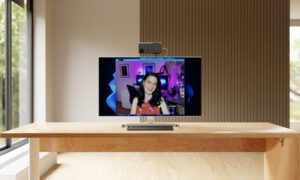
The gesture-based learning tool lets children trace letters, numbers, and shapes in the air in front of a standard webcam. Computer vision tracks hand and finger position in real time. The child moves; the system responds. There is no touchscreen, no specialised hardware, no app beyond what most laptops already support.
The result is an interaction model that feels almost counterintuitive for a digital product: the primary interface is a child’s body.
The reasoning behind this draws on a well-established body of research in developmental neuroscience and what cognitive scientists call embodied learning: the principle that physical movement and mental processing are not separate systems. When a child traces the letter ‘A’ with their arm in space, they are encoding its form through muscle memory, spatial reasoning, and motor coordination simultaneously. The evidence consistently shows that this produces stronger and more durable recall than recognising the same letter on a screen.
Fine motor skills, the precise and controlled movement of hands and wrists, are also foundational to early literacy in ways that touchscreen interaction does not support. Grip strength, the ability to apply graduated pressure, the physical coordination required to form a letterform: these develop through practice involving resistance and feedback. A glass surface, which responds to the lightest contact, provides neither.
Occupational therapists have flagged for several years that children are arriving at primary school with noticeably weaker fine motor skills than earlier cohorts. The causes
are multifactorial, but the correlation with increased touchscreen use in early childhood is consistent enough that several school systems have started taking it seriously. Sweden reintroduced handwriting and physical books after academic performance data showed real declines following a digital-first rollout. The UK government is actively reviewing screen time guidance for under-sevens. The EdTech industry built a product category; policymakers are now examining the side effects.
Gesture-based learning occupies an interesting position in this context. It uses technology (computer vision, motion tracking, real-time processing) but the interaction it produces is physical, visible, and social in ways that tablet-based learning is not. A child tracing a shape in front of a projected display is doing something their classmates can watch and respond to. The learning becomes a performance in the original sense: an act of making something visible.
From a product architecture standpoint, the accessibility of the hardware model is significant. Running on a built-in laptop webcam without proprietary sensors or subscription software means the tool is deployable anywhere a laptop exists. That matters across low-resource contexts, from schools in Sub-Saharan Africa and South Asia to lower-income districts in the UK and US, but also as a statement about what the minimum viable hardware for thoughtful learning technology actually is.
The tool was developed by Justin Ukaegbu, a Nigerian-born creative designer and technologist based in Kent, UK, whose background spans digital product design, brand communication, and technology-led learning experiences.
Gesture-based interaction in early education is not a finished idea. Calibrating motion recognition across different body sizes, lighting conditions, and movement styles is an unsolved engineering problem. Integrating this kind of tool into existing lesson planning requires real support for teachers. And meaningful evidence of learning outcomes, longitudinal data rather than user engagement metrics, would need to be built before any serious institutional adoption.
But the underlying design argument is sound: the problem with much current EdTech is not the technology, it is the passivity it produces. A child moving their arm through space to form a letter is not passive. They are doing something effortful, physical, and visible. That is what learning is supposed to look like.
The screen was never the point. It was just the easiest interface to build.