
Why a 24V Control Cabinet Needs Two Power Budgets

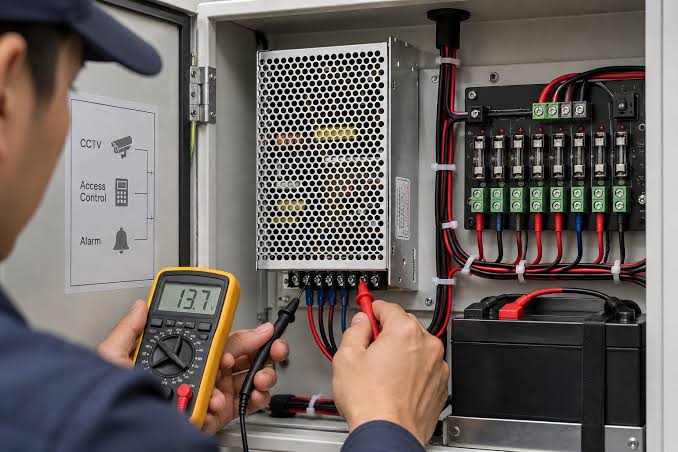
The cabinet’s load list totals 3.2A. The proposed supply is rated at 5A. On a spreadsheet, the decision looks finished.
Now ask a different question: what happens when the cabinet is powered on and all its devices try to start together?
A continuous-load budget and a startup budget answer different questions. Keeping both is a practical way to make a 24V supply selection defensible, particularly when a cabinet contains a mix of controllers, operator interfaces, sensors and switched loads.
The running total is only the first total
Take a deliberately simplified example, not a measurement from an installed machine. Assume the controller and input/output modules require 0.7A, an operator interface 0.8A, sensors and communications equipment 0.5A, and the active actuators 1.2A. The continuous total is 3.2A, or 76.8W at 24V.
The MEAN WELL NDR-120-24 DIN rail power supply is rated at 24V, 5A and 120W. The manufacturer specifies a 90-264VAC input range and convection cooling. These figures make it a candidate to investigate for the example, not a completed design decision. [1]
Suppose, purely for this illustration, that the simultaneous startup requirement reaches 5.6A. At nominal voltage that corresponds to 134.4W. The important finding is not that this particular supply must fail. It is that the steady-state calculation no longer establishes successful startup.
Engineering now needs the actual peak duration, the devices’ minimum acceptable supply voltage and the supply’s response to that demand. A short event, a prolonged overload and a recurring load pulse are different operating conditions. They should not all be hidden inside a single “safety margin” percentage.
Separate the two kinds of inrush
There is an easy source of confusion in a power-supply datasheet: its input inrush current concerns the AC side of the supply. It is not a statement of how much startup current the supply will deliver to the 24V equipment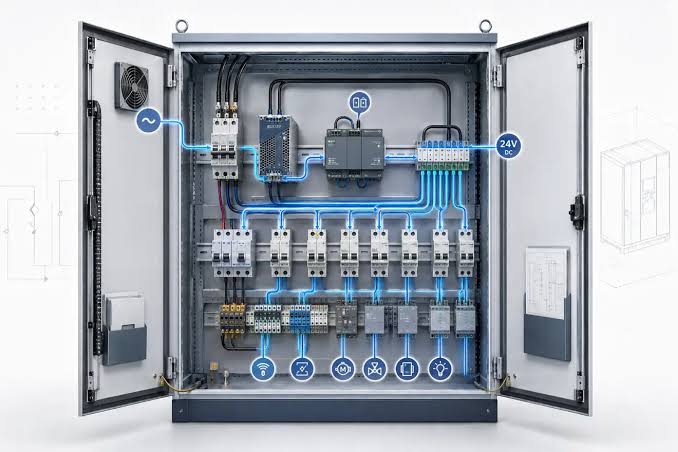
On the load side, capacitors in connected electronics must charge as the DC rail rises. Texas Instruments describes how this charging current can create a large transient demand and disturb the upstream rail. Its inrush-current application report is useful background for understanding why a running-current sum can miss the startup problem. [2]
Keep the questions separate. The electrical designer should assess AC input switching and protection for the supply itself. The controls designer should establish what the connected DC loads demand during startup and during the machine’s operating sequence.
A bench test with devices powered one at a time is not the same test as restoring power to a fully assembled cabinet. For acceptance testing, specify the sequence that matters: initial energization, a controlled restart, or simultaneous operation of the relevant loads. Record the conditions rather than just writing “tested OK”.
Protection is not a performance allowance
The NDR-120 documentation specifies constant-current limiting for overload protection, with automatic recovery after the fault condition is removed. That description should not be converted into a promise of extra regulated power for any desired duration. [1]
A useful buying question is therefore, “Does this model have a documented peak-load capability that matches our requirement?” It is more precise than asking whether the unit “has overload protection”.
When a design needs a short peak, consider the actual choices with engineering: a supply with a suitable documented peak rating, a different power rating, a revised startup sequence or separately supplied loads. None is automatically the best answer. The right choice depends on what the equipment must do and what changes the machine builder is prepared to validate.
Avoid curing an unexplained restart by simply ordering a much larger unit. Before changing hardware, establish whether the problem is load demand, distribution, a connection issue or another part of the system. An oversized replacement can obscure the original assumption without making the documentation any clearer.
Budget for the cabinet you will ship
The NDR-120’s temperature range includes derating information. That is why a published upper operating temperature should not be read as a promise of full rated power at that temperature. [1]
Its installation manual also makes mounting orientation and ventilation part of the installation conditions. Reserve the required space in the cabinet layout instead of counting only the width of the metal housing. Where project documents or revisions appear to disagree, resolve the discrepancy with the manufacturer rather than choosing the smaller clearance. [3]
For the example cabinet, the final selection record should say which ambient condition and input supply were checked, what load can operate continuously, and which startup sequence was validated. Include any planned expansion as an identified load, not a vague request for “room to grow”.
When requesting quotations for MEAN WELL power supplies, send that information alongside the part number. It helps keep a commercially convenient substitute from being mistaken for an electrically equivalent one. A buyer can compare price and availability once the engineering requirements are clear.
The most useful outcome is not a larger number on the label. It is a cabinet that starts as intended, runs within its documented limits and can be serviced without reconstructing the original design assumptions. Two power budgets are a small amount of extra work for that clarity.
Technical references
[1] MEAN WELL, NDR-120 series specification, ratings, protection and derating information. https://www.meanwell.com/Upload/PDF/NDR-120/NDR-120-SPEC.PDF
[2] Texas Instruments, Managing Inrush Current, application report SLVA670A. https://www.ti.com/lit/an/slva670a/slva670a.pdf
[3] MEAN WELL, NDR DIN Rail Power Supply Installation Manual. https://www.meanwell.com/Upload/PDF/NDR%20DIN%20rail.pdf







Comment