
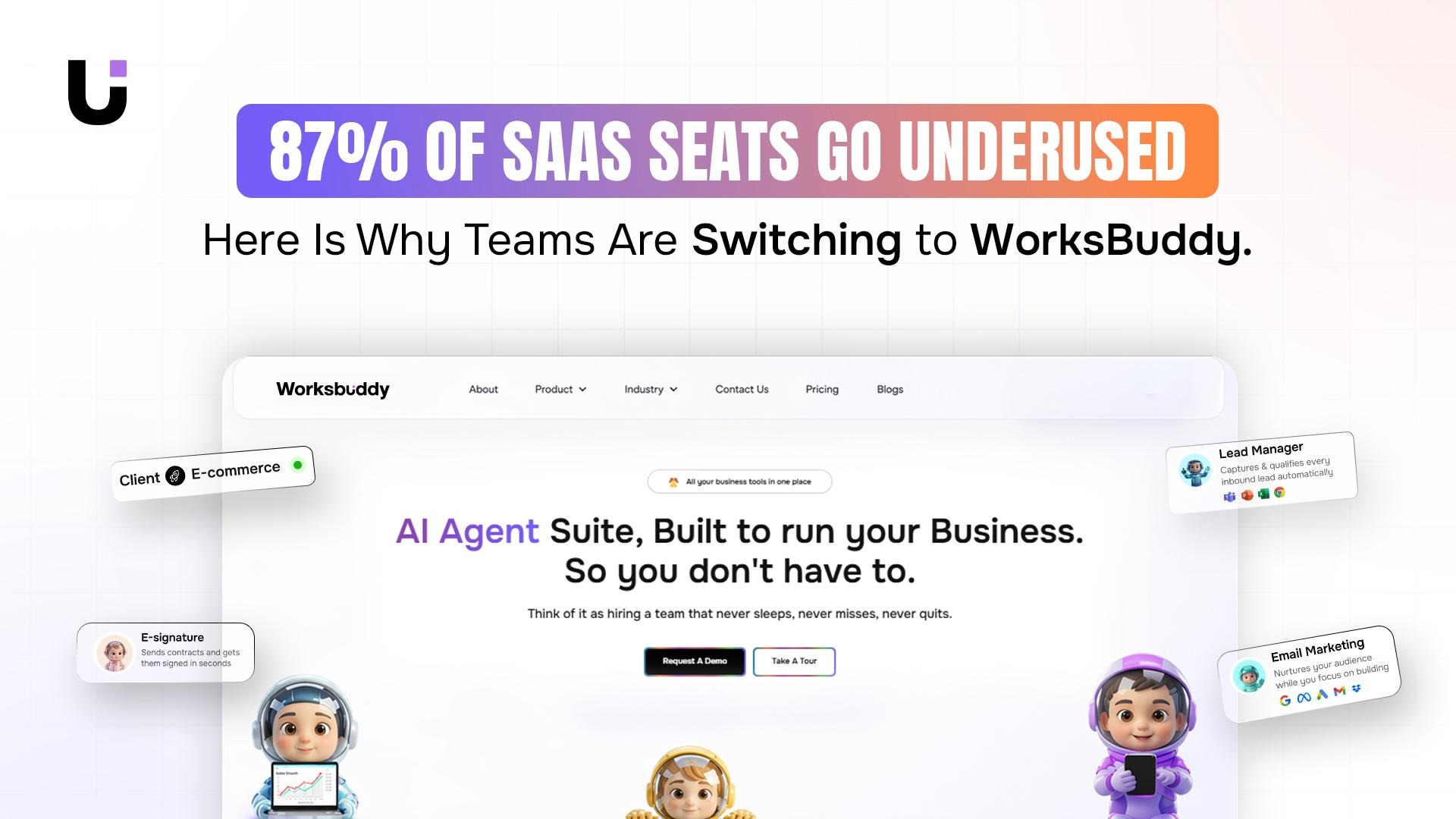
87% of SaaS Seats Go Underused. Here Is Why Teams Are Switching to WorksBuddy.

You are probably paying for software your team barely touches. Nearly 87% of paid SaaS seats go underused in any given month. That is not a technology problem. It is a fundamental flaw in how the SaaS model was designed.
The SaaS Model Was Built for Access, Not Outcomes
The promise of SaaS was straightforward: subscribe to powerful software and run your business more efficiently. For a decade, it delivered. SaaS made enterprise-grade tools accessible to companies of every size.
But as businesses stacked more tools to cover more functions, the operational overhead grew with them. Every new platform needed a login, training, and a workflow built around it. Data lived in silos. Teams switched between applications constantly.
The average employee switches between applications over 1,100 times a day. Teams spend nearly 60% of their time on administrative overhead including status updates, data entry, and manual handoffs rather than on work that actually moves the business forward.
Businesses were not failing to use their tools. They were drowning in them.
The Real Cost of a Fragmented Stack
The 87% underutilization figure represents direct financial waste. But the deeper cost is operational.
Every disconnected tool creates a gap. A lead arrives in one platform, gets scored manually, transferred to another, assigned in a third, invoiced in a fourth, and followed up through a fifth. Each transition is a point where context gets lost, delays accumulate, and work falls through the cracks.
Employees spend an average of 520 hours per year on tasks that could be automated with technology already available to them. For growing teams operating with limited headcount, this overhead is not just inefficient. It is a structural ceiling on how far the business can scale.
The problem is not that businesses chose the wrong tools. The problem is that the SaaS model was never designed to connect them.
Why Agents as a Service Is Replacing the Tool Stack
At GTC 2026, NVIDIA CEO Jensen Huang made a statement that reframed the enterprise software conversation entirely.
“Every single SaaS company will become an AaaS company, an Agentic as a Service company.”
At CES 2025, Huang had already set the direction: “AI agents are the new digital workforce. The IT department of every company is going to be the HR department of AI agents in the future.”
The distinction is fundamental. SaaS sells access to tools. AaaS delivers outcomes through autonomous agents. Under the SaaS model, a human logs into a CRM, updates records, scores leads, and schedules follow-ups manually. Under the AaaS model, an AI agent handles all of that. The human steps in only when judgment or relationships are required.
The human role does not disappear. It moves up the value chain.
How WorksBuddy Is Built Around This Model
WorksBuddy is an AI agent platform built on the AaaS model from the ground up. It delivers six purpose-built agents, each covering a specific business function, connected in one unified platform with a shared data layer. Plans are available for teams of every size with a free plan included and no credit card required. See full plan details at worksbuddy.ai/pricing.
Lio covers lead management and CRM. It captures, scores, and qualifies leads using AI-powered intent signals so sales teams always know who to call first.
Taro covers task and project management. It manages sprints, tracks dependencies, and uses AI risk prediction to surface deadline risks before they become missed deadlines.
Inzo covers invoicing and billing. It generates invoices automatically, sends payment reminders on schedule, and forecasts cash flow in real time.
Sigi covers e-signatures and contracts. It manages document signing workflows, detects contract risks through AI clause analysis, and triggers billing in Inzo the moment a contract is completed.
Evox covers email marketing. It generates campaign content using AI, runs A/B tests, and optimizes send times per recipient segment.
Revo covers workflow automation. It connects all six agents and integrates with external tools, automating the handoffs between every business function without requiring code.
Because every agent runs on a shared data layer, actions in one agent automatically inform the others. When a lead closes in Lio, Revo triggers an onboarding task in Taro, a contract in Sigi, and an invoice in Inzo. No one moves data manually.
What Makes WorksBuddy More Accessible Than the Tools It Replaces
The average SaaS stack covering CRM, project management, invoicing, e-signatures, and email marketing costs upward of $200 to $400 per user per month. Businesses waste an average of 30% of that budget on tools that overlap or go unused.
WorksBuddy changes that with a model built for accessibility:
- Each AI agent is priced at just $5
- Four plans available including Free, Core, Pro, and Business
- No separate integrations, no middleware, no hidden costs
- Free plan available with no credit card required
The value is not just in what WorksBuddy costs. It is in what it replaces.
The Founder’s Perspective
Rampawan Kumar Singla, CEO and Founder of WorksBuddy, built the platform around a straightforward observation about how growing businesses actually fail.
“Most growing businesses do not fail because of a bad product or a weak market. They fail because their operations cannot keep up with their growth. They are spending more time managing tools than serving customers, and no single SaaS subscription fixes that. We built WorksBuddy because we believe every business deserves an AI team that handles the operational work so the human team can focus on what actually builds the business.”
What Businesses Are Getting Wrong About AI Adoption
A common mistake is treating AI as a feature upgrade rather than a model change. Adding an AI assistant to a CRM, an AI writer to an email tool, and an AI scheduler to a calendar does not solve the coordination problem. It just makes individual tasks slightly faster while the gaps between disconnected tools remain exactly as they were.
The businesses seeing real operational improvements have moved to a connected agent model. The agents coordinate. The data flows. The gaps close.
Conclusion
The 87% SaaS underutilization figure is not a minor inefficiency to optimize around. It is a systemic signal that the model has reached its limits for businesses that need execution, not just access.
Jensen Huang’s prediction that every SaaS company will become an AaaS company is not a distant forecast. The transition is already underway and the businesses moving early are building operational advantages that will compound over time.
WorksBuddy is built for this moment, not as another tool to add to the stack, but as an AI agent platform that replaces the stack and delivers the outcomes that a collection of disconnected subscriptions never could.






Comment