
3D Animation Calgary: How Alberta Firms Explain Products

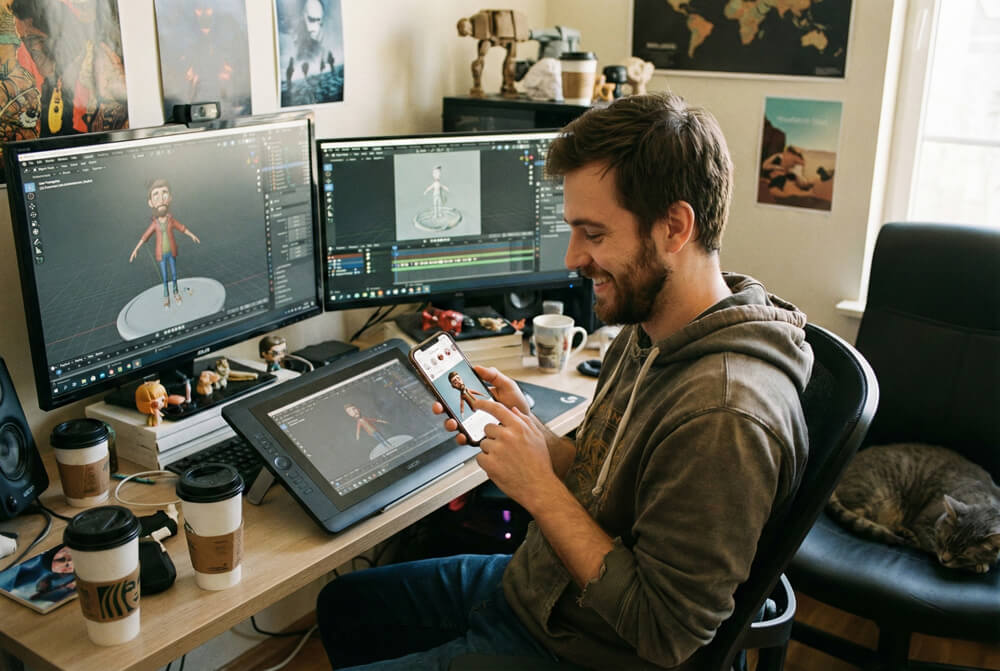
How Calgary Companies Use 3D Animation to Explain Complex Products
Calgary is home to some of the most technical work in Canada. Energy producers, oilfield service companies, engineering firms, manufacturers and a growing cleantech sector all have the same problem: their products work in places nobody can see. A tool runs thousands of metres underground, a process happens inside a sealed vessel, or a prototype exists only as engineering drawings.
Photos can’t show it, and slide decks full of diagrams lose people within minutes. That’s why more Alberta companies are turning to 3D animation to explain what they do, quickly and clearly.
This guide covers where 3D animation pays off for Calgary businesses, how a project works, and what to look for when you hire a studio.
Why Technical Industries Need 3D Animation
Most marketing videos sell a feeling. Technical companies need to sell understanding. A buyer, investor or safety officer has to grasp how something works before they’ll trust it.
3D animation does what live-action filming can’t:
It shows the invisible. Cutaways can reveal what happens inside a wellbore, a pump, a valve or a pipeline.
It shows products that don’t exist yet. You can show a design still in development using CAD files, drawings or spec sheets.
It controls time and scale. You can slow down a split-second reaction or compress a process that takes weeks.
It’s safe. You can show a hazardous situation, a failure or an emergency response without putting anyone at risk.
It’s reusable. One set of 3D models can feed videos, still renders, brochures, websites, social posts and trade-show screens for years.
Where Alberta Companies Use 3D Animation
Oil and Gas and Energy
Calgary’s energy sector has used animation for years, and for good reason. Common projects include:
Downhole tool animations showing how a tool deploys, engages and returns
Explainers for drilling, completion and production processes
SAGD (steam-assisted gravity drainage) and fracking visualizations
Pipeline routes, flow and integrity animations
Trade-show loops that draw people to a booth from across the hall
A 30-second animation can explain what a sales engineer might need ten minutes and a whiteboard to cover.
Industrial and Manufacturing
Alberta manufacturers use animation for machinery walk-throughs, assembly sequences and “how it works” videos built straight from existing CAD files. These clips also work well for operator training, because a new hire can watch a procedure step by step before touching the equipment.
Engineering and Cleantech
Startups and engineering teams often need to raise money or win pilot projects before a physical prototype exists. Turning a concept into realistic renders lets investors see the product rather than imagine it. For Alberta companies working in carbon capture, hydrogen, geothermal or emissions reduction, that visual credibility can make a real difference in a pitch meeting.
Commercial Brands
3D isn’t only for heavy industry. Consumer and retail brands use it for product visualizations, packaging shots (clean renders of the product and its packaging) and broadcast-ready commercials. Because the product is digital, you can change colours, labels or angles without a new photo shoot.
Simulations: Fire, Smoke, Liquid and Particles
Some of the most valuable work for Alberta industries uses physics-based simulation rather than hand-made animation. Simulated effects behave the way the real thing does:
Fire and smoke: combustion, flares, ignition and gas flow
Liquids and fluids: pouring, mixing and process flow with realistic thickness and light refraction
Rigid and soft bodies: collisions, fractures, cloth and structural failure
Particles: sparks, dust, debris and abstract motion effects
When you need to explain how a fluid moves through a system or how a material reacts under stress, a simulation is far more convincing than a simplified diagram.
How a 3D Animation Project Works
A professional studio follows a set process, so you know what to expect at each stage:
Storyboard. The team maps the structure, message and order of shots. This is the most important stage, because changes here are cheap and changes later aren’t.
Modeling. Custom 3D models of the product, equipment and environment are built, often from your CAD data.
Animation. The models are brought to life, either keyframed by hand or driven by real-world physics.
Lighting and texturing. Materials, surfaces and lighting are added to make the scene look realistic.
Rendering. Final frames are produced with engines such as Octane, Redshift or Arnold.
Post-production. Colour correction, transitions, 2D graphics, lower thirds (on-screen captions and labels) and final polish are added before delivery.
Calgary-based studios such as Dante Art Studio’s 3D animation team
run this whole process in-house, which keeps feedback loops short and gives you a single point of contact.
How Long Should Your Animation Be?
Length should match where the video will be used:
Technical explainers: usually 30–90 seconds
Product reveals and logo intros: usually 10–20 seconds
Trade-show loops: short, readable without sound, and built to repeat seamlessly
Website hero videos: short, light and looping
Investor decks: focused on one clear “aha” moment
A good studio will suggest a length at the storyboard stage rather than padding the video.
What Does 3D Animation Cost in Calgary?
There’s no honest flat price, because cost depends on scope. The main factors are:
How many shots and how long the finished video is
How complex the models are, and whether you can supply CAD files
Whether simulations such as fluids, fire or particles are needed
How much rendering is required and how realistic it needs to look
How tight your deadline is
The best approach is a short consultation where you explain your goal, audience and deadline, then get a quote scoped to your project. Be wary of anyone who quotes a fixed price without asking those questions.
How to Choose a 3D Animation Studio in Calgary
Before you sign, check for:
Technical understanding. Can they talk about your process, not just about visuals? Energy and engineering work needs a studio that asks the right questions.
A relevant portfolio. Look for industrial, product and process work, not just character animation.
Simulation skills. If your story involves flow, combustion or stress, make sure they’ve done it before.
A clear process. You should know when you’ll review the storyboard, models and early animation.
A local presence. A Calgary-based team understands Alberta industries and can meet in person when it matters. Many also work remotely with clients across Canada and abroad.
Reusable files. Ask whether you’ll be able to use the 3D models and renders for future marketing.
Getting Started
Before contacting a studio, prepare four things:
The product or process you want to explain
The goal: sales, investors, training, trade show or marketing
The audience: engineers, executives, operators or the general public
Your deadline
With those in hand, a studio can quickly recommend the right approach. For example, Dante Art Studio, a 3D animation studio in Calgary, offers free consultations and has served Alberta’s energy, industrial and commercial sectors for about 20 years.
Final Thoughts
Alberta builds complex things, and complex things are hard to sell with words alone. Whether you’re launching a downhole tool, pitching a cleantech prototype, training operators or standing out at a Calgary trade show, 3D animation turns hard-to-explain ideas into something your audience understands in seconds. Made well, it’s one of the most reusable marketing investments a technical company can make.





Comment