
Every Strong Text Has a Blueprint Behind It

How reverse-engineering competitor pages helps you write more persuasively and gives AI the right corpus before it starts drawing conclusions.
Very often, a strong text looks simple. It looks like an author sat down, worded his thoughts, and every sentence hit the target.
However, the authors often perform many steps between the initial idea and the final version. For example: how to start, which opener to use, where to place an example, where to provide facts, where to leave readers with an open question, etc.
To understand this underlying structure of the existing text, you can use the reverse engineering method. In software development, this term refers to a method for analyzing how a compiled app works without access to its source code. And you can use the same approach with texts: take a ready article and go backward to its draft.
Ask questions: What is the main thesis here? What hook does the author use in the first paragraph? Where does the evidence come into play? Why is the example shown after the problem, not before, etc.?
In computer science, this is called argument mining. In linguistics, such a method is called reverse outlining: when you try to extract the structure from the draft text. The terminology is different, but the idea is the same.
Text as a structure
It is more practical to begin text analysis by asking a boring question, “How does it work?” instead of “Do I like it or not?”
Here is the breakdown of the reverse outlining process:
– Thesis. The main idea that the author wants to communicate to the readers;
– Hook. This could be a question, a story, a strong assumption, statistics, or even an expression of the target audience’s pain;
– Block order. Usually, text follows this structure: problem, description, example, objection, conclusion.
– Reasoning. What the thesis is based on;
– Rhetoric. Identifying where the author builds trust, where it appeals to logic, and where it appeals to emotions;
– Transitions. How each subsequent block makes the next one necessary;
– Final action. A call to action or what the reader is encouraged to do afterward.
This review is not aimed at rewriting the text – simple copying does not produce the best texts.
But the idea is to find methods that can apply to your own topic and audience.
A regular article usually has one canonical source. A public commercial page often does not.
The same URL may return different versions when accessed from different countries: language, currency, trial periods, benefits, and even product version (offer).
So before an AI agent can reverse-engineer a competitor’s messaging, it has to answer a more basic question: which versions of this page should count as the source material?
That makes the job two-staged:
1.The Agent gathers relevant corpus of public page versions.
2.Then it reverse-engineers that corpus: it separates what stays constant from what changes, maps claims and evidence of each variant, and compares how a company speaks to different audiences.
This is where 2Extract fits. It helps to organize the first collection layer as it gives an AI Agent access to public pages through selected countries, so the Agent can retrieve the versions before it starts interpreting them.
Working with a corpus, not a single sample
Imagine we want to reconstruct how some big brand argues for the value of its premium subscription in each market. What offers it makes, and how it supports promises.
Price alone is not a full answer, but it is a visible part of the offer giving a useful starting point..
So let’s take Spotify and its premium plan as an example. To start mapping their market-facing strategy, we ask the AI agent a deliberately narrow question: How much does Spotify Premium cost?
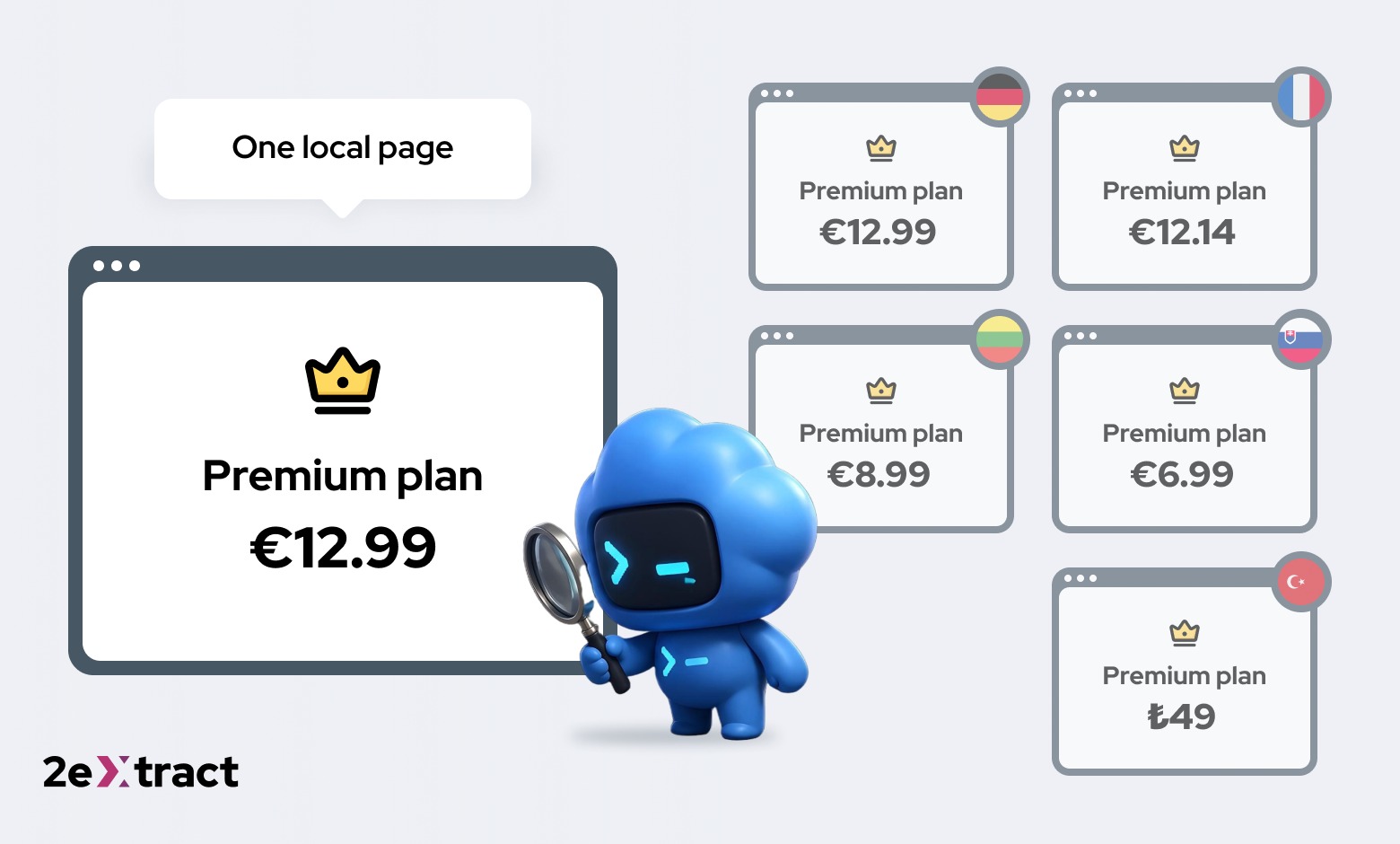
Imagine we are in Germany, and our Agent starts exploring the local page listing a specific price. The Agent will diligently reply that the cost is €12.99. While this is the actual price, it applies only to Germany.
We’ve checked Spotify Premium from various countries using 2extract proxies, and it returned a local page for each country:
Germany €12.99
France €12.14
Lithuania €8.99
Slovakia €6.99
Collected from public pages. No login, cart, checkout, or tax calculation was involved.
There is no explanation on the public pages for each country about the differences, and the content of each subscription may vary.
For example, plans for the Premium Individual subscription in the US and UK include 15 hours of audiobooks per month. In comparison, the French version shows 12 hours. The Turkish version included an additional welcome offer for ₺49 per month for the first 6 months (then a different price).
Now, having all this, we have some material for real reverse engineering of the text. It can separate static elements from local: price names, visual structure, main CTA, regular price, promo period, and other benefits. In argument mining, this could be a map of claims and evidence. Here, we add another dimension: the market in which each claim appears.
Thus, “Spotify price” stops being just a separate line in a spreadsheet. It becomes a set of observations: country, URL (after redirect), plan name, promo offer, and other visible benefits. AI can now give an accurate answer and show on which page versions it is based on.
And this is called reverse engineering of a commercial webpage, where we work not only with its wording but also with its full conditions: what is advertised, for whom, and on what terms and conditions.
What the Agent can do with 2Extract
2Extract is a residential proxy service. With 2Extract, an agent can test hypotheses on its own, open several page versions from selected countries, find local redirects, compare HTML blocks, and show results as differences along with context.
It is helpful even beyond simple pricing comparison. You can check various local offers, product pages, sign-up forms, payment methods, and text patterns that your competitor uses to address different markets. All this might not be available by simply clicking a language selector on a page.
How to provide this to AI
For a regular text, just ask it to derive the thesis, hook, argument map, and rhetorical elements. For a commercial text, add some context, and ask not to mix fact with interpretation. But in any case, avoid phrasing the task as “check the competitors’ page”, instead try to frame it as a research task:
Research a competitor’s public page across multiple countries:
- Open the original URL and identify signs of localized versions:
redirects, currencies, languages, a country selector, or different offers.
- Choose the countries to compare.
- Collect the same URL through country-specific 2extract exits.
- For every version, extract: the final URL after redirects, language,
core message, product name, price, promotion, visible benefits, CTA,
and restrictions.
- Separate the common elements from the differences.
- Do not infer the reasons for differences unless the page states them.
- Return a table of observations and a short conclusion, with a link to each version.
This is exactly what we started this text with. The Agent takes content, reconstructs its structure, and explains how it works. But it does it without treating one local version as the only one.
Start with one global competitor and one question about its offering. Give your AI access to 2extract proxies and ask it to gather several markets and compare the found versions. If the page changes, the Agent will show the evidence, not a guess, of how your competitor speaks to different users.
Over time, such checks become more than just a folder with screenshots. They form a living record of the market. An agent can revisit the same URL after some time and repeat the comparison to flag what has changed: price, offer wording, feature list, or even product availability. The team will see the full history of how the competitor talks to different markets.
This is where it links to reverse engineering. We are not asking AI to guess the intent behind a page from a single paragraph or a single local page. It gathers the relevant versions, reconstructs their structure, and says exactly what the evidence supports. In that workflow, proxies are part of the method, as they allow the Agent to obtain the material it needs for comparison.






Comment