
21D Is Transforming Full Mouth Dental Implants with AI

How a UK startup built the only end-to-end AI system in full-arch implantology, without a single outside investor, and why it’s heading to the US
When people talk about AI disrupting healthcare, the conversation usually centres on diagnostics. These are important applications. But the more overlooked opportunity is in procedural healthcare, the complex, high-cost, high-skill interventions where the bottleneck is not detection but delivery.
Full-mouth dental implant rehabilitation is exactly that kind of procedure. It is one of the most technically demanding interventions in elective medicine, requiring advanced imaging, precision surgical planning, custom-fabricated hardware, and a clinical team that can execute consistently across every case. Done well, it changes lives. Done inefficiently, it is expensive, slow, and unpredictable.
A UK company called 21D has spent four years building the AI system that makes it faster, more accurate, and more accessible for the oral surgeons who deliver it. They were recognised in The Sunday Times 100 Fastest Growing Companies two years running, 28th in 2024 and 24th in 2025. They are now bringing that system to the United States.
What the Market Looks Like, and Why It Was Ready for Disruption
The global dental implant market is large and growing fast. Full-arch rehabilitation, the specific category 21D operates in, is among its fastest-growing segments. In the UK alone, an estimated 5 million people need full-mouth rehabilitation. In the US, that figure reaches approximately 35 million. These are not people unaware the procedure exists. They are people for whom it has historically been too expensive, too slow, or too inaccessible, because the system for delivering it was built on a fragmented, manually intensive workflow that kept costs high and throughput low.
The companies that dominated the market before 21D arrived, Straumann, Glidewell, Dentsply Sirona, CHROME GuidedSMILE, all built capable products. But every one approached the problem the same way: improve one part of the workflow at a time, layer digital tools onto an existing process, leave the integrations between those tools for someone else to figure out.
21D asked a different question: what would this look like if you built the entire system from scratch, designed specifically for AI-driven automation, with every component, software, surgical guides, and implants, engineered to work together as one?
The AI System: From Scan to Surgery in a Single Morning
The 21D workflow begins where every implant procedure begins: a CBCT scan and intraoral scans of the patient. From that point, the similarities with conventional workflows end.
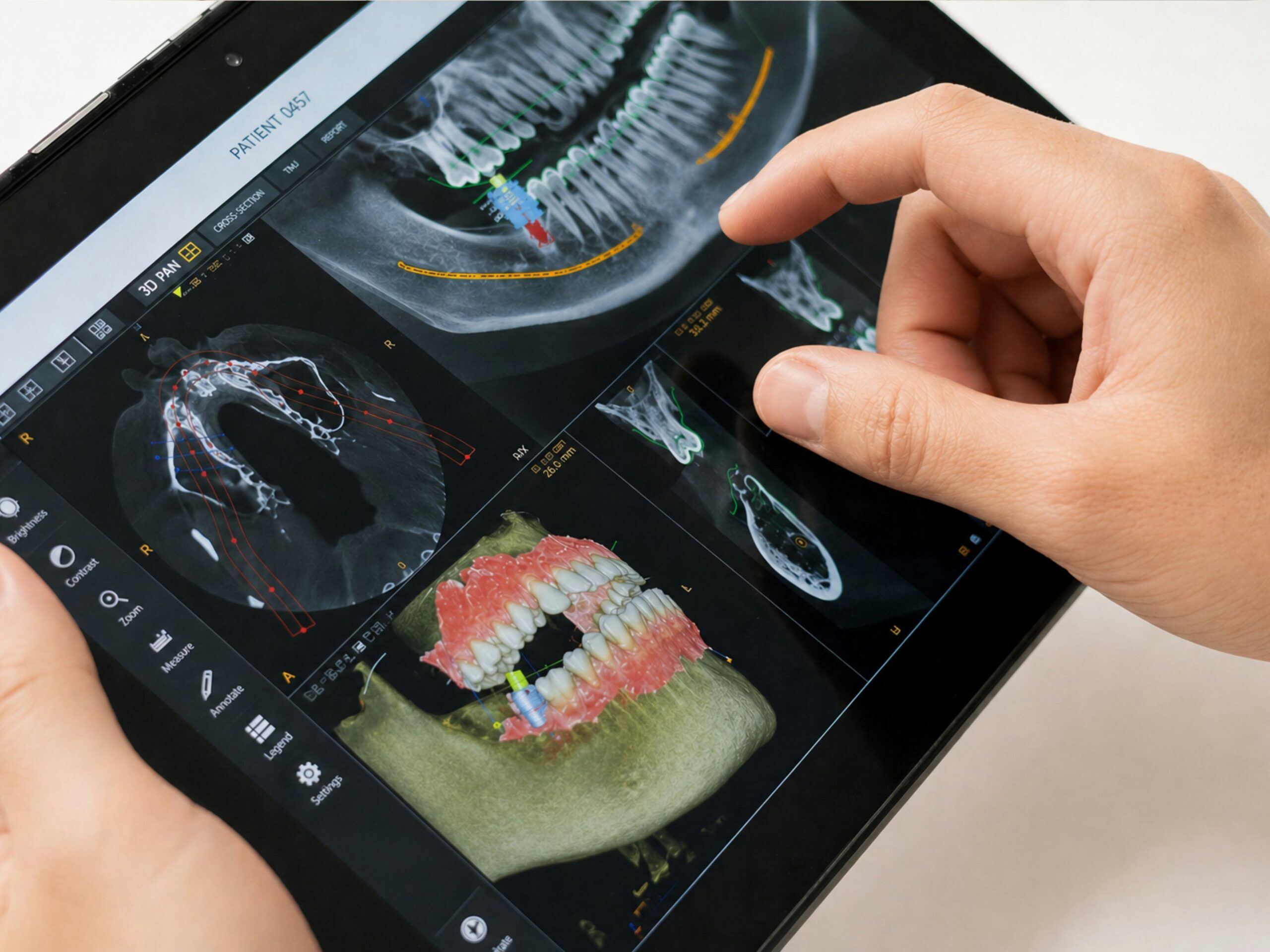
The imaging data is processed by 21D’s AI to generate a three-dimensional digital twin of the patient, a high-resolution model capturing bone structure, nerve pathways, ridge geometry, and soft tissue anatomy. The AI then automates the steps that in a conventional workflow require manual input from a planning technician, often taking hours: nerve mapping, data alignment, bone volume analysis. All of it runs without human intervention.
Then comes the genuinely distinctive element. Rather than planning implant placement based on where the anatomy allows, 21D’s AI starts with where the patient’s final teeth need to be for the best possible aesthetic and functional outcome. It calculates that ideal prosthetic position first, then determines the exact implant positions required to achieve it, working backwards from outcome to anatomy, not the other way around. The Academy of Osseointegration has noted that this kind of end-to-end AI integration is precisely what the field needs to realise its clinical potential.
The result is a surgical plan accurate to within 100 microns, approximately the width of a human hair, produced at roughly ten times the speed of manual planning. That plan is translated directly into 3D-printed surgical guides generated within the same system, with no external lab and no translation layer between digital plan and physical guide.
And uniquely, the implants used in the procedure are manufactured by 21D itself. Every other major system builds its planning software on top of third-party implant hardware. 21D designed its implants as part of the same integrated system, meaning the biomechanical tolerances of the implant, the guide, and the AI plan are all aligned by design, not by approximation. The entire workflow is approximately 98% automated and patent-pending.
Why Proprietary Hardware Creates a Moat Competitors Cannot Easily Cross
The decision to manufacture proprietary implants is the element of 21D’s strategy that is hardest to replicate and easiest to underestimate. Competitors like Straumann, Glidewell, and CHROME GuidedSMILE have all built sophisticated digital workflow tools, but they sit on top of implant hardware that was not designed to be part of an AI-automated system.
When the implant is designed as part of the same system as the AI plan and the surgical guide, the tolerances are aligned by intent rather than accommodation. A software-only competitor can attempt to copy the planning workflow. They cannot copy the proprietary implant without years of development and regulatory work. The moat is real, and it is physical as much as it is digital.
For the oral surgeons adopting the system, currently the primary customers, and the gateway through which patients access 21D’s treatment, this translates into a level of outcome predictability that platform-only systems cannot match. The AAID and AAOMS both emphasise predictability and accuracy as the cornerstones of successful implant outcomes. 21D’s integrated hardware-software system directly addresses both.
The Business Model: Owned Media as a Patient Pipeline
Beyond the technology, 21D has built something else competitors cannot quickly replicate: a patient acquisition engine independent of paid advertising. The company has grown an audience of over 500,000 YouTube subscribers and 30,000 Facebook group members, people actively researching full-arch rehabilitation, moving through a consideration journey that ends at a clinic using the 21D system.
This owned media asset generates consistent inbound demand at a fraction of the cost of paid acquisition. Unlike paid advertising, it compounds over time. For the oral surgeons and implant clinics that adopt 21D’s system, this is part of the commercial case for switching. They are not just adopting a better clinical tool, they are connecting to a patient pipeline that runs independently of their own marketing spend.
What the US Expansion Means
21D’s entry into the US market brings a validated, commercially proven system to one of the world’s largest full-arch rehabilitation markets. The competitive landscape they are entering, dominated by the same established players who held the UK market before 21D arrived, has not yet produced an equivalent end-to-end AI solution. The window for a genuinely differentiated entrant is open.
For oral surgeons in the US evaluating full-arch workflow systems, 21D is the only platform that combines fully autonomous end-to-end AI planning, aesthetics-first reverse-engineered implant positioning, proprietary implants, and integrated guide fabrication in a single system. Surgeons can also review the complete process and frequently asked clinical questions directly on the 21D website.






Comment