
No Room for “Close Enough”: YP-MFG on the Four Hidden Bars Behind the iPhone Duo Hinge Story

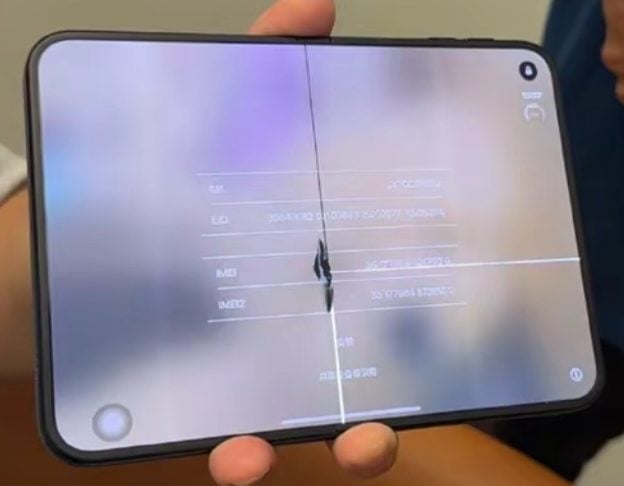
On October 24, 2026 ,iPhone Duo’s first day on sale — photos of cracked inner screens near the hinge began appearing on social media. One Australian user said he heard “the crack” after fewer than 20 folds. Apple has not confirmed a widespread defect, and the root cause is still undetermined. But the incident has pushed a problem that usually lives hidden inside the device into the spotlight: the foldable hinge is the hardest precision structural component in consumer electronics.
What public reporting shows
According to user reports relayed by MacRumors, most screen failures cluster near the hinge, commonly appearing as a bright line on one side of the display. The Australian user described feeling “something under the inner screen near the hinge” during folding, followed by an audible cracking sound — while both the screen surface and the external hinge showed no visible damage. He received a replacement unit at the Apple Store the same day.
The second clue comes from durability testing. Digital reviewer JerryRigEverything’s test video showed that the iPhone Duo, rated IP68, let large amounts of dust enter the body through multiple hinge gaps during the dust test — dust that eventually invaded the folding mechanism and disabled the magnets holding the device closed. In the reverse-bend test, the mid-frame deformed, and the 7.6-inch inner screen developed a permanent green line and lost touch response.
To be clear: these are individual user cases and third-party tests. Apple has not publicly confirmed any widespread hardware defect, and some reviewers’ repeated-folding tests produced no cracks — only wear after thousands of cycles. The cause remains under I haven’t seen any updates on that order for a long timeinvestigation. But the pattern itself already says enough: every failure concentrates on the
A hinge is not “one part” — it’s a stack of tolerances
A folding hinge is typically assembled from dozens of miniature parts: gears, damper plates, slide rails, limit blocks, cover plates, seals. Together they determine the trajectory the screen follows when folded.
Here’s a commonly misunderstood point: precision is not just “making every part as accurate as possible.” Say every part is held to ±0.01 mm. Twenty parts stacked linearly, and in the worst case the accumulated error reaches the ±0.2 mm level — while the step-height the screen’s crease zone can tolerate is often only on the order of 0.05 mm.
So the real capability is not “can we hold ±0.01,” but “do we know which dimensions to tighten and which to relax.” That is tolerance stack-up analysis, and it happens at the drawing stage — not next to the machine.
In Bao’an, Shenzhen, YP-MFG (Shenzhen Yaopeng Metal Products Co., Ltd.), which makes precision structural parts, is no stranger to this kind of problem. The factory started with rapid prototyping in 2005 and now operates 3,500 m² of owned factory space with 180+ machines and 90+ engineers and technicians, supplying custom parts to consumer electronics, robotics, automotive and medical industries on a long-term basis. In the folding-structure inquiries it receives, the most common request is not “make the precision even higher” — it’s “help us run the tolerance chain.”

Why dust gets in: the gaps are designed
IP68 is a whole-device dust-and-water rating under specific conditions; it does not mean “no gap will ever admit dust.” The hinge is the only opening on the device that must move relative to itself, and dust protection relies on three design layers: mating-gap control (typically on the 0.02–0.05 mm order), labyrinth structures (making dust travel a longer path), and the absorbing action of lubricating grease.
Of these three, the first two are purely machining and assembly problems. If the gap is too large, dust goes straight through; if too small, folding resistance rises and wear accelerates. Finding the right value between the two comes down to part consistency — across a hundred pieces in one batch, gap variation must stay small enough, or the design values look beautiful on paper but don’t hold up in assembly.
This also explains why “dust jams the magnetic latch” is usually not the fault of any single part, but batch inconsistency exposed after long-term use.
Why the mid-frame deforms under pressure
Reverse bending that deforms the mid-frame and produces green lines on the inner screen is a textbook symptom of insufficient structural stiffness. A foldable’s mid-frame must balance “thin” against “rigid”: wall thickness, rib layout, material choice (6061 or 7075 aluminum, titanium, magnesium), plus heat treatment and surface treatment — every one of these affects final stiffness.
One easily overlooked detail: anodizing changes part dimensions and introduces surface stress. If the dimensional compensation before and after anodizing is not done right, the preload in assembly drifts from the design value. Such deviations are invisible on a single part — but once assembled into the finished device, they become “this one spot always fails first.”
Three things that often get skipped
First, DFM review. Can a 0.4 mm wall thickness be machined? Will it deform after machining? Does the structure need to change? Asked at the drawing stage, these questions cost nothing; asked after mass production, they cost entire mold batches and lead times.
Second, inspection methods. A caliper can’t measure step-height deviation; a visual check can’t see flatness. CMM, step-height gauges, optical scanning, plus fold-life test benches — that’s what turns “looks fine” into “proven fine in the data.” YP-MFG’s approach is to run prototyping and production under one shared set of process documents and inspection standards, with CMM confirming dimensions batch by batch.
Third, assembly stress. Screw torque, adhesive dispensing volume, pressing sequence — all of these reshape the internal stress distribution of parts after assembly. Many “cracked after a few uses” cases are rooted not in the part, but in the assembly.
What this means for procurement
Foldables have pushed the point of reliability verification forward as a whole: problems once found only at the finished-device stage must now be predicted at the parts stage. Accordingly, the criteria for selecting suppliers have changed too.
There are really only four questions to ask: who runs the tolerance chain (sales or engineers)? What does the inspection report look like (does it have CMM data)? Where is surface treatment done (in-house or outsourced)? And how is confidentiality enforced (NDA and drawing permissions)? The answers to these four predict whether a project will collapse at mass production far better than a quote sheet does.
The last one matters especially in folding projects: the hinge structure is itself the product’s most closely guarded secret. YP-MFG signs NDAs on request and moves drawings through controlled workflows — in projects like these, such arrangements are not a plus; they’re the entry ticket.
Conclusion
0.05 mm is just a number on a drawing — in a user’s hand, it’s a “crack.” Foldables magnify this gap: they leave no room for “close enough.”
About YP-MFG
YP-MFG is the global brand of Shenzhen Yaopeng Metal Products Co., Ltd., focused on precision custom parts manufacturing since 2005. The company operates a 3,500 m² owned production base in Bao’an, Shenzhen, equipped with 180+ machines and 90+ engineers and technicians, providing one-stop services in CNC machining, sheet metal fabrication, die casting, vacuum casting, 3D printing, surface treatment and assembly. ISO 9001:2015 certified and run to IATF 16949 practices, it serves 10,000+ customers across North America, Europe, Asia-Pacific, Latin America and Australia with a 98.7% on-time delivery rate.
Company Information
Company –YPMFG
Contact Person – garson
Email – [email protected]
Phone – +86 134 2340 4327
Address – shenzhen , guangdong, China
Website – https://ypmfg.com/







Comment