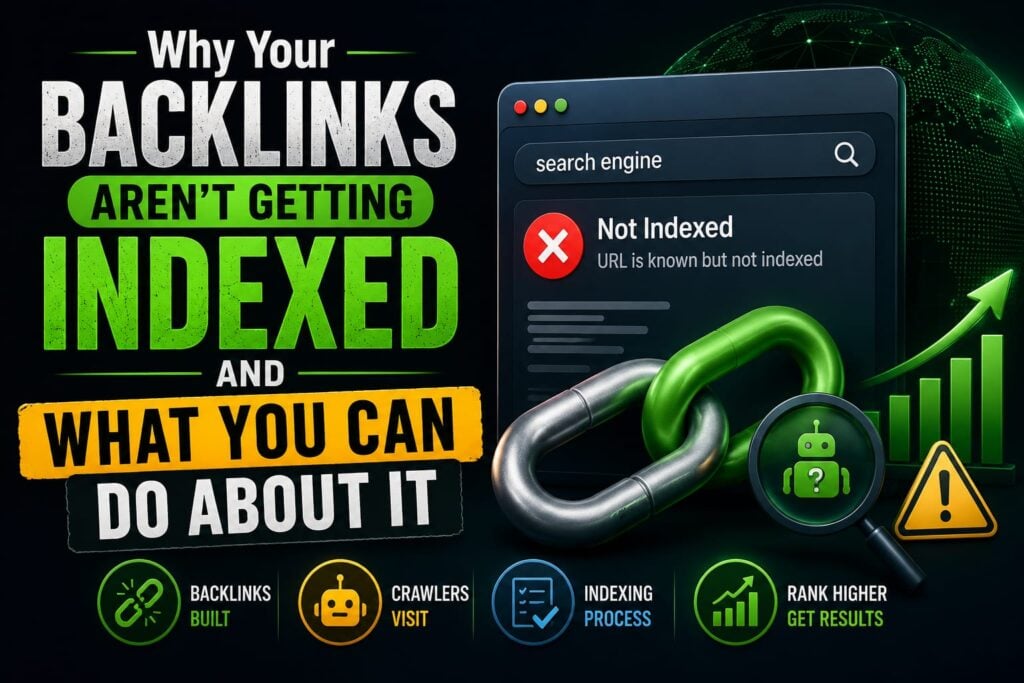
Building backlinks is still an important part of an SEO strategy, but getting a link published is only one part of the process. A backlink can be live on a referring website and still take time to be discovered, crawled, and potentially indexed by search engines. This is why seeing a newly published link does not necessarily mean that search engines have already processed it.
The delay can be frustrating, particularly when an SEO campaign involves a large number of newly created backlinks. However, slow discovery does not always mean that a link is broken or ineffective. Factors such as the referring page’s crawlability, internal linking structure, technical configuration, content quality, and overall discoverability can influence how quickly search engines encounter a URL.
Understanding what happens between publishing a backlink and its potential appearance in search systems makes the problem much easier to diagnose. Instead of simply creating more links and waiting, website owners can identify barriers to discovery, improve the accessibility of referring pages, monitor important URLs, and use appropriate tools when managing backlinks at scale.
This guide explains why backlinks may take time to be discovered, how crawling and indexing differ, how to diagnose common problems, and what a practical backlink indexing workflow can look like.
What Does It Actually Mean When a Backlink Isn’t Indexed?
When people say that a backlink “isn’t indexed,” they may actually be describing several different situations. A backlink can be published and visible to users while the search engine has not yet discovered the page containing it. In another case, the page may have been crawled but not included in the search index. Understanding these distinctions is important before trying to fix an indexing problem.
A live backlink simply means that the link currently exists on a referring webpage and can be accessed by visitors. That does not necessarily tell us whether a search engine has discovered or processed the page.
Discovery happens when a search engine becomes aware of a URL. This can happen through links, sitemaps, previously known pages, or other signals. Once a URL is discovered, a crawler may request and analyze its content.
Crawling is the process of fetching and processing the webpage. During this stage, search engines can evaluate the page’s content, links, technical signals, and accessibility.
Indexing is a separate decision and process. A page that has been crawled is not automatically guaranteed a place in a search index. Search engines determine which content they consider appropriate to include based on numerous signals.
This means a backlink can be perfectly valid from a user’s perspective while the referring page is still waiting to be discovered, crawled, or potentially indexed. Therefore, diagnosing an unindexed backlink requires looking beyond the link itself and examining the page where that link is located.
Why Are Some Backlinks Not Getting Indexed?
A backlink can remain undiscovered or unindexed for many different reasons, and there is rarely a single explanation that applies to every website. The most useful approach is to examine the referring page, its technical setup, and how easily search engines can reach it.
The Referring Page Hasn’t Been Discovered
Before a search engine can evaluate a backlink, it first needs to find the page containing that link. A newly published page with few connections to the rest of a website may take longer to enter a crawler’s discovery path.
This is particularly relevant when a page is not included in useful internal navigation or has few links pointing toward it. Publishing a URL does not automatically mean that a search engine will immediately visit it.
The Page Isn’t Crawled Frequently
Search engines continually decide which URLs to crawl and when to revisit them. Established websites with frequently updated content may provide more regular discovery opportunities, while newer or less active pages may not be revisited as often.
This does not mean that a backlink on a smaller website has no value. It simply means that the timing of discovery can vary considerably between different referring pages.
Weak Internal Linking
Internal links help connect individual pages within a website. When an article is properly connected to relevant categories, navigation elements, or other useful pages, crawlers have more pathways through which they can reach it.
An isolated article, on the other hand, can be harder to discover. This is why the structure of the referring website can matter just as much as the backlink itself when investigating delayed discovery.
Technical Indexing Restrictions
Technical settings can prevent or complicate the processing of a page. Examples include accidental noindex directives, inaccessible URLs, problematic redirects, incorrect canonical signals, or restrictions that interfere with crawling.
These issues should be checked before assuming that a backlink indexing problem requires an external solution. If the referring page itself cannot be properly accessed or processed, simply waiting longer may not resolve the underlying issue.
Low-Value or Thin Referring Pages
Search engines do not necessarily treat every discovered URL in the same way. Pages with little original value, very limited content, excessive duplication, or weak overall usefulness may receive less attention than pages that provide meaningful information to users.
For link builders, this highlights an important principle: creating a large number of backlinks is not enough. The quality, relevance, accessibility, and context of the pages hosting those links also deserve attention.
Search Engines Don’t Index Every Page They Crawl
One of the most important distinctions in SEO is that crawling does not guarantee indexing. A search engine can access a URL, process its content, and still decide not to include that page in its search index.
Consequently, an SEO professional should not interpret every indexing delay as a technical failure. Some situations require a technical fix, while others simply require better page quality, stronger discoverability, or additional time for search engines to process the URL.
Crawling vs. Discovery vs. Indexing: Why the Difference Matters
The terms discovery, crawling, and indexing are often used interchangeably, but they describe different stages of how search engines process web content. Understanding the distinction can help SEO professionals identify where a backlink-related problem may actually be occurring.
Discovery is the starting point. A search engine first needs to become aware that a URL exists. Links from other pages, internal links, XML sitemaps, and other signals can help search engines find new URLs.
Crawling happens when a search engine crawler accesses the discovered URL and retrieves its content. At this stage, the crawler can examine the page, follow available links, and process technical signals that affect how the content can be handled.
Indexing comes after these processes and involves evaluating whether the content should be included in a search engine’s index. Being crawled does not automatically mean that a page will be indexed. Search engines consider many factors when deciding how to handle individual URLs.
A simple way to visualize the process is:
Published URL → Discovered → Crawled → Processed → Potentially Indexed
This distinction is particularly important when evaluating backlinks. A link may be publicly visible while the page containing it has not yet been discovered. Similarly, a page can be crawled without ultimately being included in the index.
For that reason, the goal should not be to treat every indexing delay as a failure. Instead, SEO teams should determine which stage of the process is causing the delay and address the factors they can actually control. This leads to a more realistic and sustainable approach to backlink management.
How to Check Why a Backlink Isn’t Being Discovered
Before trying to accelerate the indexing process, it is useful to determine whether there is an actual problem with the backlink or simply a normal delay in discovery. A systematic check can prevent SEO teams from wasting time on links that are already functioning as expected.
1. Verify That the Backlink Is Still Live
Start by visiting the referring page and confirming that the backlink still exists. Check that the link points to the intended destination and that it is not returning an error or redirecting somewhere unexpected.
Backlinks can sometimes be removed, edited, or replaced after publication, so verifying the actual page is an essential first step.
2. Check Whether the Referring URL Is Accessible
The page containing the backlink should be accessible to users and search engine crawlers. Look for server errors, broken URLs, unexpected redirects, or other technical problems that could prevent the page from being properly retrieved.
If the referring page itself cannot be accessed reliably, there is little reason to focus on indexing the backlink before resolving that issue.
3. Review Indexing and Crawling Signals
Technical directives can influence how search engines handle a page. Check for accidental noindex instructions, inappropriate canonical settings, or crawling restrictions that may interfere with normal processing.
These checks are especially important when a page was recently migrated, redesigned, or published through a new content system.
4. Examine Internal Links
Look at how the referring page connects to the rest of its website. Is it linked from a relevant category, another article, navigation element, or other useful page?
A page that is completely isolated may have fewer discovery paths than one that is naturally integrated into the site’s structure.
5. Evaluate the Page’s Content and Relevance
Consider whether the referring page provides useful information and has a clear purpose for visitors. Content that is highly repetitive, extremely thin, or created primarily to host links may not receive the same treatment as a useful editorial page.
The surrounding context matters too. A relevant backlink placed naturally within useful content is generally a more sensible SEO asset than a link that appears disconnected from the topic.
6. Give the URL Enough Time
Not every newly published backlink needs an immediate intervention. Search engines process an enormous number of URLs, and discovery and indexing timelines can vary.
After checking the technical and content-related factors, allow reasonable time for the search engine to encounter and process the page. If a large campaign contains many URLs, ongoing monitoring can help identify which pages require further attention.
How to Improve Backlink Discovery Naturally
Once the cause of delayed discovery has been identified, the next step is to improve the conditions that allow search engines to find and process referring pages. There is no universal method that guarantees immediate indexing, but several practical SEO practices can make important pages easier to discover and maintain.
Strengthen Internal Linking
Internal links create pathways between pages on a website. Linking a newly published article from relevant, established pages can make the content easier for both users and crawlers to reach.
The goal should be logical navigation rather than adding links simply for the sake of increasing link counts. A contextual internal link that helps users understand related information is generally more useful than a collection of unrelated links.
Publish Backlinks on Useful, Relevant Pages
The page containing a backlink should have a genuine purpose beyond hosting the link. Relevant, informative content gives the referring URL more value and creates a stronger context around the link.
This is why backlink acquisition should focus on the quality and relevance of the referring page rather than treating every placement as equivalent.
Maintain a Crawl-Friendly Site Structure
A clear website architecture helps search engines move between related pages. Important content should not be buried behind unnecessary navigation layers or left completely disconnected from the rest of the site.
Categories, contextual links, navigation elements, and other appropriate pathways can help create a more coherent structure.
Keep Technical Signals Clean
Technical problems can interfere with how URLs are processed. Regularly checking for broken pages, unexpected redirects, incorrect canonical signals, accidental noindex directives, and other accessibility issues can eliminate avoidable barriers.
Technical SEO does not guarantee indexing, but it can prevent a website from creating unnecessary obstacles for crawlers.
Monitor Important Backlinks After Publication
Backlink management should continue after a link goes live. Periodically checking important referring URLs can reveal whether a page has disappeared, changed, become inaccessible, or otherwise stopped serving its intended purpose.
For larger campaigns, monitoring becomes particularly useful because manually checking every URL can quickly become impractical.
Focus on Quality Instead of Volume
Creating more backlinks is not necessarily the answer to slow discovery. A smaller set of relevant, useful, and accessible referring pages can provide a more sustainable foundation than producing large numbers of low-value placements.
Ultimately, improving backlink discovery is about creating a healthy environment for search engines to find and process useful content—not trying to force every URL into an index immediately.
Does an Indexed Backlink Automatically Improve Rankings?
Getting a backlink discovered or indexed should not be confused with earning an immediate improvement in search rankings. Indexing is one part of how search engines process web content, while ranking depends on a much broader set of signals and evaluations.
A backlink can be successfully discovered and the page containing it can become part of a search engine’s index, but that alone does not guarantee that the destination website will move higher in search results. The relevance and usefulness of the referring page, the context surrounding the link, the quality of the content, and the overall authority and trustworthiness of the websites involved can all influence how a link is interpreted.
The relationship between indexing and SEO can therefore be viewed as a sequence rather than a single event:
Backlink published → Referring page discovered → Page crawled → Page potentially indexed → Link evaluated as part of the wider SEO ecosystem
This is also why chasing indexing numbers without considering the quality of the underlying backlinks can lead to an incomplete SEO strategy. A large collection of indexed links does not automatically outperform a smaller collection of relevant, editorially useful links.
SEO teams should consequently treat backlink indexing as a visibility and discovery consideration, not as a guaranteed ranking shortcut. The more sustainable approach is to earn useful links, maintain technically accessible referring pages, monitor important URLs, and give search engines enough time to process the content.
Tools can help organize and streamline parts of this workflow, particularly when the number of URLs becomes difficult to manage manually. However, the fundamentals remain the same: useful content, relevant links, sound technical SEO, and realistic expectations.
When Can a Backlink Indexer Help?
For a small SEO campaign, checking a handful of newly published backlinks manually may be manageable. The challenge becomes greater when an organization is working with dozens, hundreds, or even thousands of referring URLs across different websites. At that scale, keeping track of every URL, its current status, and its discovery progress can become time-consuming.
This is where a Backlink indexer can become part of a broader backlink management workflow. Rather than treating indexing as a guaranteed shortcut to higher rankings, an indexing tool can help SEO teams organize URLs and streamline parts of the discovery and monitoring process.
A useful workflow may include collecting newly published referring URLs, keeping them organized, monitoring their availability, and identifying pages that may need additional attention. This can be particularly helpful when a campaign generates backlinks at a scale where manual tracking becomes inefficient.
Tools should still be viewed as supporting resources rather than replacements for sound SEO practices. A tool cannot compensate for a broken referring page, poor-quality content, inaccessible URLs, or an inappropriate backlink placement. Those underlying issues should be addressed first.
For teams looking to streamline the operational side of backlink and URL management, solutions such as Monkey Indexer can be incorporated into the workflow to help manage and organize indexing-related tasks at scale.
The key is to use an indexing tool as one component of a larger process: build relevant backlinks, verify the referring pages, maintain technical accessibility, monitor important URLs, and evaluate results over time. This approach keeps the focus on sustainable SEO rather than promising instant indexing or guaranteed ranking improvements.
A Practical Backlink Indexing Workflow
A consistent workflow can make backlink management easier, especially when an SEO campaign involves a large number of newly published URLs. Instead of treating every backlink as an isolated task, SEO teams can follow a repeatable process that combines quality control, technical checks, monitoring, and appropriate tools.
1. Build a Relevant Backlink
Start with the quality of the placement itself. The referring page should be relevant to the subject and provide genuine value to its audience. A useful contextual link is a stronger foundation than a placement created only to increase backlink volume.
2. Verify the Referring Page
After publication, confirm that the page is live and that the backlink points to the intended destination. Check for unexpected redirects, broken URLs, or changes to the published content.
3. Check Technical Accessibility
Make sure the referring URL can be accessed normally. Review important technical signals and look for issues such as server errors, inappropriate noindex directives, problematic canonical configurations, or crawling restrictions.
4. Strengthen Discoverability
Where the referring website is under your control, connect the new page naturally with relevant internal links and appropriate site sections. This creates additional pathways through which crawlers can discover the URL.
5. Monitor the URL
Do not assume that a backlink will remain unchanged after publication. Monitor important referring pages to confirm that they remain available and continue to contain the intended link.
6. Use an Indexing Tool When Scale Justifies It
For larger campaigns, manually managing every referring URL can become inefficient. An appropriate indexing or URL-management tool can help streamline repetitive tasks and keep a large collection of URLs organized.
7. Evaluate Results Over Time
Finally, measure the outcome realistically. Look beyond whether a URL was discovered and consider whether the backlink remains relevant, whether the referring page remains accessible, and whether the broader SEO campaign is producing useful results.
The value of this workflow is its balance. It does not depend on a single tactic or assume that indexing can be forced. Instead, it combines sound link acquisition with technical checks, ongoing monitoring, and tools where they provide practical efficiency.
Common Backlink Indexing Mistakes to Avoid
Backlink indexing problems are often made more difficult by unrealistic expectations or by overlooking basic SEO checks. Avoiding a few common mistakes can make the entire process more efficient.
Treating Every Live Link as an Indexed Link
A backlink can be visible on a webpage without the referring URL having been discovered or included in a search engine’s index. Always distinguish between a published link and a processed URL.
Expecting Immediate Results
Search engines process URLs at different rates. A newly published backlink may require time to be discovered and evaluated, so an indexing delay should not automatically be treated as a failure.
Focusing Only on Backlink Quantity
A large number of links does not necessarily create a stronger SEO profile. Relevance, context, page quality, and the overall usefulness of the referring content deserve equal or greater attention.
Ignoring Technical Problems
Broken URLs, inaccessible pages, incorrect canonical signals, accidental noindex directives, and other technical issues can create unnecessary barriers. These should be checked before looking for more advanced solutions.
Using Indexing Tools as a Ranking Shortcut
An indexing tool can help streamline URL management and discovery-related workflows, but it cannot turn an irrelevant or low-quality backlink into a valuable SEO asset. Indexing should be viewed as one part of a broader SEO strategy.
Forgetting to Monitor Published Backlinks
A link that works today may be removed, changed, redirected, or placed on a page that later becomes inaccessible. Regular monitoring helps ensure that important backlinks continue to serve their intended purpose.
Avoiding these mistakes shifts the focus from simply chasing indexed-link counts toward building a backlink profile that is technically sound, relevant, and useful over the long term.
Final Takeaway
Backlink indexing is not simply a matter of publishing a link and expecting it to appear in search results immediately. A search engine must first discover the referring URL, crawl and process its content, and then determine whether that page should be included in its index.
When a backlink takes longer to be discovered, the right response is to investigate the referring page rather than automatically assume that the link has failed. Checking accessibility, internal linking, technical signals, content quality, and overall relevance can help identify potential barriers.
For larger SEO campaigns, a backlink indexer can also help streamline URL management and reduce the amount of repetitive manual work involved in monitoring newly published links. However, indexing should remain one part of a broader strategy built around relevant backlinks, useful content, sound technical SEO, and realistic expectations.
Ultimately, sustainable backlink performance comes from combining quality link acquisition with proper discovery, monitoring, and ongoing SEO maintenance—not from relying on indexing alone.