
Why Venom Is Moving to a 150,000 TPS Protocol, and What Users Gain

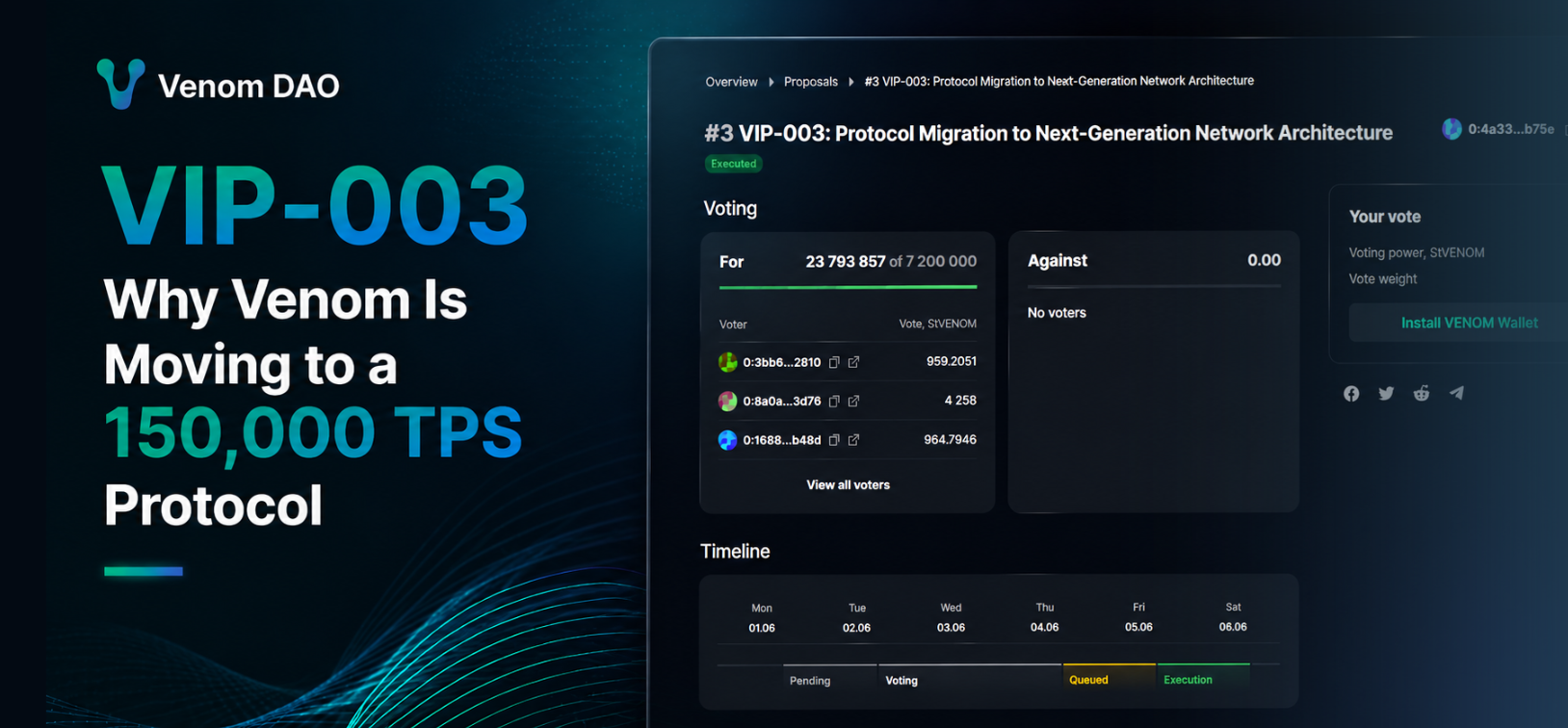
The community vote on proposal VIP-003 has passed, officially migrating the Venom network to a new protocol. The question now is what changes for the people who use it.
Most blockchains roll out their biggest upgrades the same way. The core team builds the thing, validates it, and launches it, and the community reads about it in the release notes. Venom took a different route. Rather than authorizing its migration to a next-generation protocol via Foundation decision, it put the power to decide in the hands of its community by hosting a Venom DAO vote on proposal VIP-003.
That vote has now closed, and the result was lopsided. 23,793,857 votes were cast in favor and none against, so the proposal passed and Venom is migrating to the upgraded network.
Venom’s new protocol
VIP-003 is a substantial technical upgrade. The new protocol is designed to deliver throughput of 150,000 TPS, sub-second transaction finality, advanced dynamic sharding, and an improved proof-of-stake consensus model. It is also built to keep compatibility with the applications and contracts already running on Venom, so the ecosystem does not have to be rebuilt from scratch around it.
The throughput number is not a hypothetical figure. It matches a closed-network stress test the Foundation conducted in 2025, in which the protocol processed 150,000 TPS. The vote moved that protocol from testnet into production on the live network. The engineering was already finished, so what holders were really deciding was whether to adopt it, not whether it works.
What users get
For most people using a network, “150,000 TPS” is an abstraction. The benefits read more clearly once you put them into practical context.
The first is speed. Sub-second finality means a transaction settles and becomes irreversible almost as fast as you send it. For payments, trading, and on-chain games, that is the gap between a network that feels like infrastructure and one that feels like a waiting room.
The second is headroom that does not blow up fees. Throughput only counts if it holds under load. Dynamic sharding lets the network add capacity as demand climbs, so a busy day for one application does not wreak havoc with congestion and high fees for the ecosystem at large. Venom already runs on minimal fees and reports 99.99% uptime, and the upgrade is meant to maintain both but at a much larger scale.
The third is continuity. Because the new protocol keeps existing apps and contracts compatible, the products people already use are designed to keep working rather than being scrapped and rebuilt. Holders will need to move their tokens onto the new network, but the Foundation says it will publish a step-by-step guide and an FAQ to walk them through it rather than leaving anyone to work it out alone.
The fourth benefit is less obvious, and probably the most interesting. It is the governance precedent. Choosing to let such an important decision be made by the community, rather than a routine treasury or parameter tweak, put token holders in charge of the choice that shapes their day-to-day experience. For anyone deciding whether to build a business on Venom, that says something about who controls the roadmap.
How the decision was made
This was not a one-off gesture. It continues a move toward community-led decisions that has progressively continued since Venom DAO was set up in 2025, itself by a community vote. VIP-003 was the most serious test of that structure so far, because the stakes were high and the outcome was, in principle, open. A unanimous result does not change the fact that the Foundation chose to put the question to holders rather than settle it alone.
What happens next
With the vote decided, attention turns to the migration itself. The Foundation has said that within the coming week it will publish a guide on moving tokens to the new network, along with an FAQ covering the questions holders are likely to have. The proposal and final results remain viewable on the network’s governance portal.
The throughput figures were the easy part to read. The more interesting outcome is that a network aiming to run global financial infrastructure just let its own users decide whether to move forward with its most consequential upgrade, and they overwhelmingly gave the green light.





Comment