Why Users Are Looking for Alternatives to Established Social Networks

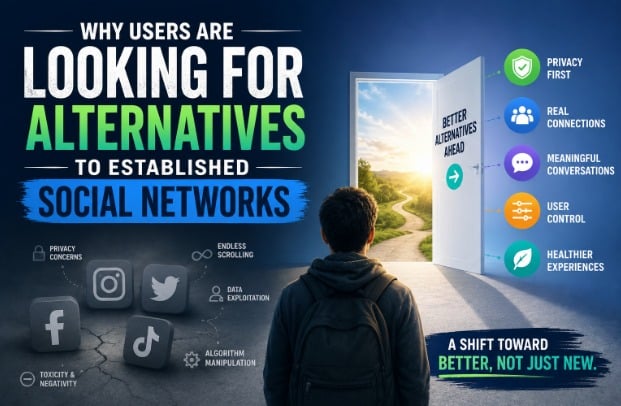
For more than a decade, a small number of major social networks have shaped how people communicate online. They have made it easy to share photographs, publish updates, follow public figures, watch videos and stay connected with friends. Their enormous audiences have also created a powerful network effect: the more people who join, the more difficult it becomes for users to consider leaving.
Yet size does not guarantee that a social network will satisfy every kind of user.
People use social media for different reasons. Some want entertainment. Others want professional connections, private communication, specialized communities, thoughtful discussions or a place to share interests without competing for attention. As these expectations become more diverse, interest in alternative social experiences is growing.
The appeal of a new network is not simply that it is smaller or newer. Users want to know what they will actually gain by joining another platform.
A new network needs to offer something meaningfully different.
That difference can come from community design, content creation, privacy, discovery, interaction and even the way popularity is measured.
The Problem With One-Size-Fits-All Social Media
Established networks have become extremely broad.
That scale is useful because almost everyone is already there. A user can usually find friends, creators, businesses, communities and entertainment in one place.
But a platform designed for billions of people cannot perfectly reflect every individual’s preferences.
Someone interested in a niche hobby may find it difficult to locate focused conversations among millions of unrelated posts. Another user may dislike the pressure to build a large follower count. Someone else may feel uncomfortable with how much personal information is connected to their online identity.
This creates an opening for alternatives.
Instead of trying to serve everyone in exactly the same way, a newer network can build its identity around a particular philosophy of social interaction.
The goal does not have to be replacing the biggest networks.
It can simply be providing a different experience.
Community Should Come Before Scale
One of the biggest mistakes a new social network can make is focusing on user numbers before building a reason for those users to stay.
A platform can advertise millions of potential connections, but that does not necessarily create a community.
Community develops through repeated interaction.
People ask questions.
Others respond.
Users recognize familiar contributors.
Shared interests create recurring discussions.
Members begin to understand the culture and expectations of the space.
This process takes time.
A smaller community can therefore be more engaging than a massive network if its members have a clear reason to interact.
For new platforms, creating strong communities around interests may be more valuable than attempting to immediately replicate the scale of established networks.
Users Need a Reason to Create Content
Every social network needs content.
But asking users to create content simply to fill a feed is not enough.
People need to feel that their contributions have somewhere to go.
A new network could encourage users to create questions, opinions, discussions, stories, recommendations, photographs or other forms of material that invite responses.
The key difference is between publishing and participating.
Publishing means putting something online.
Participation means creating something that becomes part of an interaction.
A question can be more socially valuable than a carefully edited status update if it leads to a useful conversation.
A personal experience can encourage several people to share their own experiences.
A controversial opinion can produce a constructive debate.
The content becomes a starting point rather than an endpoint.
Creation Should Not Be Reserved for Influencers
The creator economy has changed social media, but it has also introduced a hierarchy.
Users with large audiences can receive enormous visibility, while someone with a small following may struggle to get attention even when they have something interesting to say.
A newer network has an opportunity to reduce that dependence on established audiences.
Someone should be able to create a worthwhile post without first accumulating thousands of followers.
That could mean giving greater importance to the subject of a post, the quality of a discussion or the relevance of a contribution.
If a person writes something useful about a particular topic, people interested in that topic should be able to discover it.
The author’s follower count should not have to determine its potential reach.
Privacy Has Become Part of the User Experience
Privacy is no longer simply a technical issue hidden inside settings menus.
For many users, it affects whether they feel comfortable participating.
People may not want every conversation connected to their real-world identity. Others may prefer control over who can see certain information. Some users may simply want to avoid platforms that collect more personal data than they consider necessary.
A new network can differentiate itself by making privacy understandable.
Users should know what information is collected, how it is used and which parts of their activity are visible to others.
Clear controls can also make a significant difference.
Privacy should not require users to understand complicated technical terminology.
The best approach is to make the choices obvious.
Anonymity Can Encourage Participation, but It Needs Balance
There are situations where people are more willing to speak openly when they are not required to expose their full identity.
A person may want to ask an embarrassing question.
Someone might want to discuss an unusual experience.
Another user may simply prefer keeping their online activity separate from their professional identity.
Some degree of anonymity can make participation easier.
However, anonymity also creates challenges.
Without accountability, some people may behave in ways they would avoid under their real names.
A successful network therefore needs to balance privacy with community standards.
The objective is not maximum anonymity at any cost.
It is giving people enough control over their identity to participate comfortably while maintaining an environment where other users can interact safely.
Discovery Needs to Go Beyond Who You Already Follow
Follower-based discovery has an obvious limitation.
If you only see content from accounts you follow, your experience becomes dependent on the people you already know.
That can make social media predictable.
A more interesting model allows users to discover conversations based on interests, subjects and contributions.
Imagine joining a platform because you are interested in photography.
Instead of first finding photographers with huge audiences, you could explore discussions about camera settings, editing techniques, travel photography or unusual shooting conditions.
You might then discover people because of what they contribute to those conversations.
This reverses the conventional order.
Instead of finding people and then seeing what they post, users can find interesting subjects and discover the people participating in them.
Topic-Based Discovery Can Help New Voices
A recommendation system does not have to prioritize popularity alone.
It can consider relevance.
That distinction is important for smaller accounts.
Suppose someone publishes an excellent explanation of a niche technical subject but has only a few followers.
A follower-driven system may give that post limited exposure.
A topic-driven system could identify the subject and show the contribution to people interested in that topic.
This gives newer users a chance to be discovered because of what they create.
It also gives established users a reason to keep exploring rather than repeatedly seeing the same popular accounts.
Interaction Is More Important Than Reactions
Likes are easy.
A person can tap a button and continue scrolling.
But interaction becomes more meaningful when users have reasons to respond.
Comments, questions, replies, debates and collaborative discussions can transform a piece of content into a social experience.
This is especially important for a new network.
People will not necessarily stay because they can press another reaction button. Established platforms already provide that functionality.
A newcomer needs to make interaction feel worthwhile.
That might mean creating better discussion tools, making replies easier to follow or helping users discover conversations where their contributions are genuinely relevant.
Disagreement Can Be a Feature
Social networks sometimes try to optimize for agreement because positive reactions are easier to manage.
But disagreement can make communities more interesting.
People have different experiences, priorities and assumptions.
Two users can look at the same subject and reach different conclusions.
A good social environment does not need to eliminate those differences.
Instead, it can encourage people to explain why they disagree.
This creates a distinction between disagreement and hostility.
A healthy community allows someone to say, “I see this differently,” and explain their reasoning.
That kind of interaction can help users understand perspectives they would not encounter inside a highly personalized feed.
Popularity Should Not Be the Only Measure of Value
Follower counts are easy to understand.
They are also highly visible.
But they are an imperfect measurement of contribution.
A person might have 50 followers and regularly provide useful answers.
Another might have 500,000 followers and publish content that generates enormous attention without adding much discussion.
Both can be successful in different ways, but follower count alone cannot tell us which contribution is more valuable to a particular community.
Alternative networks can experiment with other signals.
Relevance could matter.
Helpful responses could matter.
Participation in a discussion could matter.
Community feedback could matter.
Consistency could matter.
The goal is not necessarily to eliminate popularity.
It is to prevent popularity from becoming the only path to visibility.
Quality Discovery Can Create Better Social Connections
When people discover each other through shared interests, connections can become more meaningful.
A person may find another user because they asked a useful question.
They might encounter someone whose opinion challenges their thinking.
They may discover a contributor who has experience in a subject they are learning about.
The relationship develops naturally from interaction.
This is different from following someone simply because they are already famous.
It can make social discovery more dynamic.
People are not just building lists of personalities.
They are finding people through conversations.
New Networks Need a Clear Identity
The internet does not need another platform that simply copies existing networks.
A new service needs a reason to exist.
That reason does not have to be revolutionary technology.
It can be a different philosophy.
Perhaps the network focuses on discussions instead of viral content.
Perhaps it organizes discovery around interests.
Perhaps it makes user contributions more visible.
Perhaps it offers stronger privacy controls.
Perhaps it gives people ways to participate without turning themselves into public personalities.
The strongest differentiation is often behavioral rather than technical.
Users should be able to explain in one sentence why they use the new network instead of another one.
Conflingo and the Conversation-Centered Approach
This broader shift can be seen in services such as Conflingo, where social interaction is organized around conversations, opinions, shared interests and participation.
The concept is worth considering because it reflects a larger question facing social media: can people discover each other through what they contribute rather than primarily through follower counts and established popularity?
A conversation-centered social experience can make posts, comments and opinions important parts of discovery.
Someone does not necessarily need to arrive with an existing audience.
They can participate in a subject, contribute something useful and potentially become visible to people who care about that topic.
This is one possible alternative to the traditional follower-first model.
The Challenge of Reaching Critical Mass
There is an unavoidable problem facing every new social network.
People go where other people already are.
A platform with excellent features but no active users can feel empty.
This is known as the network effect, and it is one of the biggest barriers to entering the social media market.
New networks therefore need to build communities strategically.
Instead of trying to attract everyone immediately, they can focus on groups with strong shared interests.
A community of several thousand highly engaged members can create enough activity to attract additional users.
Once conversations become active, newcomers have something to discover.
The platform begins generating its own momentum.
Onboarding Should Encourage Participation Immediately
Another important factor is what happens during a user’s first session.
If a new user signs up and sees an empty feed, they may leave.
Traditional platforms often solve this by immediately recommending popular accounts.
A conversation-oriented network can take another approach.
It can ask about interests.
It can recommend active discussions.
It can present questions that need responses.
It can help users discover communities rather than simply telling them who to follow.
The objective is to create a useful first interaction as quickly as possible.
Moderation Is Part of the Product
A new social network cannot treat moderation as an afterthought.
The ability to create content and participate openly is valuable only when people feel comfortable doing so.
Spam, harassment, misinformation and abusive behavior can quickly damage a community.
Clear rules are therefore essential.
So are practical reporting mechanisms and consistent enforcement.
At the same time, moderation should not remove every disagreement.
A platform centered around opinions would become meaningless if users were discouraged from expressing views that others might challenge.
Good moderation should protect participation while allowing legitimate differences of opinion.
The Best Alternative May Combine Familiar and New Ideas
Users are unlikely to abandon everything they already understand.
They still want profiles.
They still want notifications.
They still want multimedia content.
They still want quick ways to communicate.
The opportunity is to combine those familiar elements with a different social structure.
A network can have profiles without making profiles the center of everything.
It can have a feed without making endless scrolling the primary activity.
It can have popularity signals without making follower counts the ultimate measure of influence.
It can offer discovery without constantly pushing the same viral personalities.
The difference lies in how these features work together.
Why People May Give New Networks a Chance
For users considering a new social media platform, the deciding factor is rarely novelty alone. They want a clear reason to join, participate and return.
Users have to create an account, understand the interface and decide whether the community is worth their time.
There needs to be a clear benefit.
That benefit might be better discussions.
It might be access to a niche community.
It might be greater control over privacy.
It might be a less competitive environment.
It might simply be the opportunity to discover people through interests rather than popularity.
The more specific the benefit, the easier it is for users to understand why the platform deserves a place in their digital routine.
Social Media Does Not Have to Be a Popularity Contest
One of the biggest opportunities for alternative networks is changing how people think about visibility.
Popularity will always matter to some degree.
People naturally pay attention to things that others find interesting.
But popularity does not have to be the starting point for every interaction.
A user should be able to discover an unknown contributor because they wrote something relevant.
A thoughtful response should have an opportunity to reach people who need it.
A new member should be able to start participating without first building an audience.
This can create a more open environment for contribution.
The Future Could Be More Diverse
The future of social media is unlikely to belong to one type of platform.
There will continue to be enormous entertainment networks.
There will be professional communities.
There will be private messaging services.
There will be creator-focused platforms.
There will also be networks centered around discussion, interests and community participation.
This diversity is healthy.
Different users want different experiences, and the internet is large enough to support multiple models.
The success of a new network will therefore not necessarily depend on defeating established competitors.
It may depend on serving a need those competitors do not serve particularly well.
Final Thoughts
The interest in alternative social networks is ultimately about more than escaping familiar platforms.
It reflects changing expectations about what social media should provide.
Users want communities where they can find people who share their interests. They want opportunities to create content without already having an audience. They want meaningful interaction rather than endless reactions. They want discovery based on relevance as well as popularity. They want privacy controls they can understand. And increasingly, some users want social experiences where follower counts do not determine whose voice deserves attention.
A new network cannot succeed simply by being new.
It needs a compelling reason for people to participate.
That reason could be a better community, a different discovery model, stronger privacy, richer conversations or a more balanced approach to popularity.
The most promising alternatives may not attempt to reproduce everything established networks already do. Instead, they can rethink what makes an online community valuable in the first place.
The central idea is simple: social media becomes more interesting when users are given meaningful reasons to contribute.
People do not only want somewhere to watch.
They want somewhere to belong, discover, respond, create and be heard.