By Monarch Library
Motivation Is Powerful—But Temporary
We’ve all experienced moments of motivation.
The beginning of a new year.
The start of a new job.
A fresh fitness goal.
The excitement after reading an inspiring book.
Motivation feels incredible. It gives us energy, confidence, and the belief that change will come
easily.
But motivation has one major weakness:
It doesn’t last.
Life becomes busy. Stress increases. Energy drops. Unexpected challenges appear.
If success depends entirely on feeling motivated, progress eventually slows.
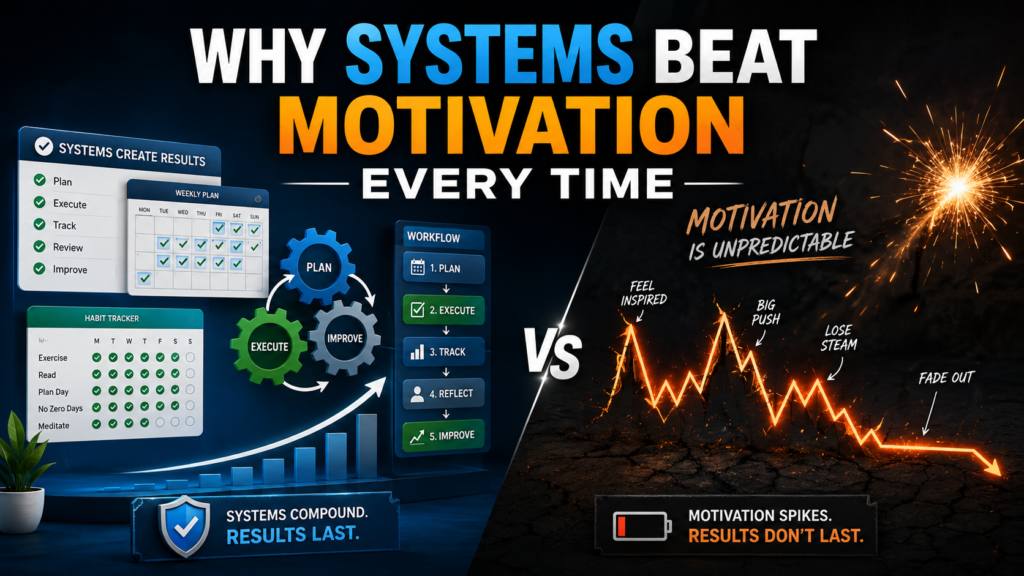
That’s why many high performers rely less on motivation and more on systems.
What Is a System?
A system is a repeatable process that helps you achieve a goal consistently.
Instead of asking:
“How motivated am I today?”
A system asks:
“What’s the next step?”
For example:
A writer commits to writing 500 words every
morning.
An investor automatically contributes money every month.
A business owner reviews key metrics every Friday.
A student studies for one hour each evening.
These routines remove unnecessary decision-making.
The work simply gets done.
Why Motivation Fails
Motivation depends on emotions.
Some days you’ll feel unstoppable.
Other days you won’t.
Stress, poor sleep, illness, disappointment, and distractions all influence motivation.
If your progress depends on feeling inspired, consistency becomes difficult.
Successful people experience these same
emotions.
The difference is that their systems continue even when motivation disappears.
Small Actions Create Big Results
Many people underestimate small improvements because they seem insignificant.
Reading ten pages a day doesn’t feel life-changing.
Saving a small amount every week doesn’t seem impressive.
Practicing a skill for thirty minutes may not produce immediate results.
But consistency compounds.
Ten pages a day becomes thousands of pages each year.
Small investments grow over decades.
Daily practice becomes expertise.
Large achievements are often built from
surprisingly ordinary routines.
Systems Reduce Decision Fatigue
Every decision requires mental energy.
Should I work out today?
Should I study tonight?
Should I save money this month?
The more decisions you make, the easier it becomes to delay action.
Systems remove many of these choices.
Instead of deciding every day, you decide once.
Then you follow the process.
This frees your attention for more important decisions.
Progress Beats Perfection
Many people wait for the “perfect time.”
The perfect schedule.
The perfect opportunity.
The perfect plan.
Unfortunately, perfection often becomes procrastination.
Systems encourage progress instead.
Even small progress repeated consistently usually produces better results than waiting for ideal circumstances.
Done consistently is often better than done perfectly.
Systems Apply to Every Area of Life
Systems aren’t limited to business or productivity.
They improve nearly every area of life.
Financial Systems
Automatic savings
Monthly budgeting
Regular investing
Reviewing expenses
Health Systems
Consistent exercise
Meal planning
Quality sleep
Daily walks
Learning Systems
Reading each day
Taking notes
Reviewing material
Practicing new skills
Business Systems
Weekly planning
Customer follow-up
Performance reviews
Process documentation
Each small system reduces uncertainty while increasing consistency.
Habits Become Your Default
One of the greatest advantages of systems is that repeated actions gradually become habits.
Habits require less mental effort than constantly making new decisions.
Eventually, actions that once required discipline become part of your normal routine.
That’s when long-term progress becomes easier to maintain.
Focus on Inputs, Not Just Outcomes
Many people obsess over results.
“I want to earn more.”
“I want to lose weight.”
“I want to grow my business.”
Those are valuable goals.
But systems focus on the daily actions that make those outcomes more likely.
Instead of focusing only on the destination, successful people improve the process.
Better processes often produce better results naturally.
Building Your Own System
Creating a system doesn’t need to be complicated.
Start with one goal.
Break it into small daily or weekly actions.
Schedule those actions.
Track your consistency.
Adjust when necessary.
The simpler the system, the easier it becomes to maintain.
Consistency matters far more than complexity.
Final Thoughts
Motivation can help you start.
Systems help you continue.
Every meaningful achievement—whether in business, health, learning, or personal finance—is usually the result of consistent actions repeated over time.
You don’t need to feel inspired every day.
You simply need a process that keeps moving you forward.
Build systems that support the person you want to become.
Because while motivation comes and goes, well-designed systems continue working long after inspiration fades.
About Monarch Library
Monarch Library creates books and educational systems designed to help people develop practical skills in wealth, business, legal literacy, critical thinking, and lifelong learning. Learn more at https://monarchlibrary.com.