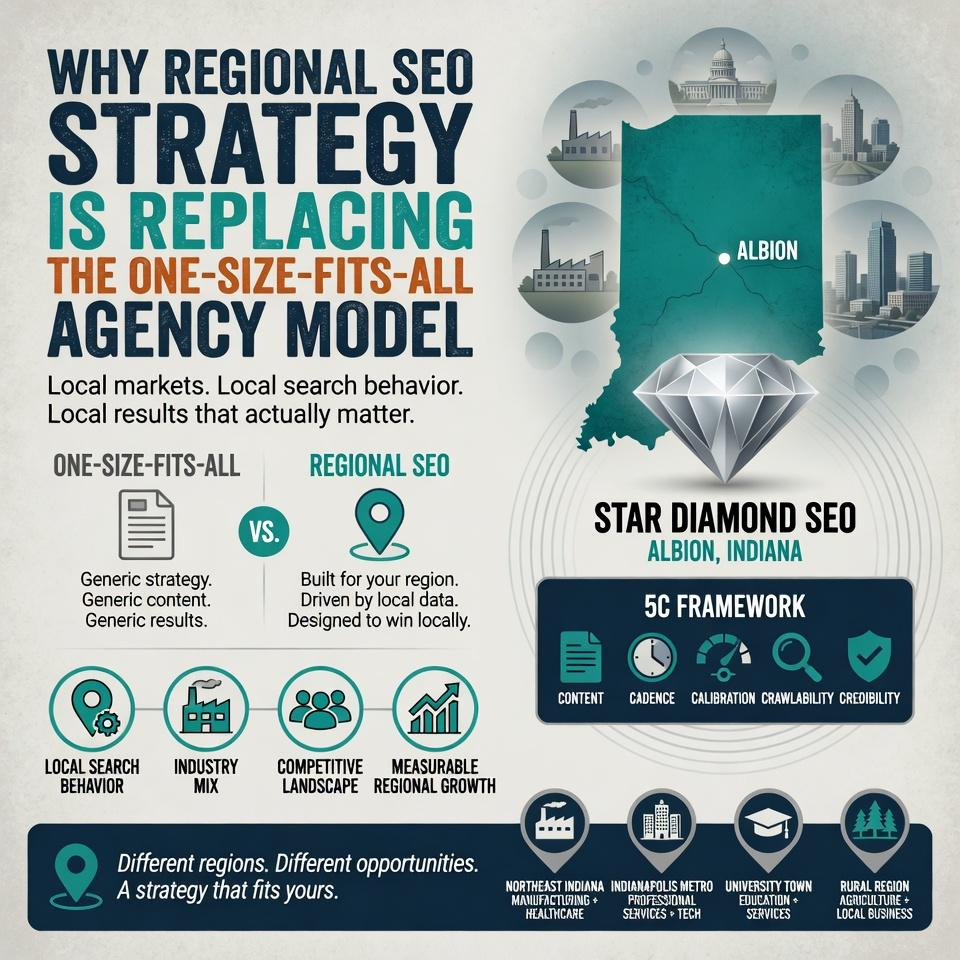
The SEO industry has spent two decades consolidating around a single service model: sign a retainer, receive a monthly report, and hope the numbers move. For businesses in major metros with large budgets, this model works well enough. For businesses outside those metros, it has been a reliable way to spend money without getting found.
That gap between what national agencies deliver and what smaller-market businesses actually need has created an opening for a different approach. Instead of applying the same playbook to every client regardless of geography, a growing number of firms are building strategies around the specific search behavior, industry mix, and competitive landscape of each region they serve. The shift is not cosmetic. It changes what gets published, how technical audits are prioritized, and which keywords drive the strategy.
The Template Problem
Most agency SEO follows a pattern. A client signs up, the agency runs a technical audit using the same tool suite it uses for every client, identifies a list of keywords based on national search volume, and begins producing content that could describe any business in any city. The service pages read the same whether the client is in Fort Wayne, Indiana, or Phoenix, Arizona. The blog posts reference no local context. The Google Business Profile gets the same optimization checklist handed to every account.
This approach is not lazy, exactly. It is scalable. And for years, scalability was the priority because Google was not sophisticated enough to distinguish between a page written for a specific local audience and a page written for everyone. That has changed. Search engines now evaluate geographic relevance, local entity recognition, and content specificity with far more precision than they did even two years ago. A page that could describe any city gets filtered in favor of a page that clearly belongs to one.
What Regional Strategy Actually Looks Like
Regional SEO means organizing a firm’s service delivery around geographic clusters rather than a flat client list. Each region gets its own keyword research, its own competitive analysis, and its own content strategy reflecting the industries that drive that local economy. A strategy built for a manufacturing corridor looks different from one built for a university town, even if both are in the same state.
One firm taking this approach is Star Diamond SEO, a founder-operated company based in Albion, Indiana. Rather than offering a single statewide service, the firm has organized its Indiana coverage into distinct regional practices, each mapped to the specific industries, search behavior, and competition of that market. The company’s 5C Framework, which breaks SEO into Content, Cadence, Calibration, Crawlability, and Credibility, is applied differently depending on what each region’s data reveals.
The distinction matters because search competition in northeast Indiana, where manufacturing and healthcare dominate, looks nothing like search competition in the Indianapolis metro, where professional services and tech companies drive the landscape. A keyword that converts in one region may not even register volume in another. An Indiana SEO company that treats the state as a single market misses those differences entirely.
Why Smaller Markets Reward Specialization
National agencies tend to concentrate resources on large-metro accounts because the economics are simpler. Higher search volumes, bigger budgets, and more competitive keywords justify the retainer. Smaller markets get deprioritized, and the clients in those markets receive a diluted version of the same strategy designed for larger ones.
But smaller markets have a structural advantage that national agencies overlook: lower keyword difficulty combined with higher purchase intent. A consumer searching for a service provider in a mid-sized city is often closer to a buying decision than someone browsing the same category in a major metro. The competition is thinner, the intent is stronger, and a well-built page can capture meaningful traffic with far less investment than the same keyword would require in a larger market.
For businesses in these communities, a regional SEO strategy means competing on terms they can actually win, with content that reflects the reality of their market rather than a generic approximation of it.
The AI Layer Adds Another Dimension
The rise of AI-generated search results has added complexity to the regional equation. Platforms like ChatGPT, Perplexity, and Google’s AI Overviews are increasingly answering queries with synthesized responses rather than simple link lists. For local businesses, this creates both a threat and an opportunity. The threat is that a generic page is even less likely to surface in an AI answer than it was in traditional search. The opportunity is that AI systems tend to favor content with clear geographic specificity, structured data, and demonstrated expertise, exactly the qualities that regional SEO is built to produce.
Firms that have invested in AI search visibility early are finding that the same content principles that drive traditional rankings also improve their presence in AI-generated answers. The overlap is not accidental. Both systems reward depth, specificity, and topical authority. A regional strategy that produces genuinely localized content performs better across both channels than a national template applied to a local zip code.
Measuring What Matters
The standard SEO dashboard tracks keyword rankings, organic traffic, and conversion rate. These metrics still matter. But a regional strategy introduces a layer of geographic segmentation that most reporting tools were not designed to surface. Which regions are generating impressions? Which local keywords are gaining position? Where is the content resonating with the audience it was written for, and where is it falling flat?
The firms doing this well are treating each region as its own micro-campaign, with its own benchmarks and its own trajectory. The aggregate numbers tell a story, but the regional breakdowns tell a more useful one. A statewide traffic increase means less if all the growth is coming from one city while three others are stagnant.
What This Means for Businesses Choosing an Agency
For business owners evaluating SEO partners, the regional question is worth asking directly: does this agency build a strategy for my specific market, or does it apply the same approach it uses everywhere else? The answer reveals more about the quality of the engagement than any sales deck or case study.
The SEO industry is moving toward specialization because the search landscape demands it. Generic content, generic strategy, and generic reporting are producing diminishing returns in a system that increasingly rewards specificity. For businesses outside the largest metros, that shift is overdue. The agencies that understand regional differences are the ones delivering results that the one-size-fits-all model never could.