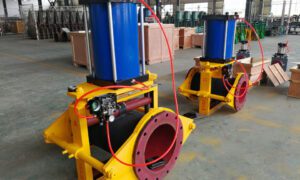
As industrial systems become more automated, valve performance is expected to do more than simply open and close. Valves must respond reliably to control signals, cycle consistently, integrate with broader process logic, and maintain performance even when the media is difficult to handle. This combination of automation and severe-duty service creates a challenge for many conventional valve designs. In applications involving abrasive slurries, powders, granulates, sticky fluids, or solids-bearing process streams, the wrong valve can quickly become a maintenance problem rather than a process solution.
Pinch valves are often well suited to this environment because their operating concept is both simple and practical. Rather than using a rigid closure component inside the flow path, a pinch valve controls flow by compressing a flexible sleeve. This reduces the number of mechanical internals directly exposed to the process media. In harsh conditions, that can improve performance and reduce the risk of wear, buildup, and sealing interference.
For automation systems, that simplicity has real value. A valve that performs consistently is easier to integrate into timed sequences, remote control logic, batching systems, and automatic shutdown functions. If the valve itself is prone to clogging or internal wear, automation does not solve the reliability problem. It only automates the failure. Pinch valves help address that issue by providing a valve design that is inherently better suited to difficult media.
This is particularly important in systems that handle abrasive material. Slurries with suspended solids, dry powders, and granular products can all be harsh on traditional valve internals. Repeated cycling only increases the stress on the components. Pinch valves reduce that exposure by relying on sleeve compression, which often makes them a better fit for severe-duty automated service.
Flow path characteristics are also relevant. Media that settles, bridges, or accumulates in tight spaces can create inconsistent process performance and eventually lead to maintenance calls. A cleaner, more open path when the valve is open helps reduce obstruction and supports more stable operation. In automated systems, where repeatability is important, that kind of process stability matters.
Reliable shutoff is another reason these valves are chosen. Fine particles and suspended solids can interfere with rigid-seat valve designs and create incomplete closure. A pinch valve closes around the process flow more directly, which can improve containment and process isolation in difficult applications. That becomes especially valuable in automation systems where precise valve response and dependable shutoff are critical.
These strengths make pinch valves useful in wastewater treatment, chemical dosing, conveying systems, mining operations, cement handling, ceramics, and bulk solids processes. In each of these areas, engineers often need a valve solution that supports automation without sacrificing durability in challenging service conditions.
When facilities evaluate pinch valves for automation systems, they are often looking for a combination of control compatibility, simplified operation, and long-term reliability. In severe-duty industrial environments, this valve technology continues to stand out as a practical and effective answer.