Why Open Banking Is Transforming Financial Services Worldwide


A landlord in Leeds checks whether a tenant’s rent has cleared, a lender in Madrid verifies a borrower’s income in seconds, and a shopper in Sydney pays a merchant straight from her bank account without touching a card. None of these people would say they used open banking, yet all three did. The market behind those quiet interactions is growing fast: open banking financial services generated an estimated 35.72 billion dollars in global revenue in 2025, and Precedence Research projects the figure will reach 240.31 billion dollars by 2035, a 21 percent compound annual growth rate.
That trajectory puts open banking among the fastest growing categories in financial technology. This article looks at where the growth is coming from, which regions are ahead, what the usage data shows, and why banks, fintech builders, and investors are treating account data access as core infrastructure rather than a compliance chore.
What open banking actually does
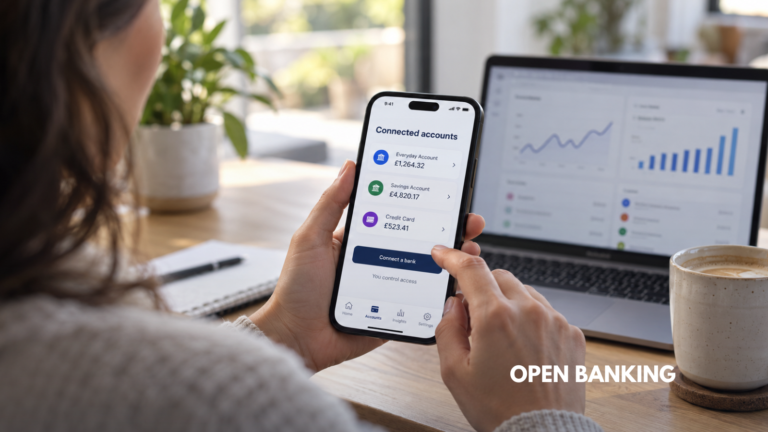
Open banking is a framework that lets customers share their bank account data with regulated third parties, and increasingly lets those third parties initiate payments, through standardized APIs. The customer gives explicit consent. The bank exposes the data. The third party builds the product, whether that is a budgeting app, a lending platform, or a checkout button.
Two service families dominate. Account information services read balances and transactions to power tools like credit scoring and financial management. Payment initiation services move money directly between accounts, skipping card networks. Both run on the same consent and API rails, and both are growing, though at different speeds.
The consent piece deserves emphasis because it distinguishes open banking from the data practices that preceded it. Customers approve each connection inside their own bank’s app, can see which services hold access, and can revoke any of them without calling anyone. The bank never hands over a password, and the third party never sees credentials at all.
The model matters because it separates the account from the experience. A customer can keep a current account at a traditional bank while managing money, borrowing, and paying through services built by companies the bank has never met. That separation is the engine behind most of the revenue projections in this market.
Open banking financial services by the numbers
The headline figures come from different measurement approaches, so it helps to see them side by side. Market sizing firms measure vendor and platform revenue, while ecosystem bodies count users and API traffic. Together they describe the same expansion from two angles.
| Indicator | Figure | Source |
|---|---|---|
| Global market size, 2025 | 35.72 billion dollars | Precedence Research |
| Projected market size, 2035 | 240.31 billion dollars | Precedence Research |
| Global API calls, 2025 | 137 billion | Juniper Research |
| Projected API calls, 2029 | 720 billion | Juniper Research |
| UK users, July 2025 | 15.1 million | Open Banking Limited |
Sources: Precedence Research, Juniper Research, Open Banking Limited, 2025.
Europe held roughly 36 percent of global open banking revenue in 2025, according to Precedence Research, and cloud based deployments accounted for about 70 percent of the market. The banking and capital markets segment produced around 46 percent of revenue, ahead of payments and digital currencies. Those splits describe an industry that is already commercial, not experimental.
From regulatory mandate to market infrastructure
The story began as regulation. The European Union’s second Payment Services Directive took effect in 2018 and required banks to open account access to licensed third parties. The United Kingdom went further, ordering its nine largest banks to build a common API standard under the Competition and Markets Authority. Australia followed with the Consumer Data Right, Brazil with its own phased rollout, and dozens of markets from India to Saudi Arabia built variations.
The United States took a different path. Data sharing there grew out of commercial agreements between banks and aggregators rather than a single mandate, a history covered in TechBullion’s report on open banking in the US. The Consumer Financial Protection Bureau finalized a data rights rule in late 2024, though its implementation has moved through legal challenges and revisions since.
What changed between 2018 and 2025 is the direction of energy. Early compliance programs treated APIs as a cost. The current generation of bank strategy treats them as distribution. Once a bank exposes reliable account APIs, it can sell premium data products, participate in new payment schemes, and plug its services into third party platforms.
The usage data shows a system in production
The United Kingdom publishes the most detailed ecosystem statistics, and they read like a production system rather than a pilot. In July 2025 the UK recorded more than 2 billion open banking API calls and 15.1 million active users in a single month, close to one in three UK adults, according to Open Banking Limited. User numbers grew 34 percent in a year.
Traffic composition is shifting too. Account information still generates about 80 percent of UK API calls, but payment initiation traffic grew 66 percent year on year. In 2021, account information users made up 75 percent of the total. By mid 2025, payment users accounted for 55 percent. People started by viewing data. They are now moving money.
Globally, Juniper Research expects open banking API call volume to rise from 137 billion in 2025 to more than 720 billion in 2029, a 427 percent increase. The firm points to artificial intelligence as a major driver, since personalized finance tools query account data constantly rather than once at onboarding.
Volume growth of that order changes the engineering conversation inside banks. An API estate built to satisfy a regulator in 2019 was sized for thousands of requests a day, not hundreds of millions. Banks in the busiest markets now run their open banking gateways with the same uptime targets as their card processing systems, because a merchant checkout depends on them in real time.
Reliability has commercial consequences. Aggregators route around banks whose APIs fail often, and payment schemes publish performance league tables that procurement teams read closely. In a market where the product is a connection, availability is the brand.
Europe leads, but the growth map is wider
Europe’s 36 percent revenue share reflects its head start, its regulatory clarity, and the density of licensed third party providers. The UK alone supports hundreds of regulated firms, and continental hubs in Berlin, Stockholm, and Vilnius host aggregators and payment institutions serving the whole single market.
Asia Pacific is the fastest moving region in most forecasts. India’s account aggregator framework, Singapore’s SGFinDex, and Australia’s Consumer Data Right each take a different legal route to the same outcome. Latin America’s standout is Brazil, where the central bank tied open finance to the Pix instant payment system and reached tens of millions of consents within three years of launch.
The United States remains the largest single prize. TechBullion’s analysis of the US fintech market shows why: digital payments and lending platforms there already depend on aggregated bank data at enormous scale, whatever the final shape of the federal rule.
What separates the leading markets from the laggards is rarely the technology. It is the presence of a body that enforces API standards, a clear liability framework, and at least one killer use case with commercial pull. The UK had all three: a mandated standard, a defined dispute path, and a payments use case that merchants wanted. Markets that published principles without enforcement have adoption curves that look flat by comparison.
Why banks are moving from defense to offense
For most of a decade, bankers described open banking as margin erosion dressed up as consumer rights. That framing is fading for a practical reason: the banks that built good APIs found new revenue attached to them. Premium APIs for identity verification, balance checks, and payment confirmation now earn fees from fintech customers.
Banks also consume open banking data themselves. A lender assessing a small business can pull twelve months of verified transaction history from accounts at rival institutions, with consent, instead of asking for PDF statements. That cuts underwriting time and widens the pool of borrowers a bank can price with confidence.
The infrastructure spend is measurable. The market for API platforms, consent management, and connectivity software is the core of the revenue figures from Precedence Research, and it overlaps with the growth of API driven banking platforms that TechBullion has tracked across the sector.
What founders and investors should read into it
For fintech founders, open banking lowers the cost of building on top of the banking system. A startup no longer needs a banking license or screen scraping workarounds to read balances or initiate transfers. It needs a regulatory permission, an aggregator relationship, and a product worth connecting.
The investment case rests on volume economics. API calls scale faster than headcount, and payment initiation captures basis points on transaction flows that used to belong entirely to card networks. That is why forecasts such as the one from Precedence Research assign a 21 percent compound growth rate to a market that already measures in tens of billions.
There are second order effects as well. Open banking data feeds the broader fintech stack, from the credit products described in TechBullion’s coverage of the global fintech market to accounting automation for small businesses. Every product that consumes verified account data becomes a customer of this infrastructure.
How merchants and platforms are joining the system
The demand side of open banking increasingly comes from outside finance. Subscription businesses use account data to reduce failed payments before they happen. Marketplaces verify seller bank accounts in seconds during onboarding. Utilities and councils in the UK now accept open banking payments for bills and taxes because the funds settle faster and cost less to accept than card transactions.
Merchant economics explain the pull. A card transaction can cost a retailer between one and three percent once interchange, scheme fees, and acquiring margins stack up. An account to account payment routes around most of that stack. For a merchant processing millions in volume, the difference funds entire product teams, which is why checkout providers keep adding pay by bank options across European markets.
Payroll and lending platforms lean on the same rails from another angle. Income verification that once required paper documents now happens through a single consented API call, and repayment collection through variable recurring payments gives lenders a flexible alternative to direct debit. Each of these use cases generates recurring API traffic, which is exactly what the Juniper Research volume forecast is measuring.
The frictions that could slow the curve
The obstacles are real. API quality varies widely between banks and between countries, and a failed connection at checkout costs a merchant the sale. Consent journeys still confuse some customers, particularly when they hop between a merchant app, a bank app, and back again.
Liability is the harder question. When a payment goes to a fraudster through an open banking rail, the split of responsibility between bank, third party, and customer is still being worked out in most jurisdictions. Regulators in the UK and the EU are drafting rules on this now, and the answers will shape how aggressively banks promote account to account payments.
Commercial models are the third friction. Mandated APIs are free at the point of use in most markets, which guarantees access but starves banks of direct revenue. The move toward premium APIs and commercial schemes is an attempt to fix that, and its success will decide how much banks invest in reliability.
Where the transformation goes next
The next phase extends the model beyond banking. Open finance brings pensions, investments, insurance, and mortgages into the same consent framework, and several governments are drafting smart data rules that reach into energy and telecoms. The technical pattern, consented data access through standard APIs, travels well across industries.
Payments will carry much of the near term growth. Variable recurring payments in the UK, Pix linked consents in Brazil, and pay by bank checkouts in the US and Europe all convert data infrastructure into transaction flow. Each successful scheme makes the next one easier to launch.
Institutional adoption will follow the money already committed. Banks that spent 2018 to 2022 building compliance APIs are now packaging them into products, and the vendors selling connectivity, consent management, and fraud tooling around those APIs are the direct beneficiaries of the market growth Precedence Research measures. The buildout resembles the early years of cloud computing: infrastructure first, then platforms, then applications nobody predicted.
A decade from now, the term open banking may sound as dated as internet banking does today, absorbed into the plain meaning of financial services. The 240 billion dollar forecast is not a bet on a niche. It is a bet that account data access becomes as unremarkable, and as indispensable, as the payment card once was.