
Why More Hosting Providers are Accepting Bitcoin Payments

Hosting has always been a global business. A customer can purchase a VPS from a provider in another country, choose a server location on the other side of the world, and manage everything online. As a result, hosting companies have had to support a wide range of payment methods.
Bitcoin has become one of those options.
More hosting providers now allow customers to pay for VPS, dedicated servers, domains, and other services with Bitcoin. For some companies, this is simply another checkout option. For others, it is a way to appeal to customers who prefer cryptocurrency, need an alternative to traditional payment methods, or value greater flexibility when paying for online services.
But why does Bitcoin make sense for hosting in particular?
Hosting Is a Naturally Global Service
Unlike many traditional businesses, a hosting company doesn’t need a physical presence in the customer’s country.
A customer in Europe might rent a VPS located in the United States. Another customer may choose a server in Germany while living in Asia. The service is delivered digitally, and the entire relationship can be managed online.
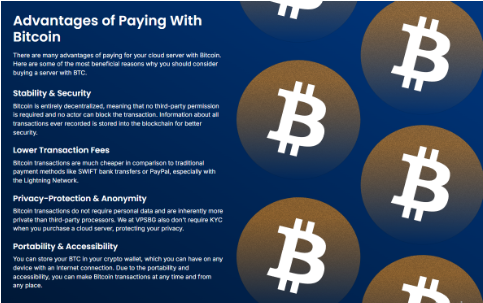
Traditional payment methods don’t always work equally well across borders. Credit cards can be restricted, bank transfers can be inconvenient, and currency conversion can add another step to the payment process. Bitcoin provides an alternative.
A customer who already holds Bitcoin can pay a hosting provider without needing to use a local banking system or convert the cryptocurrency into a traditional currency first. This makes Bitcoin particularly relevant to an industry where customers and infrastructure are often located in different countries.
Bitcoin Gives Customers Another Way to Pay
The main reason for accepting Bitcoin can be surprisingly simple: payment choice. Hosting providers already support different payment methods because customers have different preferences. Some use credit cards, others prefer PayPal or bank transfers, and some are more comfortable using cryptocurrency.
Adding Bitcoin doesn’t necessarily mean replacing traditional payment methods. It simply gives customers another option.
This can be especially useful for developers, freelancers, digital businesses, and technically experienced users who already use cryptocurrency for other online transactions. A hosting provider that supports Bitcoin can therefore accommodate customers without requiring them to change the way they normally manage their digital payments.
Bitcoin Can Reduce Dependence on Traditional Payment Systems
Online businesses depend heavily on payment processors and financial institutions. Cards can be declined, accounts can be restricted, and payment providers may have their own policies regarding particular customers, countries, or types of transactions. Bitcoin operates outside this traditional card-payment structure.
A hosting provider accepting Bitcoin can give customers an alternative when a card payment isn’t suitable or available. This doesn’t mean Bitcoin eliminates every payment-related problem. Transactions still need to be processed correctly, and providers need appropriate systems for handling refunds, accounting, and compliance.
However, having an additional payment channel can make a hosting company’s billing infrastructure more flexible.
Bitcoin Can Be Useful for International Customers
International customers are one of the strongest reasons for offering Bitcoin payments. Imagine a developer who needs a VPS from a provider in another country. If their preferred card doesn’t work with the provider, they may need to find another payment method or another hosting company.
If the provider accepts Bitcoin, the customer has another way to complete the purchase. This can be particularly useful for customers who regularly work with international services and already use cryptocurrency. For the hosting company, the advantage is straightforward: fewer potential customers are blocked by payment limitations.
Some Customers Prefer Not to Use Cards for Online Services
Not everyone wants to use a credit or debit card for every online purchase. Some customers prefer to keep online service payments separate from their primary banking accounts. Others may simply prefer managing their digital purchases through a cryptocurrency wallet. Bitcoin gives these customers an alternative.
There is an important distinction here, however. Paying with Bitcoin does not automatically make hosting anonymous. A hosting provider can still require an account, email address, identity verification, or other customer information. Bitcoin transactions are also recorded on a public blockchain.
Therefore, providers should avoid presenting Bitcoin payments as a guarantee of anonymity. Instead, the benefit is better described as payment flexibility and an alternative to traditional card-based transactions.
Hosting Providers Can Convert Bitcoin to Fiat
Accepting Bitcoin doesn’t necessarily mean a hosting company has to hold Bitcoin. This is an important consideration for businesses concerned about cryptocurrency price volatility.
A hosting provider can use a cryptocurrency payment processor to accept BTC and convert the payment into a traditional currency. The customer pays with Bitcoin, while the provider receives the value in the currency it normally uses for operating expenses.
This creates a separation between the customer’s preferred payment method and the provider’s financial management. As a result, a hosting company can offer Bitcoin without necessarily changing its entire accounting or treasury strategy.
Cryptocurrency Payments Can Be Automated
Hosting is highly automated. Customers expect to select a plan, complete payment, and receive their service without waiting for someone to manually check a bank transfer. Bitcoin payments can fit into this model.
A payment gateway can communicate with the hosting provider’s billing system and confirm when a transaction has been received. The system can then activate the VPS or extend an existing service. This is particularly important for hosting companies because automation is often built into every stage of the customer lifecycle.
The same principle can be applied to VPS upgrades, renewals, additional services, and other purchases. The easier cryptocurrency payments become to integrate into existing billing systems, the more practical they are for hosting providers.
Bitcoin Can Help Hosting Providers Stand Out
The hosting market is highly competitive. Customers can compare dozens of providers based on CPU, RAM, storage, bandwidth, server locations, uptime, support, and price. Many providers offer very similar configurations.
Payment options can become another point of differentiation. A provider that accepts Bitcoin can appeal to customers specifically looking for cryptocurrency-friendly hosting. This doesn’t mean Bitcoin alone will make a hosting company competitive. Infrastructure, pricing, reliability, and support remain much more important. However, when several providers offer similar services, flexible payment options can help one company stand out.
Bitcoin Isn’t Only About VPS Hosting
Bitcoin payments can apply to much more than VPS plans.
Hosting companies can potentially accept Bitcoin for:
- Shared hosting
- VPS hosting
- Dedicated servers
- Domain registrations
- SSL certificates
- Backup services
- Server upgrades
- Additional IP addresses
- Managed services
This makes cryptocurrency a potential payment method across the entire customer lifecycle. A customer might initially use Bitcoin to purchase a VPS and later use the same payment method for an upgrade or additional service.
Recurring Hosting Payments Are More Complicated
There is also a practical limitation. Traditional payment methods are particularly convenient for recurring services because a card can be charged automatically every month or year. Bitcoin doesn’t work in exactly the same way.
A customer generally needs to authorize each blockchain transaction. This means hosting providers need to design their billing systems differently if they want to support recurring cryptocurrency payments.
Some providers may use prepaid balances. Others may require customers to manually renew their services. This isn’t necessarily a reason not to accept Bitcoin, but it does mean cryptocurrency billing requires more thought than simply adding another button to the checkout page.
Bitcoin and Stablecoins Can Work Together
Bitcoin isn’t necessarily the only cryptocurrency that makes sense for hosting companies. Stablecoins can also be attractive because their value is generally tied to a traditional currency, such as the U.S. dollar.
For customers, this can make budgeting for recurring services easier than using a cryptocurrency with a highly variable market price.
For providers, stablecoins can also provide an alternative to traditional payment rails while reducing some of the volatility associated with Bitcoin. As a result, hosting companies that begin accepting cryptocurrency may eventually support several digital payment options rather than focusing exclusively on BTC.
What Customers Should Look for When Paying With Bitcoin
Not every hosting provider that displays a Bitcoin payment option offers the same experience.
Before paying, customers should check how the provider handles cryptocurrency transactions, including:
- Which cryptocurrencies are supported
- Whether payments are processed directly or through a third party
- How refunds are handled
- Whether prices are fixed in fiat currency
- How long customers have to complete a payment
- Whether crypto payments can be used for renewals
- Whether additional transaction fees apply
- What customer information is required
These details can be just as important as the availability of Bitcoin itself.
The Future of Bitcoin Payments in Hosting
Bitcoin makes sense for hosting because both are fundamentally digital and global. Hosting companies sell services that can be purchased from almost anywhere, while Bitcoin provides another way for customers to make those purchases without relying exclusively on traditional card and banking systems.
For providers, the decision is less about replacing conventional payments and more about expanding their options.
Credit cards, bank transfers, PayPal, Bitcoin, and stablecoins can all serve different types of customers. As cryptocurrency payment infrastructure becomes easier to integrate with billing and provisioning systems, offering Bitcoin can become a practical feature rather than a complicated experiment.
Conclusion
More hosting providers are accepting Bitcoin because it fits the way their industry operates: globally, digitally, and with customers who often expect flexible payment options.
For customers, Bitcoin provides an alternative way to pay for VPS, dedicated servers, domains, and other online services. For hosting companies, it can help reach cryptocurrency users, reduce dependence on traditional payment methods, and differentiate their services.
Bitcoin isn’t a replacement for every payment method, and it doesn’t automatically provide anonymity. But as another option at checkout, it can make sense for both hosting providers and their customers.







Comment