
Why Mobile Entertainment Brands Need More Than a Download Website

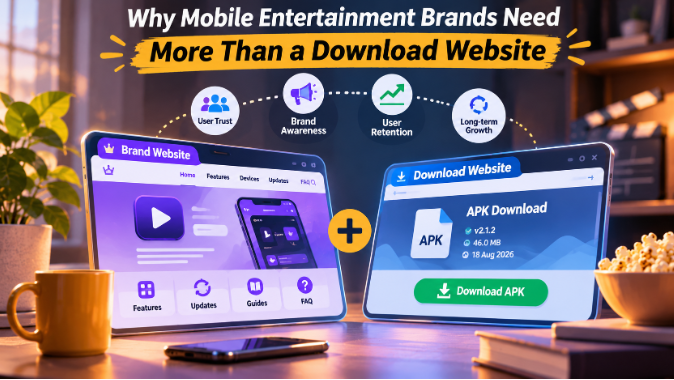
Imagine an Android entertainment app generating thousands of downloads every month. Its website ranks for relevant search terms, visitors regularly click the download button, and traffic reports suggest that everything is moving in the right direction. Yet six months later, the publisher faces an uncomfortable question: why does the business still struggle to build a recognisable brand or a loyal audience?
The problem may have little to do with search visibility. A download website is designed to help someone complete a specific task, but that task represents only one moment in a much longer relationship. Users also need to understand the product, trust its publisher, receive updates, and find reasons to keep using it.
For mobile entertainment businesses, particularly those distributing Android applications through independent websites, the distinction between acquiring downloads and building a sustainable brand deserves more attention. A successful download page can attract users. It cannot, by itself, deliver everything required to retain them.
The Download Website Does One Job Extremely Well
A dedicated download website has a clear commercial purpose. It serves people who already know what they want and are looking for the information needed to obtain an application. These visitors may search for an APK, check compatibility requirements, or look for installation instructions after hearing about a product elsewhere.
This focused approach has advantages. A well-designed download page can present the application version, file size, supported Android versions, and installation guidance without requiring visitors to navigate an entire corporate website. For publishers relying on organic search, pages that directly address download-related questions can attract visitors with relatively specific intentions.
The limitation appears after the file has been obtained. A visitor may complete the download and never return to the website. They might remember the application’s name, but they may know little about the publisher, future updates, or where to find support when something goes wrong.
That doesn’t make download websites ineffective. It means their success should be evaluated according to the role they actually perform. Generating an installation opportunity is valuable, but it is not the same as establishing a lasting customer relationship.
Brand Discovery and Download Intent Are Different Businesses
A person searching for an entertainment brand and someone searching for its APK may appear to belong to the same audience. Their immediate needs, however, can be quite different.
Understanding that difference is essential when deciding how to organise a mobile application’s online presence.
When Someone Searches for a Brand
A visitor searching for flixfox may want to understand the entertainment service before making any installation decision. They could be looking for information about the application, supported devices, available features, or recent updates. A brand-focused website can help answer these questions while providing a consistent reference point for people encountering the product for the first time.
This matters because users don’t always arrive with a clear intention to download. Someone may have seen the brand mentioned in a discussion, noticed it in a search result, or heard about it from a friend. At that stage, the website’s responsibility is to explain what the application offers and help visitors decide whether it is relevant to them.
Brand websites can also support returning users. Troubleshooting guides, release announcements, compatibility information, and frequently asked questions give people reasons to revisit the site after their initial installation.
When Someone Searches for an APK
The search for flixfox apk reflects a more specific information need. The user may already recognise the brand and now wants to investigate its Android installation package, version details, or download requirements. At this stage, lengthy brand introductions are less useful than accurate technical information and a clearly explained installation process.
An APK-focused page should make it easy to identify the file being offered and understand its source. Version numbers, release dates, compatibility requirements, and security guidance deserve more attention than promotional language.
The two types of website therefore serve complementary purposes. One helps users understand the brand and its broader product experience. The other addresses the practical questions that arise when someone considers installing the application.
Trying to make both experiences identical can create unnecessary friction. A visitor researching a brand shouldn’t be pushed immediately towards a download, while someone looking for installation details shouldn’t have to navigate through unrelated marketing content.
The Risk of Building an Entire Brand Around One Landing Page
A single high-performing landing page can be attractive from a business perspective. It is relatively easy to maintain, its performance can be measured, and marketing efforts can focus on a small number of search terms.
The risk is that the business becomes dependent on one acquisition channel and one type of user behaviour.
Consider two hypothetical entertainment app publishers. The first operates a download-focused website that attracts steady search traffic. Most visitors arrive through a handful of keywords, obtain the application, and leave. The publisher has limited information about whether those users remain active or where they go when they need assistance.
The second publisher also maintains a dedicated download page, but supports it with a brand website, updated documentation, and clear product information. Visitors can explore the service before installing it and return later for support or release information.
The second approach does not automatically guarantee better performance. Maintaining additional content requires resources, and poorly coordinated websites can create confusion. However, it provides more opportunities to support users beyond the initial download.
For businesses seeking sustainable growth, that broader relationship can be valuable when search rankings fluctuate, acquisition costs increase, or user expectations change.
What a Brand Website Should Actually Accomplish
A brand website should do more than repeat the same information already available on an APK download page. Its primary role is to establish a clear product identity and help users understand what they can expect from the service.
That begins with consistent branding, accurate descriptions, and straightforward navigation. Visitors should be able to identify the publisher, understand the application’s purpose, and locate relevant information without searching through unrelated promotional pages.
The distinction between a brand website and a download website becomes clearer when their responsibilities are compared.
| Brand Website | Download Website |
| Explains the product and its purpose | Provides installation-related information |
| Builds a consistent brand identity | Addresses download-oriented searches |
| Introduces features and supported devices | Explains APK versions and compatibility |
| Provides support and product updates | Guides users through obtaining the package |
| Serves new and returning users | Focuses on a specific installation task |
These functions can exist on separate websites or within different sections of the same domain. The important factor is not the number of websites a publisher operates, but whether visitors can find the information they need.
A brand website also creates space for communication that doesn’t fit naturally on a download page. Changes to supported devices, updates to application features, and answers to common technical questions can be presented without interfering with the installation process.
For independent app publishers, this information can contribute to credibility. Users are more likely to understand a product when its website offers clear explanations rather than relying entirely on download buttons and broad claims.
Why Search Traffic Can Create a False Sense of Growth
Organic search traffic is an important acquisition metric, but it can become misleading when treated as a direct measure of business performance.
A website might experience a significant increase in clicks after improving its keyword rankings. The marketing team may interpret this as successful growth, yet the number of active application users could remain unchanged.
The reason is that several separate actions occur between a search result and meaningful product usage.
These metrics represent different outcomes. A search click indicates that someone visited a page. A download-button click records an attempted action, while a completed file download confirms that a package was obtained. Neither event proves that the application was successfully installed or used.
Activation and retention provide additional information about whether the product delivers value after installation.
For example, imagine a publisher recording 100,000 organic visits during a month. If 20,000 visitors click a download button, the resulting click-through rate may look encouraging. However, without reliable installation and activation data, the business cannot determine how many of those visitors became actual users.
These figures are hypothetical, but the measurement problem is real. Publishers need to distinguish acquisition activity from meaningful engagement rather than combining every metric into a single growth narrative.
Building an Ecosystem Without Creating More Confusion
Operating a brand website and a dedicated download resource can improve the user journey, but only when both are coordinated.
One common problem is inconsistent product information. A brand homepage may describe a recent application release while the download page displays an older version. Installation instructions might refer to features that have changed, or different websites may use branding that makes them appear unrelated.
These inconsistencies can undermine trust even when the application itself works correctly.
Publishers should establish clear responsibilities for maintaining version information, release announcements, and technical documentation. When an application is updated, every relevant page should be reviewed to ensure that visitors receive consistent guidance.
Search strategy also requires coordination. If multiple websites target identical keywords with nearly identical content, they may compete for the same audience without providing additional value. A clearer approach is to assign distinct purposes to pages and ensure that navigation reflects those differences.
Security is another consideration. Independent APK distribution requires transparent information about file authenticity, publisher identity, and installation requirements. Users should not be encouraged to bypass Android security warnings without understanding the risks.
More websites do not automatically create a stronger brand ecosystem. A small number of accurate, well-maintained resources can be more useful than a large collection of inconsistent pages.
Sustainable Growth Starts After the Download
For mobile entertainment businesses, the most valuable relationship begins when someone starts using the application.
A successful first experience can encourage repeat visits, while confusing navigation, intrusive advertising, or poor performance may cause users to abandon the product shortly after installation.
This is why retention deserves attention alongside acquisition. Publishers need to understand whether users can find relevant content, navigate the interface comfortably, and return when they want entertainment again.
The relationship between product experience and brand perception also works in both directions. A reliable application can strengthen trust in the brand, while clear support information can help resolve problems that might otherwise lead to an uninstall.
Over time, these interactions influence whether users remember the service, recommend it to others, or continue using it when alternatives become available.
For publishers investing in SEO and paid acquisition, improving these experiences may create more lasting value than simply increasing the number of download opportunities.
Conclusion
A download website can be an effective acquisition channel for an Android entertainment application. It helps users locate installation information and can attract valuable search traffic from people with specific intentions.
But downloads alone cannot establish brand recognition, user trust, or long-term engagement.
Mobile entertainment publishers need a broader approach that connects brand information, reliable distribution, accurate measurement, and everyday product experience. That does not necessarily mean operating numerous websites. It means ensuring that every part of the user journey has a clear purpose.
The strongest digital entertainment businesses will not be defined solely by how many people download their applications, but by how many find enough value to keep using them.







Comment