
Why Changing Your Christmas Wrapping Paper Every Year Costs Brand Recognition

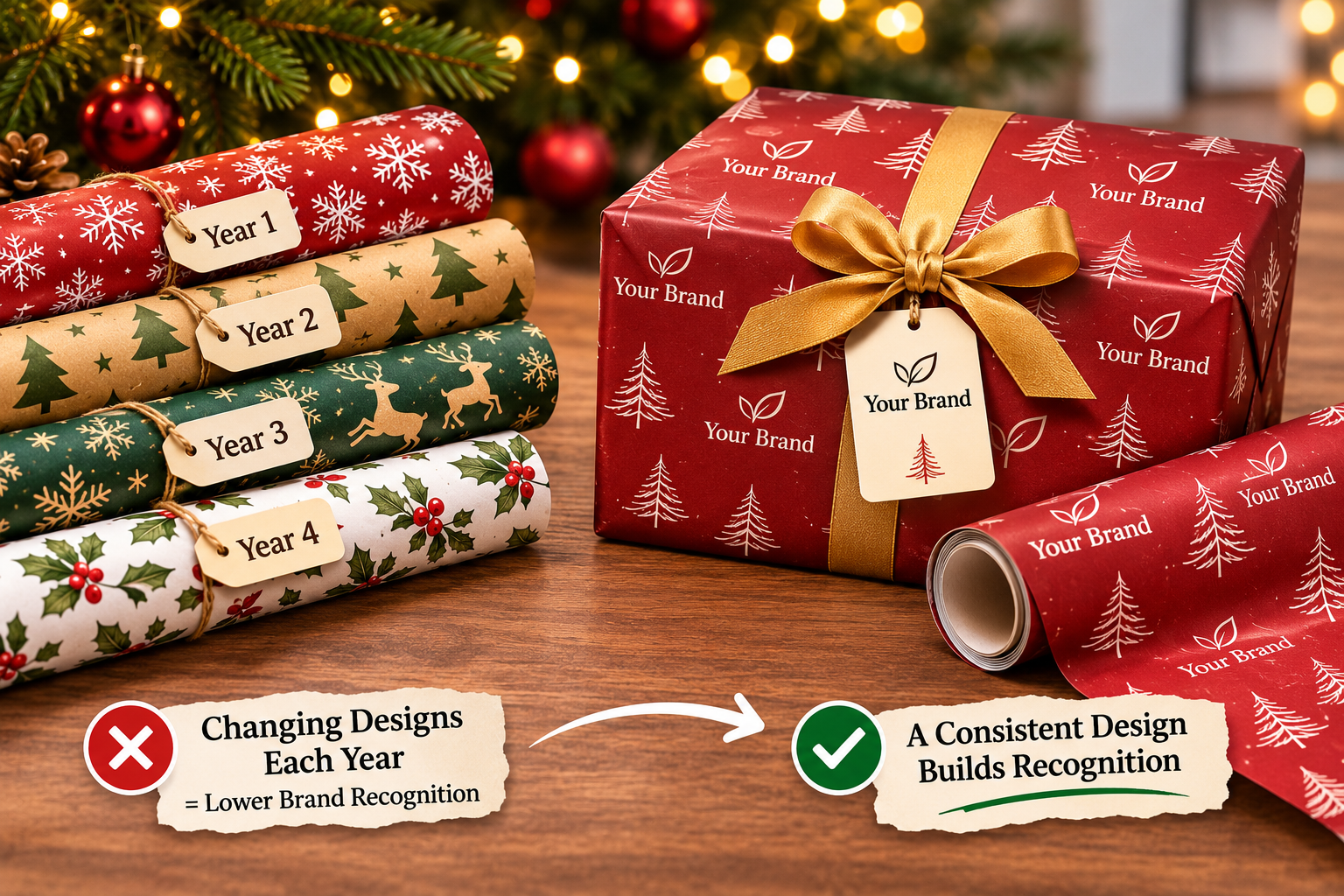
How a consistent Christmas wrapping paper design builds recognition season after season, and how to refresh it without starting again from zero.
Some shops never need their name on the parcel. You see the paper on a train, under someone’s arm or under a friend’s tree, and you know where it came from before you’ve read a word. That isn’t luck, and it rarely comes from one brilliant design. It builds up over several Christmases, as the same Christmas wrapping paper keeps turning up in the same hands at the same time of year.
Which is why the annual redesign deserves a harder look than it usually gets. Every October, plenty of businesses brief a brand-new festive pattern because last year’s feels tired. To the people who approved it, it probably does. To customers, who handled it for a few weeks twelve months ago, it was only just becoming familiar.
A new design doesn’t add to that familiarity. It quietly resets it.
How Christmas Wrapping Paper Builds Recognition Over Several Seasons
Recognition comes from repetition, not novelty
People don’t memorise a pattern the first time they see it. They register it, forget most of it, and notice it slightly faster the next time. Colour, a recurring motif and the way a logo sits within the repeat all become shortcuts. Over time, the shortcut is enough: a flash of your particular green and gold across a crowded room does the job your logo would otherwise have to do.
Christmas paper is unusually good at building those shortcuts, because it arrives in a concentrated burst. It’s handled, photographed, passed between people and left under trees for days. The trouble is that the burst lasts only a few weeks a year. If the design changes every time, there’s never a second or third season for the shortcut to form.
Why the urge to redesign comes from inside the business
The people most tired of a design are usually the ones who see it most. The marketing team saw it as a draft in September, signed off a proof in October and looked at boxes of it in the stockroom for weeks. Regular customers saw it briefly, at the till or on a gift. Internal fatigue arrives years before customer fatigue, and it’s easy to mistake one for the other.
There’s also a creative itch. A fresh design feels like progress and gives the season a sense of occasion. That instinct isn’t wrong, but it’s often aimed at the wrong place. The festive energy can come from the campaign around the paper rather than from throwing out the paper itself.
What Changing Your Christmas Paper Every Year Actually Costs
The recognition you’ve already paid for
Each season of consistent wrapping is an investment in familiarity. Change the design and that investment doesn’t carry over in full. A customer who might have spotted your parcel from across a shop now has to learn something new, and a new pattern competes with every other festive print on the high street for attention. It may look lovely. It just starts from the back of the queue.
The production costs nobody budgets for
A redesign isn’t only a design fee. New artwork has to be prepared, set up for print, proofed and colour-checked again, with all the room for error that involves. Then there’s the stock you already hold. A Christmas wrapping paper roll left over from last year is perfectly usable if the design hasn’t changed. Once it has, those rolls become a mismatch you either hide in a cupboard or use and hope nobody compares them.
The knock-on effect across your other print
Wrapping paper rarely works alone. If your Christmas menu, Christmas poster and Christmas flyers were designed to echo last year’s paper, a new pattern either breaks that link or forces every other piece to be redesigned to match. Either way, the joined-up look you worked for takes another season to rebuild.
| Consideration | Full redesign every year | Consistent core design with a light refresh |
| Recognition | Starts again each season | Builds from one Christmas to the next |
| Artwork preparation | New files, new set-up, new checks | Mostly reuses approved master artwork |
| Colour matching | Has to be reviewed again from scratch | Can be checked against last year’s printed sample |
| Leftover stock | Previous design becomes a mismatch | Remaining rolls and sheets stay usable |
| Other Christmas print | Menus, posters and flyers may need redesigning | Supporting print can keep the same visual link |
| Proofing risk | Higher, because everything is new | Lower, because only the changes need close checking |
Consistent Doesn’t Mean Identical: Refreshing Christmas Gift Wrapping Paper the Smart Way
None of this means printing the same file forever. The aim is to keep the parts that create recognition and let the rest move.
Separate the fixed elements from the flexible ones
Before anyone opens a design file, it helps to decide which parts of the paper carry the recognition and therefore shouldn’t change:
- Core brand colours, which do the earliest recognition work, often before anyone notices the logo.
- Logo scale and placement in the repeat, so the brand keeps landing on the visible faces of a parcel in a familiar way.
- One signature motif, whether that’s a particular star, sprig, pattern or illustration style.
- The paper’s look and feel, meaning the finish and weight people handle every year.
Everything outside that list can flex. An accent colour, a secondary illustration or the density of the pattern can all shift from year to year without unpicking what people already associate with you.
Change one thing at a time
When a refresh is genuinely needed, a single deliberate change tends to feel like an update rather than a replacement. Swap the accent colour one year. Add a seasonal detail the next. Customers notice something new, but the parcel still looks like yours. Changing colour, motif and layout at once is, in practice, a redesign under a gentler name.
Keep the year-specific message off the paper
Dates, campaign slogans and “Christmas 2026” lettering date the paper the moment January arrives. Put time-bound messages on the things that are meant to be temporary: gift tags, a flyer tucked inside, the menu, the window poster. The paper stays reusable, and leftover stock remains on brand next season.
| Design element | Keep it fixed? | Why it matters | Where change can happen instead |
| Brand colours | Yes | Often the first thing people recognise | An accent or secondary colour |
| Logo and its repeat | Yes | Keeps the brand visible on every parcel | Spacing can be adjusted for new gift sizes |
| Signature motif | Usually | Becomes the shortcut people remember | Seasonal additions around it |
| Paper finish and feel | Usually | Customers notice how it handles | Only if the original choice wasn’t working |
| Year or campaign message | No, leave it off | Dates the paper and strands leftover stock | Gift tags, flyers, menus and posters |
Who Gains Most from Consistent Christmas Wrapping Paper in the UK
Consistency pays off most where the same people come back every year. Independent shops, gift boutiques, florists, bakeries and delis wrap for regulars who will see the paper again next December. Restaurants that send out hampers, and professional firms that post client gifts every year, are in a similar position: the audience is repeat by nature, so each season can build on the last.
It’s less important in other situations. A one-off event, a pop-up that won’t return, a business in the middle of a rebrand or a charity whose annual appeal deliberately carries a new theme each year may well be better served by fresh designs. Recognition only builds if there’s someone to recognise you twice. Being honest about which camp you’re in saves money either way.
Ordering Christmas Wrapping Paper You Can Reorder Year After Year
The practical side of consistency is mostly about record-keeping, and it’s where many businesses come unstuck. A design that looked identical on screen can be ordered next year on different paper, at a different scale, and end up looking like a cousin of the original rather than the same thing.
A few habits make reorders straightforward:
- Keep the final print-ready master file, with a vector logo and CMYK colour references, somewhere everyone can find it.
- Write down the format, size, paper and finish you chose, whether rolls or Christmas wrapping paper sheets.
- Keep one printed sample from each run as the colour reference for the next proof.
- Note how much you used and whether you ran out, so next year’s quantity is based on evidence rather than guesswork.
That printed sample matters more than it sounds. Comparing a new proof against last year’s actual paper is far more reliable than comparing it against a screen, and it’s the simplest way to keep the colour people recognise from drifting. When you’re ready to reorder, check the current options and specifications on the Christmas wrapping paper product page against your notes before approving artwork.
One more temptation to resist. Cheap Christmas wrapping paper from a January sale can look like a sensible way to stock up, but generic paper bought in bulk carries none of your recognition. If you’re going to spend on wrapping, spend it on something that adds to next year’s familiarity.
The same thinking stretches beyond the paper. A promotional calendar carrying your signature motif keeps it in view through the other eleven months, so the pattern feels familiar when Christmas comes round again. And if you ever commission a hardback book, perhaps an anniversary title or a seasonal recipe collection, giving it the same visual language ties it back to everything else people already know.
Christmas Wrapping Paper Works Best When People Already Know It
The value of Christmas wrapping paper isn’t decided by how striking it looks in its first season. It’s decided by how quickly people recognise it in its third. Each redesign trades that slow-building familiarity for a few weeks of novelty, often to satisfy a fatigue felt inside the business rather than by the customers it’s meant to reach.
Keep the colours, the logo repeat and one signature motif. Refresh around them, one change at a time, and leave dated messages to the print that’s meant to be temporary. If you’re planning this year’s order, I YOU PRINT prints custom wrapping paper for UK businesses, with easy online ordering, artwork support and UK delivery, so the design you settle on can be reordered consistently season after season.
Previously in Digital Marketing: The Spreadsheet Era of Influencer Research Is Ending. Here’s What Replaces It







Comment