
Why Jaisalmer Is Quietly Replacing Goa and Udaipur as India’s Most Sought-After Luxury Destination

Ask someone to name India’s top luxury destinations and you’ll hear the same three cities. Goa for the beach villa crowd. Udaipur for the lake palace romantics. Maybe Jaipur if they’re into pink forts and rooftop cocktails.
Jaisalmer almost never makes the list. Which is strange, because the people who’ve actually been there rarely want to go anywhere else.
Something has shifted in the last three or four years. The city that used to attract backpackers and camel-ride tourists has quietly built a luxury hospitality layer that rivals anything in Rajasthan. Heritage hotels with hand-carved sandstone architecture. Rooftop restaurants overlooking a 900-year-old fort. Private desert experiences that make Goa’s beach clubs look manufactured.
The word hasn’t fully spread yet. That’s probably part of the appeal.
What Luxury Looks Like in the Desert
Luxury in Jaisalmer doesn’t look like luxury in Mumbai or Goa. There’s no glass-and-chrome lobby. No infinity pool hanging off a cliff. No molecular gastronomy tasting menu served with tweezers.
What you get instead is something rarer. Space. Silence. And craftsmanship that took centuries to perfect.
The best hotels here are built from the same golden sandstone as the fort. Walking to breakfast means passing through corridors with carved arches that an artisan spent months chiselling by hand. The courtyard has a fountain that’s been running since before your grandparents were born. Your room has a jharokha window, a carved balcony seat that Rajput women once used to watch the street below and the view from it is the Thar Desert catching the morning sun.
That’s not luxury you can install. That’s luxury that exists because the building has been standing here for generations.
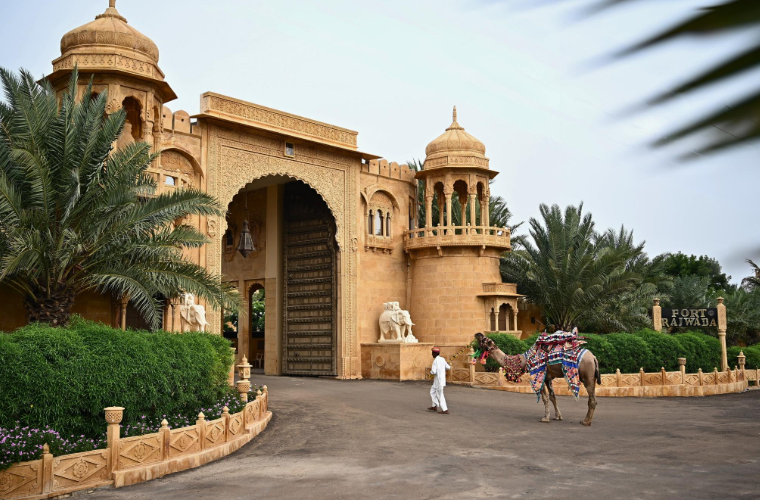
Fort Rajwada in Jaisalmer is probably the best example of what this looks like in practice. A 6-acre heritage property built in the style of a Rajputana fortress. Ninety-plus rooms spread across palace-category suites and fort-view rooms. A swimming pool that looks out toward the fort. Six distinct event spaces from carved stone courtyards to open-air terraces. The property was designed by celebrated opera set designer Stephanie Engeln, which explains why every corner feels like it was composed rather than constructed.
It’s not the only luxury option in town. Suryagarh offers a desert-fort experience outside the city. The Marriott brings international-chain reliability. A handful of restored havelis cater to the boutique crowd. But Fort Rajwada sits in a category of its own because the scale 6 acres, 90+ rooms, multiple restaurants and event spaces gives it a versatility that smaller properties can’t match.
Why People Are Choosing Jaisalmer Over Udaipur
Udaipur is gorgeous. Nobody’s arguing that. But Udaipur has also become predictable. The lake. The palace. The rooftop restaurant where you take the same photograph that ten thousand people took last month. It’s beautiful in a way that feels almost too polished. Like a film set that knows it’s a film set.
Jaisalmer has an edge that Udaipur has smoothed away. The fort isn’t a museum; three thousand people still live inside it. You buy your morning chai from a stall carved into an 800-year-old bastion. A cat sleeps on a medieval cannon. Schoolchildren chase each other through the same narrow lanes that soldiers once defended.
The desert adds a dimension that lake cities can’t offer. Sunrise over the Sam Sand Dunes. The abandoned village of Kuldhara, where an entire community vanished overnight two hundred years ago and nobody fully knows why. The quiet of Khuri village at midnight, where the only sound is wind crossing sand.
And then there’s the price conversation. A comparable luxury experience in Udaipur costs 30–40% more than Jaisalmer. The Oberoi Udaivilas charges what the Oberoi Udaivilas charges, and God bless them. But a heritage suite at a top Jaisalmer property with hand-carved architecture, desert views, and five-star service comes in at a fraction of that price. Same quality of experience. Fraction of the cost. The math is not complicated.
The Food Nobody Expects
People come to Jaisalmer expecting desert and forts. Nobody expects the food to be this good.
Rajasthani desert cuisine is built on ingenuity. When you live in a place with almost no water and limited fresh produce, you learn to make extraordinary things from what’s available. Ker sangri is a dish made from desert beans and berries that tastes tangy, spicy, and faintly bitter all at once. Panchkuta five dried desert ingredients cooked into a curry that carries flavours you won’t find in any other Indian state. Bajre ki roti with lahsun ki chutney that sounds simple and tastes anything but.
The luxury hotels here have figured out that Rajasthani food is the selling point, not the afterthought. Fort Rajwada’s Roopal Restaurant does a full Rajasthani thali that serves as a culinary education dal baati churma, gatte ki sabzi, laal maas, papad ki sabzi, all served on traditional thalis with live folk music in the background. It’s not a restaurant meal. It’s a performance.
Street food matters too. The kachori stalls near Amar Sagar Gate are legendary. Crispy, spiced, served with tamarind and green chutney that makes you wonder why you ever ate a kachori anywhere else. Mawa kachori, a sweet version stuffed with dried fruits and khoya, is the city’s dessert gift to the world.
The Wedding and Celebration Factor
Something that’s accelerated Jaisalmer’s luxury profile is the wedding crowd. The city has become one of India’s most in-demand destination wedding locations, and for obvious reasons. Golden sandstone architecture as your wedding backdrop. Pheras under a sky full of stars. Sangeet with Manganiyar folk musicians who’ve been performing for generations.
What weddings have done is force the hospitality infrastructure to level up. Hotels that might have been content with basic service had to raise their game when they started hosting 200-guest celebrations. The catering improved. The event coordination got sharper. The décor partnerships matured. Staff training became more rigorous.
The result benefits every guest, not just wedding parties. The luxury layer that was built to serve the wedding market is now available to every traveller who walks through the door. The difference between Jaisalmer hospitality in 2018 and 2026 is night and day.
Experiences You Can’t Get Anywhere Else
Luxury hotels are lovely. But what makes Jaisalmer genuinely special is the stuff that happens outside the hotel. Things you literally cannot experience in any other Indian city.
Sleeping under open skies in the Thar. Not in a tent. On a charpoy. No roof, no walls. Just you and a sky so thick with stars it looks fake. The Milky Way is visible to the naked eye. The silence is total except for wind over sand. It sounds like a cliché until you’re lying there at 2 AM and your brain goes quiet in a way it hasn’t in months.
The Jain temples inside the fort. Dating to the 12th century. Marble carvings are so delicate they look like lace. Most tourists walk through in ten minutes. Give them an hour. The craftsmanship is on par with anything in Florence or Kyoto.
Kuldhara at dusk. An entire village, abandoned overnight. Stone houses still stand in neat rows along empty streets. Nobody else was around. The evening light pouring through empty doorways. It’s beautiful and eerie in equal measure.
Manganiyar music in the desert. Not the tourist version at a hotel lobby. The real thing, around a fire in the dunes, performed by musicians whose families have been singing the same songs for five hundred years. When the kamaicha player hits a certain note and the desert wind carries it, something in your chest shifts. I can’t explain it better than that.
The Practical Side
Getting there: Direct flights from Delhi (2.5 hours), Mumbai (2.5 hours), and Jaipur (1 hour). The overnight train from Jodhpur is a solid option if you enjoy rail travel. From London, it’s one stop via Delhi.
Best time: October through March. November and February are the sweet spots of the best weather, best light. December and January are peak seasons with higher prices but festive energy.
How long: Three nights is the right amount. Two feels rushed. Four gives you breathing room for a desert overnight and deeper exploration.
What it costs: A luxury heritage room in Jaisalmer runs ₹8,000–18,000 per night during season. A comparable experience in Udaipur or Jaipur’s top-tier properties starts at ₹25,000+. The value proposition is hard to argue with.
The City That Doesn’t Chase You
Jaisalmer doesn’t have a PR team. It doesn’t sponsor influencer trips. It hasn’t rebranded itself for the Instagram era. The fort has been standing there since 1156, glowing gold at sunset, not caring whether you visit or not.
That indifference is part of the charm. In a world of curated experiences and algorithm-fed travel recommendations, there’s something deeply appealing about a place that hasn’t optimised itself for your attention. It’s just there. Ancient, golden, quiet.
The luxury travellers who’ve discovered it tend to keep it to themselves. Partly because they want to come back to it uncrowded. Partly because explaining Jaisalmer to someone who hasn’t been there is like explaining a colour they’ve never seen.
Go. You’ll understand.






Comment