
Why Is My Website Not Ranking on Google? 12 Reasons to Investigate

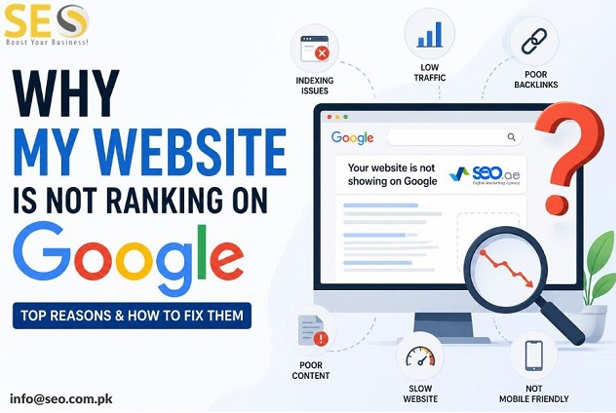
Ranking a business website on major search engines is more than indexing pages or creating new pages. You search for relevant keywords and phrases that match your business goals. But you are not achieving ranking goals, not anywhere near them, despite putting in the effort. So, what is the reason your team cannot rank on Google or Bing or any other search engine? And what role a professional SEO consultant can play in boosting your search engine rankings? These are vital questions that need a proper answer.
There is no one-size-fits-all answer any SEO Company or expert can give you your website may struggle first because many pages never get indexed. However, there are several other factors such as search intent mismatch, content quality, wrong keyword targeting, technical SEO issues, and stronger UX appeal. So, if you’re not a digital marketing expert, no worries. We’ll guide you on how effective SEO services can impact your Google rankings in the long run. Read till the end. Our top SEO specialists will show you 12 reasons your personal or business website isn’t ranking on Google, and how to fix them.
1. Your Page May Not Be Indexed
Before worrying about rankings, establish whether Google can actually include the page in its search results. A vital consideration is to figure out why Google isn’t indexing your pages or posts. Is it due to a noindex directive, or is the page not being discovered by the crawler? The first tool to identify and diagnose this issue is Google Search Console. It you figure out why the page is not indexed; the ranking will not improve.
What to check:
- Is the correct URL indexed?
- Can Google crawl the page?
- Is a noindex directive present?
- Is Google selecting a different canonical URL?
- Can the page be reached through internal links?
2. You’re Targeting a Keyword That Is Too Competitive
You thought you figured out keywords right. Sometimes, your relevant keywords are not realistic keyword choices for your niche. Consider a new website targeting “study in the UAE for Pakistani students.” This keyword can be competitive because many other top agencies are also ranking for it. We’re not saying you should ignore the relevant keyword. However, you may need a better keyword choice or strategy. Also, look for searches that more closely reflect your target audiences and areas where you are providing services. In this case, it’s Pakistan.
3. Your Content Isn’t Useful Enough for the Searcher
When you are writing a page that 3,000 or more words of content, don’t assume or imagine that Google will consider it useful for its readers. Ask yourself whether this page can genuinely create value and help your audiences. Content may underperform when it:
- Gives only a superficial explanation
- Leaves important questions unanswered
- Contains outdated information
- Makes unsupported claims
- Repeats generic information found everywhere
- Fails to provide useful examples or practical guidance
4. Technical SEO May Be Limiting Your Visibility
This is extremely important because technical SEO problems are not always visible. You should proactively examine the following issues on your website, such as broken links, wrong URLs, no-index directives, and pages not being crawled. Also look for issues such as:
- Duplicate URL versions and poor mobile usability
- Slow or unstable page performance
- Don’t try to index pages quickly
5. Your Website Has Limited Relevant External Recognition
So, you have been following a link-building strategy with external and internal linking. However, not earning credible and high-quality links didn’t help your website build authority. This means you may have been incorporating several poor-quality website links for years. Examine this and look to earn useful and original links that improve digital prowess of your website and help you create better relationships. That requires:
- Genuine outreach and expert contributions
- Relevant professional or business listings
- Content that other websites have a genuine reason to reference
6. Your Internal Linking Is Too Weak
Both external and internal linking strategies help your website rank poorly or strongly. Using an internal linking strategy will also send a positive signal to Google to identify a unified cluster of pages connected strategically. Look for linking all of your blogs and articles to a main topic. Then, create a cluster and topical authority map. Also use descriptive anchor text to make sense of your internal linking.
7. Impressions but Fewer Clicks Problems
Poor search engine visibility also means that your pages are getting lots of impressions online. However, if you examine your Search Console information, it shows you that very few people are actually clicking on your link at the SERP. So, examine which queries are producing the most impressions and how many clicks a page is getting. There is no point in imagining that improving click-through rate automatically guarantees higher rankings.
8. The Page Experience is Not What You Desire
If you’re creating valuable content with proper research and data, there is no way your pages can get ignored by Google. However, there can be a problem with page speed and website navigation that ultimately sends users to other pages, despite all the good content they have. So, review:
- The page speed of every single page
- Is the main information easy to find?
- Is the text comfortable to read?
- Does the page work properly on mobile?
- Can visitors move easily to related information?
9. Your Topic Coverage is Poor
Your website pages cannot remain poorly connected. You need to work on it by creating a stronger connection between pages. For instance, you should look for questions your audience is asking on Google. Also, you should build quality content and copywriting skills to cover broad topics in detail. Then do proper internal linking. This will offer greater topical depth to your website pages.
10. Search Intent Mismatch
Search intent mismatch is another problem you need to solve as quickly as possible. Even though you’re targeting a good keyword, it does not match the search intent of that page. What should you do? Ask your team if a specific guide or a product page is providing genuine value to readers. Map it against the search intent of readers.
11. Weak Competitors Analysis
Mostly, websites that rank low often suffer from a weak competitor analysis. Your competitors may be doing great and getting more traffic and leads. This may happen because they may have created a strategy to build better topic coverage and done stronger internal linking. They might have also done the following to improve outcomes, such as:
- Better page experience and more useful examples
- Clearer service positioning and relevant external references
- Original and researched content rather than copying
So, don’t just add keywords; see if your users are searching for the content you are writing for. It must align better with their intent.
12. Don’t Expect Top Rankings Too Early on Google
Are you impatient to see better rankings and results on Google for your web pages and blogs? Google does not work that way. The algorithm keeps changing. It takes some time to discover your new web pages and rank them or index them with other competing pages on the internet. However, that does not mean you should wait forever to see results. What you should do is to get creative. Put your experimental hats on and try some fixing on your blog pages and images. Use alt text, do A/B testing of headlines and hashtags, and find and remove technical SEO glitches. If you want your page performance and discovery to improve over time, give Google evidence that it should consider it an authoritative page.
The Bottom Line
Do you want to see what kind of a ranking problem you have? Your pages may not be competitive enough. It may fail to match search intent. Its content may not be useful enough. However, a good strategy is to find a solution that changes your ranking with proper strategy. Once you are on the right track, you will not lose audience bounces off your pages. Effective SEO is not about finding a magical formula for your rankings. It is about making your content and keywords relevant and easier to discover by search engines. This is where professional and top SEO company can help you discover the right strategy for your ranking problems. We are effective for Pakistani businesses because we are the oldest in the industry. We help businesses understand their loopholes and provide solutions that fit their specific needs.







Comment