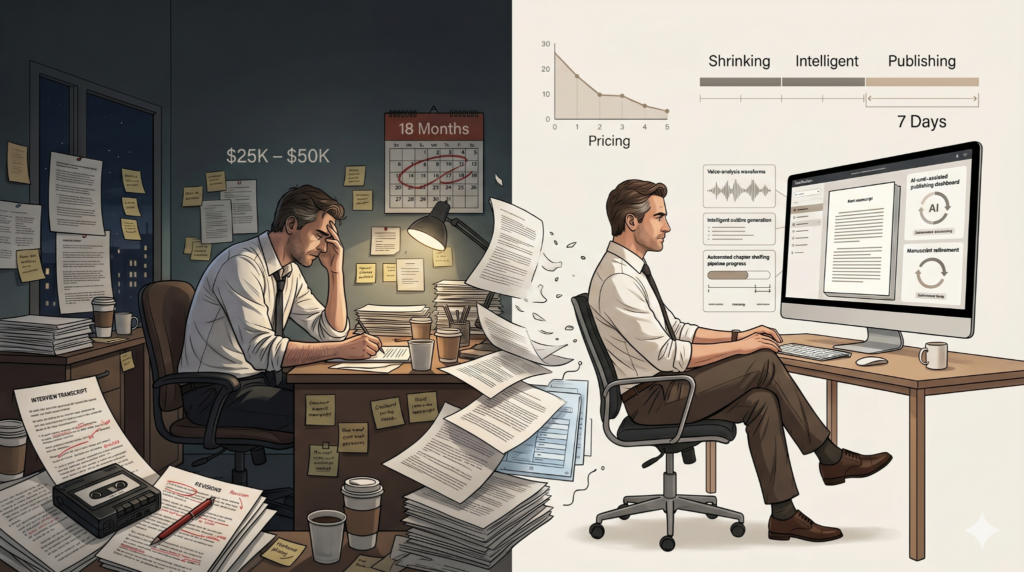
The professional ghostwriting market long a quiet, premium-priced corner of the publishing industry is having its first economic discontinuity in decades.
For thirty years the price floor for a serious nonfiction ghostwritten book held remarkably steady. Adjusted for inflation, a typical engagement in 1995 cost roughly what one cost in 2023: somewhere between $15,000 for a short business book and $50,000 for a substantive memoir or category-defining title. The reason the price was sticky is simple. The cost structure was almost entirely human labor — interviews, transcription, drafting, revision, editing, project management — and human labor does not get cheaper. If anything, the senior writers capable of producing a book worth reading became scarcer over time, not more abundant.
Then, in roughly an eighteen-month window, the cost structure underneath that price stopped behaving like a fixed input.
What changed is not the writing
Generic AI prose has been available since 2022, and the professional ghostwriting market correctly ignored it. A polished, voiceless first draft is not what clients pay $25K for. They pay for judgment — the ghostwriter’s ability to find the through-line in five hours of interviews, to know which story belongs in chapter one versus chapter eleven, to keep the author from publishing an embarrassing version of themselves.
What changed is that the layer between judgment and finished pages — the part that used to consume most of the ghostwriter’s billable hours — is now a software problem.
A modern publishing studio handles roughly 70-80% of what used to be billable ghostwriting time. Voice extraction from a small set of writing samples. Outline generation that produces something defensible on the first pass instead of the fifth. Chapter drafting that compounds across the book — every accepted edit makes the next chapter more accurate. Continuous evaluation against the author’s stated standards before any draft reaches their inbox. None of this replaces editorial judgment. All of it replaces the manual production work that judgment used to be wrapped inside.
The economic consequence is straightforward. A ghostwriter using a modern studio internally can produce the same quality output in roughly a third of the calendar time, with materially less manual drafting. Either their effective rate triples, or the market price corrects downward, or — most likely — both happen unevenly across the industry.
The clients are noticing faster than the providers
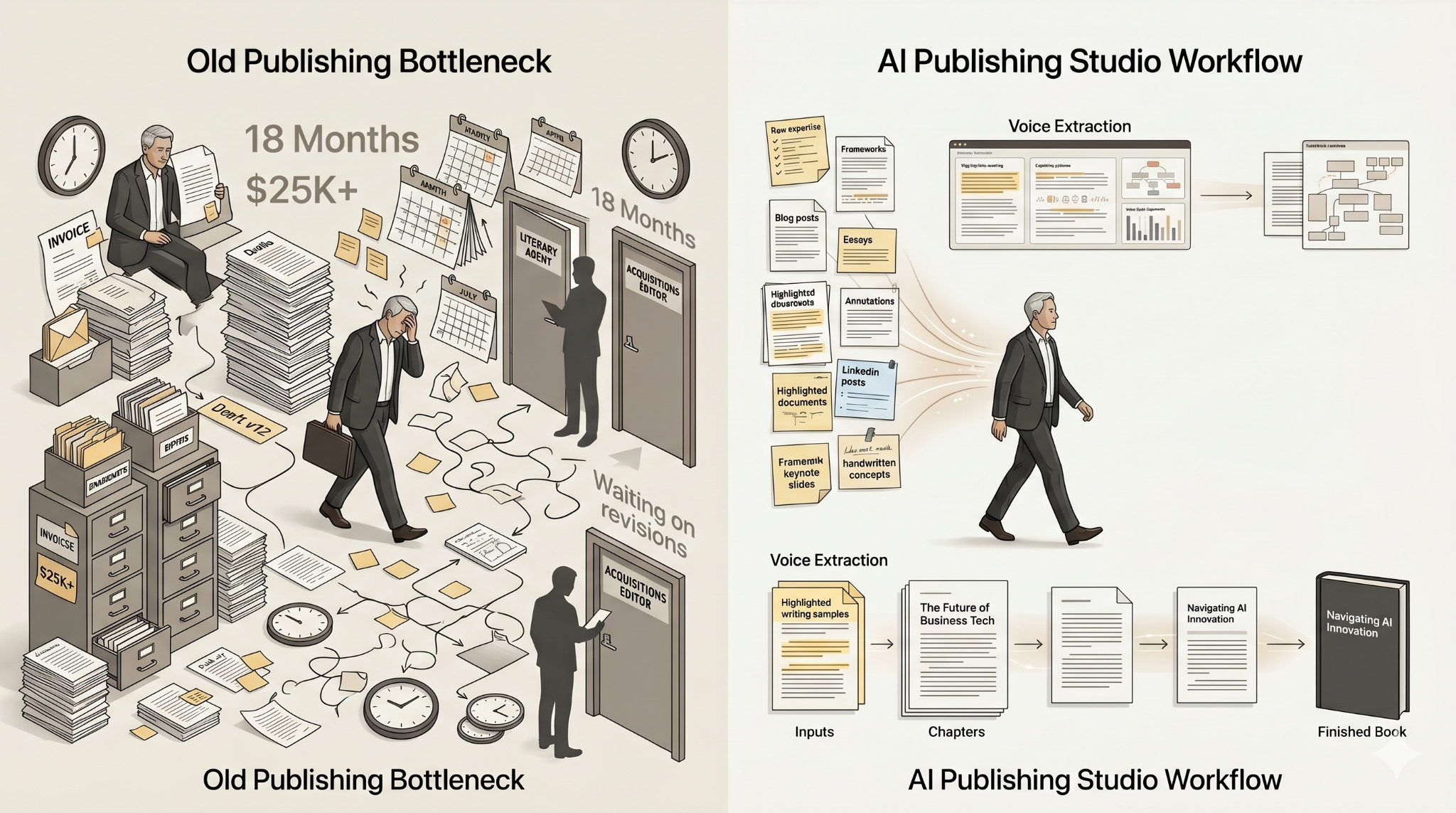
Senior professionals — consultants, executives, surgeons, founders — were always the natural buyers for ghostwriting. They have authority, accumulated expertise, and constrained time. They were also, historically, the customer segment most likely to abandon the project mid-engagement when the timeline slipped past eighteen months.
For this segment, the $25K-and-eighteen-months model was the only available option for a long time. It is no longer.
AuthorOS, one of a handful of platforms purpose-built for the domain expert rather than the novelist or content marketer, now offers what amounts to a productized ghostwriting workflow at a small fraction of the traditional cost — pricing tiers in the low hundreds rather than five-figure packages, with the manuscript pipeline running in days rather than quarters. The tool is opinionated about who it serves: the consultant with twenty years of frameworks, the doctor with a backlog of stories her residents ask for, the founder who already has the book in their head and just needs the structural infrastructure to get it out.
Other entrants are appearing in adjacent positions. Some are extensions of existing self-publishing platforms. Some are AI wrappers built for general fiction writers being repositioned toward nonfiction. The category is forming visibly, and within twelve to twenty-four months it will likely have its three or four serious entrants and a long tail of feature-poor imitators.
The traditional market is not disappearing
A specific tier of buyer — the celebrity memoir, the political book, the high-stakes corporate biography — will still pay seven figures for a writer of record whose name on the project signals quality on its own. That market is structurally insulated. The buyer is paying for the writer’s reputation, not their throughput.
But the much larger market — the professional who wants a credible, voice-accurate, well-structured book and was previously priced out — is shifting. And it is shifting in a way that resembles every prior software-enabled disruption of a service business: the price floor breaks first, the timeline compresses second, the underlying buyer expands third.
Three things to watch over the next year
First, expect ghostwriting agencies to begin quietly using AI publishing studios internally while continuing to charge premium rates. This is the standard playbook for service businesses facing software disruption. It works for two to three years, then collapses when clients learn to run the studio themselves.
Second, expect a meaningful increase in nonfiction publication volume from a specific demographic — senior professionals in their 40s, 50s, and 60s — that had been blocked by the old timeline. This will be visible in book industry data within twelve months.
Third, expect the early signals from this segment to influence how trade publishers think about acquisitions. A book proposal from an expert who already has a finished, voice-accurate draft is a fundamentally different acquisition object than one with a sample chapter and a promise.
The price floor was never about the value of the book. It was about the cost of producing it. That cost has moved, and the rest of the market is now adjusting in slow motion to a change that has, technically, already happened.