
Why Are Pakistani IT Professionals Choosing Canada and Australia


Why Are Pakistani IT Professionals Choosing Canada and Australia in 2026?
Pakistan’s technology sector is reporting record growth. According to the Ministry of IT and Telecom, ICT exports reached $4.6 billion in fiscal year 2025-26, up 20.6% on the previous year. Yet many of the developers, engineers and analysts behind those results are planning their next career move abroad.
Official overseas employment data shows that more than 90,000 Pakistanis in selected professional categories have taken jobs abroad since the start of 2024, including about 4,150 computer programmers and systems analysts.
For IT professionals who want to settle abroad permanently rather than work on a short-term contract, Canada and Australia stand apart. They are among the few major destinations that grant permanent residency to skilled workers without a job offer, and both offer large technology job markets and a path to citizenship.
Skilled immigration consultants in Pakistan provide the profile assessment needed to determine which country offers the stronger pathway, a step that has become essential since both countries revised their rules for tech workers in 2026.
Five Reasons Canada and Australia Attract Pakistani IT Professionals
- Stable earnings: salaries in Canadian or Australian dollars are protected from rupee depreciation and inflation, although higher taxes and living costs reduce actual savings.
- Career growth: larger technology markets offer more senior roles, specialist teams and work on global products.
- Permanent residency: unlike employer-tied Gulf work visas, permanent residency lets skilled workers settle with their families and apply for citizenship after 3 years of physical presence in Canada or 4 years of residence in Australia.
- Family benefits: permanent residents can enrol their children in public schools and receive healthcare through Medicare in Australia or provincial health insurance in Canada.
- International experience: Pakistani IT freelancers earned about $1.16 billion from foreign clients in FY2025-26, up 49.4%. Many applicants therefore already work with global tools, standards and English-speaking teams.
Canada Express Entry for IT Professionals
Express Entry is Canada’s application system for three federal economic programs: the Federal Skilled Worker Program, the Canadian Experience Class and the Federal Skilled Trades Program. Candidates receive a Comprehensive Ranking System (CRS) score based on age, education, language results and work experience, and those ranked highest in each draw receive an invitation to apply for permanent residency.
CRS Points for High-Wage Tech Occupations
Most IT roles, including software developers and data scientists, are not part of Canada’s 2026 STEM category, which focuses mainly on engineering occupations and cybersecurity specialists. On 16 October 2026, however, Immigration, Refugees and Citizenship Canada (IRCC) announced a new Labour Market Integration factor, effective 3 November 2026. The factor awards points for a qualifying job offer based on how the occupation’s median wage compares with the national median:
- 100 points (2x the median): computer and information systems managers (NOC 20012)
- 70 points (1.5x the median): software engineers and designers (NOC 21231), software developers and programmers (NOC 21232), data scientists (NOC 21211), cybersecurity specialists (NOC 21220) and several other IT specialist roles
- 50 points (1.3x the median): web developers and programmers (NOC 21234)
The offer must generally cover full-time, continuous work for at least one year after the candidate becomes a permanent resident. Candidates with at least 12 months of Canadian experience in these occupations can instead earn 20 to 70 points for that experience. IRCC counts whichever option scores higher, and the factor is capped at 150 points.
A qualifying job offer also no longer requires a Labour Market Impact Assessment (LMIA). This saves Canadian employers the CAD 1,000 government fee and the minimum four-week recruitment campaign that an LMIA normally requires.
How the CRS Changes Affect IT Applicants in Pakistan
The new points reward tech workers with a Canadian job offer or work experience in Canada. A developer in Lahore or Islamabad without either does not benefit directly and must still compete on core CRS factors. Strong English results, a recognized degree, and well-documented experience therefore remain essential. The removal of the LMIA requirement, however, makes it easier for Canadian employers to extend qualifying offers to candidates abroad.
Provincial Nominee Programs for Tech Workers
An enhanced provincial nomination, issued through a stream linked to Express Entry, adds 600 CRS points and almost guarantees an invitation. Canada’s 2026-2028 Immigration Levels Plan targets 91,500 Provincial Nominee Program admissions in 2026, and several provinces reshaped their technology pathways this year:
- Ontario replaced its former streams with the job-offer-based Ontario Workforce Priority stream on 26 June 2026.
- Saskatchewan added technology to its 2026 priority sectors, alongside healthcare, agriculture, skilled trades, mining, manufacturing and energy.
- British Columbia closed its Tech, graduate and entry-level streams in April 2026 and now nominates candidates under three pillars: Care, Build and Innovate. Some high-impact technology roles may still qualify under Innovate.
Because provincial streams now change several times a year, AIRCS immigration consultants assess IT professionals’ profiles against both the Canadian and Australian systems before recommending the stronger route.
Australia Skilled Visas for IT Professionals
Australia offers software engineers a clearer occupation-based route to permanent residency, because core IT occupations such as Software Engineer (ANZSCO 261313) and Developer Programmer (ANZSCO 261312) remain on its skilled occupation lists.
Points-Tested Visas
Candidates first submit an Expression of Interest (EOI) through SkillSelect, then apply for one of three visas:
- Skilled Independent visa (subclass 189): a permanent visa that needs no sponsor, with invitations issued to the highest-scoring candidates.
- Skilled Nominated visa (subclass 190): a permanent visa that requires nomination by a state or territory, which adds 5 points.
- Skilled Work Regional visa (subclass 491): a provisional visa for applicants nominated by a state or territory or sponsored by an eligible relative in regional Australia. It adds 15 points and leads to permanent residency through the subclass 191 visa after three years.
Applicants need at least 65 points to submit an Expression of Interest, but IT occupations are far more competitive, with industry estimates putting recent subclass 189 invitations for software engineers at 95 to 100 points.
ACS Skills Assessment and the Subclass 482 Visa
Applicants in ICT occupations need a positive skills assessment from the Australian Computer Society (ACS), which reviews qualifications and work experience against the nominated occupation. Professionals with an Australian job offer can also apply for the employer-sponsored Skills in Demand visa (subclass 482). After two years with their sponsor, visa holders can apply for permanent residency through the Employer Nomination Scheme visa (subclass 186).
Canada vs Australia for IT Professionals
Australia favours IT professionals who can score highly on the points test without a job offer, while Canada now favours those with a Canadian job offer or Canadian work experience.
| Factor | Canada | Australia |
| Main system | Express Entry (CRS score) | SkillSelect (points test) |
| IT-specific advantage | High-wage CRS points for a job offer or Canadian experience | Software Engineer and developer programmers remain on the skilled lists |
| Credential assessment | Educational Credential Assessment (ECA) | ACS skills assessment |
| Accepted English tests | IELTS General Training, CELPIP-General, PTE Core | IELTS, PTE Academic |
| Largest points gain | Enhanced provincial nomination (600 points) | Superior English (20 points) |
| Best suited to | Candidates with a Canadian job offer, Canadian experience or a high CRS score | Software engineers with strong English and several years of experience |
Applicants preparing for both countries can use the same experience letters and HEC-verified degree, but each country requires its own credential assessment and accepts different English tests.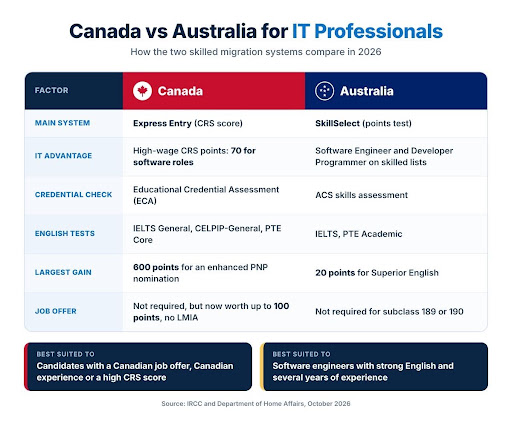
How to Prepare a Strong Skilled Immigration Application
Credential assessments and language tests must be completed before you can submit a profile, so preparation usually takes several months. The following steps apply to both countries:
- Match your job to an occupation code. Choose the National Occupational Classification (NOC) code for Canada or the ANZSCO code for Australia based on your actual duties. A job title alone does not establish eligibility.
- Get your degree assessed. Have your degree verified through the Higher Education Commission (HEC), then apply for an Educational Credential Assessment (ECA) from an IRCC-designated organisation for Canada or an ACS skills assessment for Australia. HEC verification does not replace either assessment.
- Maximise your English score. Superior English earns 20 points in Australia, and higher results raise several CRS factors in Canada.
- Document your experience properly. Experience letters should be on company letterhead, signed by a manager or the HR department, and should list your duties, employment dates, weekly hours, and salary. Support them with employment contracts, payslips or tax records.
- Compare your scores. Use IRCC’s CRS tool and the Home Affairs points test to identify where your profile is more competitive.
- Prepare funds and police certificates. Federal Skilled Worker candidates must show settlement funds unless they hold a valid job offer and are authorised to work in Canada. Canada requires police certificates from every country where you have lived for 6 months or more since age 18, while Australia requires them from every country where you have lived for 12 months or more in the past 10 years.
Common Mistakes That Delay Skilled Immigration Applications
Skilled immigration rules change every year, and small errors can cost months or lead to refusal. Common mistakes include:
- choosing a NOC or ANZSCO code that does not match actual job duties
- relying on outdated information, such as a provincial tech stream that has since closed
- submitting experience letters that omit duties, working hours or salary details
- underestimating the English score needed to stay competitive
- trusting agents who promise guaranteed visas or sell job offers
The most serious mistake is submitting false or misleading documents, as misrepresentation can lead to a five-year ban from applying to Canada and a three-year bar from most Australian visas.
Conclusion
Pakistani IT professionals are choosing Canada and Australia for the same reasons: stable earnings, career growth and a permanent future for their families. Australia offers software engineers a clear occupation-based route, while Canada’s new high-wage points favour tech workers who secure a Canadian job offer.
Those who succeed start early, raise their English scores, document their experience carefully and apply under current rules rather than last year’s. For professionals unsure which country suits their profile, AIRCS Group provides skilled immigration assessments for Canada and Australia from its offices in Rawalpindi, Islamabad and Faisalabad.







Comment