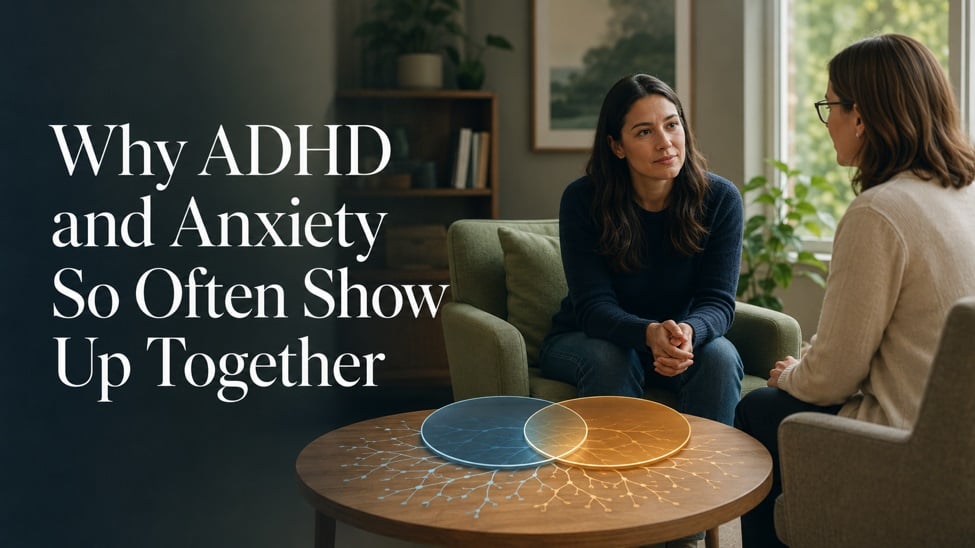
ADHD rarely shows up alone. A significant share of adults living with ADHD are also managing an anxiety disorder, and when both are present, they tend to interact in ways that make each condition harder to recognize and treat if only one gets addressed. Understanding why they overlap so often is a meaningful part of getting ADHD therapy that actually works.
The Numbers Behind the Overlap
Roughly 7.9 million adults live with both ADHD and an anxiety disorder, a substantial overlap that reflects something more than coincidence. The two conditions frequently feed into each other, which is part of why symptoms often look different when they occur together compared to how either condition presents on its own.
How ADHD Can Generate Anxiety
Living with untreated or poorly managed ADHD often produces its own chronic stress. Missed deadlines, forgotten commitments, disorganization that affects work and relationships, these accumulate over time into a persistent undercurrent of worry: worry about forgetting something important, worry about how others perceive the pattern, worry about the next deadline slipping the same way the last one did. This isn’t a separate anxiety disorder appearing coincidentally. It’s often a direct downstream effect of ADHD symptoms that haven’t been addressed.
How Anxiety Can Worsen ADHD Symptoms
The relationship also runs in the other direction. A stressed brain has very little bandwidth left over for focus, and chronic stress tends to make ADHD symptoms worse, not just harder to manage. Anxiety can intensify inattention, disrupt sleep in ways that further degrade concentration, and increase impulsivity as a stress response. Someone managing both conditions can find themselves in a cycle where each one actively feeds the other.
Why Treating Them Separately Often Falls Short
A common but flawed approach treats ADHD and anxiety as two separate issues to work through independently, sometimes with different providers who don’t coordinate. This tends to leave gaps. Addressing ADHD symptoms without accounting for the anxiety they’ve generated leaves that anxiety fully intact even as attention and organization improve. Addressing anxiety without addressing the underlying ADHD driving it often means the anxiety keeps regenerating from the same source, since the root pattern hasn’t changed.
What Integrated Treatment Actually Looks Like
Effective treatment for co-occurring ADHD and anxiety addresses both together rather than treating one and hoping the other settles on its own. This means untangling which symptoms belong to which condition, since that distinction shapes the entire treatment plan, and building an approach that accounts for how the two interact for that specific person. Therapies like Cognitive Behavioral Therapy and stress-focused approaches are often used together, since chronic stress and disrupted sleep tend to worsen both conditions simultaneously, and addressing the stress load directly often improves focus and attention as a secondary benefit.
Why an Accurate Evaluation Matters So Much Here
Because ADHD and anxiety symptoms can mask or resemble each other, an accurate evaluation is what makes it possible to build a plan that addresses the actual pattern rather than chasing whichever symptom happens to be most visible. This is part of why treatment planning should start with a real conversation about someone’s specific experience, not a generic protocol applied to either diagnosis in isolation.
How This Gets Addressed in Practice
Therapy Now in Berlin, New Jersey addresses ADHD and anxiety together when both are present, rather than treating one and hoping the other settles, recognizing that untangling which symptoms belong to which condition shapes the whole treatment plan.
The Bottom Line
ADHD and anxiety frequently occur together because they actively reinforce each other, not by coincidence. Treatment that addresses both simultaneously, rather than picking one to focus on first, tends to interrupt that cycle more effectively than treating either condition in isolation ever could.