The retail markets of Central Asia can truly be called emerging. In Tashkent and Almaty, the average retailer runs 40 to 80 stores, sells through shopping malls, marketplaces, and Telegram channels simultaneously, and doubles revenue year over year. And while doing all of that, the same retailer is still reconciling warehouse balances in Excel, postponing the SAP integration due to urgent deadlines and tight budgets, and getting by without the IT team that would make operations more efficient. The market is expanding and generating healthy revenue, but for a long time, it has lacked an operating system in the “all-in-one” sense. The Tashkent-based technology company OX took on this problem and built one of the first Commerce OS platforms designed for international markets.
The growth is there. The operational base is not.
The offline retail numbers tell the story. In 2022, the Uzbek retail market stood at $14 billion; the projection for 2027 is $19.6 billion. Online retail has grown faster: $311 million in 2022 to $1.2 billion within two years. E-commerce CAGR for Uzbekistan from 2022 to 2027 is estimated at 41–47%. European markets last saw a pace like that in the early 2010s.
What is driving growth that outpaces Europe? Demographics, mostly. Most of the Uzbek population is under thirty, and the 18–39 cohort accounts for 33.2%. These are the people ordering sneakers on a marketplace at four in the morning, and that behavior is becoming the baseline of consumer demand. The same picture is visible across Central Asia, Turkey, and the Gulf.
Infrastructure has not kept pace with the demand curve. Retailers work with disconnected systems: POS from one vendor, accounting from another, and warehouse tracking in Excel spreadsheets. This operational base cannot serve the demand that the region is now producing. Picture the scenario: a customer orders a t-shirt through a Telegram store, the seller sees in the spreadsheet that the item is in stock, and at the same moment, the same t-shirt has just been sold in the offline store. Data desync turns into a complaint and, often, the loss of a customer.
Why Western platforms do not work here
European retail management platforms were built for different market conditions, and they do not transfer cleanly to Central Asia.
SAP S/4HANA takes 12 to 18 months to deploy and is priced accordingly. For a company that opens another 30 stores in the same period, the math does not work. Oracle Retail assumes the buyer has an in-house IT team to maintain the system after launch; the average regional operator does not have that team and will not hire one in the foreseeable future. A Shopify Plus stack with a separate WMS requires integration work that, in the Central Asian context, entails connecting to local payment systems (UzCard, HUMO), supporting Uzbekistan’s fiscal regime, and handling the country’s mandatory product-marking requirements. Each of those becomes a separate custom project, multiplying an already high implementation cost.
As a result, mid-sized regional retailers, the segment driving most of the actual growth, end up without software that fits their needs for unified process management. Neither the large Western platforms nor the available local tools deliver a stack that brings everything into a single system without complex technical integration.
OX: the operational layer for a market without infrastructure
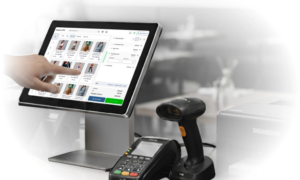
OX approaches the problem from the constraints side. Our team is building a Commerce OS, not just another retail platform: a single system that combines the modules that operators across segments and at different stages actually need. POS, CRM, e-commerce, analytics, payments, RFID, and several other capabilities are integrated into a single product, so businesses do not have to manage multiple unsynchronized platforms in parallel.
OX RFID has become one of the most distinctive modules. It was made possible by partnerships with Chinese companies that lead the world in RFID hardware production. RFID equipment usually arrives in Central Asia without localization, with no awareness of local payment rails or mandatory product marking. OX sources the hardware and writes the software layer that integrates RFID seamlessly into the rest of the business stack, offering a broader feature set. Tags are scanned, and the data flows immediately into the warehouse, the cash registers, and the online catalog, without any of the channels falling out of sync.
The decisive point is that the entire system can be deployed without an IT department within a short timeframe and can be learned in a few days. That has allowed roughly 4,000 stores in Uzbekistan, Kazakhstan, and other countries to put OX into production.
Where the export of technology is heading
Retail technology has historically been built in Redwood City or Walldorf and then adapted for the rest of the world. That model worked while the operational complexity sat in mature markets. The picture today is different.
Mature markets are stable and they generate demand for optimization. Emerging markets generate demand for basic operational coherence under conditions that keep moving: unreliable internet, new fiscal requirements, volume spikes. Building for the second scenario is harder. A product that works under those conditions covers a wider range of cases by default.
This is not to say that OX will inevitably displace SAP in the European market. As Central Asian, South Asian, and African markets mature, technologies built for their conditions will become harder to ignore, including for Western corporate buyers operating under comparable operational loads.
The direction in which technology export flows is gradually shifting. OX is one of the early signs of that shift.