A restaurant TikTok account is often judged by views. An operator should ask a tougher question: can a nearby potential customer quickly understand the food, location, atmosphere and next step—and can the business connect that attention to a booking, order or visit?
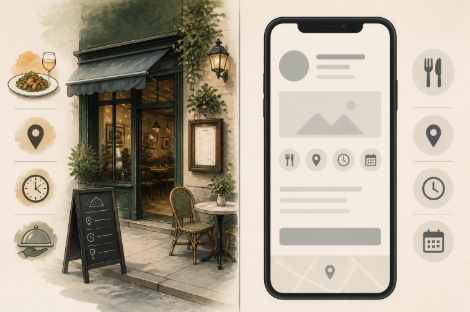
That is the value of treating TikTok as a digital shopfront. It does not replace a restaurant’s premises, map listing, website or reservation system. It is a practical operating analogy: each video and profile visit should help a customer decide whether the restaurant is relevant, available and worth trying.
A shopfront answers the obvious questions
Treat the profile as a digital shopfront: useful information should be easy to find before a customer visits.
A physical window shows the product and signals what kind of place sits behind the door. A TikTok profile should do comparable work. A first-time viewer should be able to establish:
- what the restaurant serves and what makes it distinctive;
- where it is and when it trades;
- what a normal visit, collection or delivery experience looks like; and
- how to see the menu, book, order or get directions.
Start with these basics before pursuing reach. Keep the restaurant name, branch, opening hours and menu or booking route accurate. A multi-site operator should make the featured location unmistakable. If a video shows a temporary special, a price, a dietary claim or a limited service window, check that it remains current.
This is practical judgement, not a promise that profile optimisation will generate local demand. Its purpose is simpler: to remove avoidable friction once attention arrives.
Make the food legible, not merely attractive
Food close-ups can stop a scroll, but they do not necessarily explain the offer. A useful signature-dish video gives enough context for a customer to decide whether it suits them: the dish name, service style, neighbourhood or city, and—where appropriate—price, portion context, dietary information or availability.
A repeatable format is usually more realistic than occasional polished production. A bakery can show the morning batch; a lunch counter can explain its fastest combination; a dinner restaurant can introduce a changing special before service. Use spoken explanation and on-screen text so the premise remains clear when someone watches without sound.
The aim is not to turn every post into an advert. It is to ensure that a memorable clip also communicates the actual proposition. Avoid presenting an exceptional portion, one-off service moment or item that is routinely unavailable as though it were standard.
Show people and process without staging a false promise
The food is the merchandise. The people and process can explain why it matters. An owner discussing a regional recipe, a chef demonstrating a technique, or a server explaining a popular order can give context to an offer that a plated shot alone cannot convey.
This approach is particularly useful when the value lies in specialist ingredients, cultural knowledge, preparation, dietary expertise or a distinct service ritual. It can also create a more sustainable content calendar than permanent discounts and launches.
These are content ideas to test, rather than evidence that behind-the-scenes footage will improve sales. The operational test is whether the experience shown resembles normal service. Front- and back-of-house teams should know what has been promised online, because they will be asked to fulfil it.
Build for local relevance, not broad applause
A widely viewed video outside a restaurant’s trading area may have little commercial value. For most independent operators, local relevance is a better working objective than generic reach.
Name the location naturally in the spoken script, caption and on-screen text. Describe dishes in terms customers use rather than internal menu shorthand. Use an accurate location tag where the feature is available. These measures may help a relevant viewer assess the post; they do not guarantee local distribution by TikTok.
A local story also broadens the material available: a market delivery, a pre-theatre service, a neighbourhood collaboration or a weather-led special can make the restaurant easier to place in a customer’s routine.
There is a useful cautionary example in the viral attention received by Coventry fish-and-chip takeaway Binley Mega Chippy in 2022. Contemporary BBC reporting described queues and surging interest after the business became a TikTok meme. The episode illustrates why capacity and clear communication matter, but it does not show that TikTok alone caused demand or that viral attention creates durable, profitable custom.
Give attention a defined next action
A useful TikTok presence connects attention to a clear customer action and a deliverable experience.
The intended journey should be short:
video → profile → menu, map or booking route → visit or order → follow-up experience → repeat visit.
Each hand-off can fail. A weekend-special video should not lead to an expired menu. A reservation-focused post should not force users to search a website for the booking button. A takeaway offer should state collection, delivery area and cut-off times.
Use a concrete call to action: “See today’s menu,” “Book Friday dinner,” “Find the Brixton site,” or “Order before 8pm.” For a campaign, create a distinct landing page, tracking parameter or code. Ask bookers and walk-ins how they heard about the business, and give staff a simple way to record the answer.
TikTok’s advertising tools can measure defined website events when an operator has configured its website data connection. That can assist campaign analysis, but it is not complete proof that a video caused a sale: platforms and booking, web and point-of-sale systems can apply different attribution windows and definitions. Reconcile platform reporting with completed bookings, orders, redemptions and trading data.
Creators are discovery partners, not sales guarantees
Creators and customer posts can introduce a restaurant to audiences it may not otherwise reach. Selection is an operational judgement: review likely audience geography, dining relevance, content style and the creator’s ability to communicate an accurate experience—not just their follower count.
Agree practical details before a hosted or paid visit: what is being provided, which items are available, filming boundaries, guest numbers, timing and whether the restaurant may reuse content. Do not require a positive review. Do provide accurate information and enough notice for the team to deliver the experience shown.
For US-linked activity, the Federal Trade Commission says that paid, free or discounted relationships behind endorsements should be disclosed clearly and conspicuously with the endorsement itself. Operators elsewhere should check the advertising, consumer-protection, privacy and promotional rules that apply in their own market.
Chain case study: useful mechanics, limited transferability
Large brands can demonstrate campaign mechanics, but not provide a blueprint for a single-site restaurant. In an official TikTok case study, Portillo’s reported an 18% increase in site visits within 24 hours after a Chicago-area TikTok Creative Challenge involving creator content and routes to nearby restaurants and online ordering.
That is a platform-reported, campaign-specific result and may reflect paid activity, established awareness, a defined geography and resources unavailable to independents. It should not be read as evidence that organic creator posts will produce the same outcome. The transferable lesson is modest: content, geography and a next action should be designed as one customer journey.
Prepare operations before promoting demand
The risk is not a successful post; it is a gap between the advertised experience and the real one. Before boosting content, inviting creators or launching an offer, check:
- stock levels and realistic daily capacity;
- staffing, queue, reservation and collection rules;
- how sold-out items, waits and substitutions will be communicated;
- who can pause or amend a promotion; and
- how the team will respond if a featured item disappoints.
A small operator may simply cap a special at a stated number per day. That is clearer than allowing customers to discover a shortage after travelling. The long-term opportunity is not the initial queue but whether a first-time guest receives a reason to return.
Measure qualified attention, not vanity metrics
Views and followers are signals; bookings, orders and repeat visits are closer to the operating result.
Views, likes and followers are diagnostic signals. They are not revenue, profit or loyalty. Separate the dashboard into three levels:
| Attention | Qualified actions | Commercial outcomes |
| — | — | — |
| Views, watch time, shares, comments | Profile visits, menu clicks, map taps, calls, booking starts, code use | Completed bookings, orders, covers, average order value, repeat visits, contribution margin |
Compare formats, locations, dayparts and offers. A modest local clip that produces attributable covers may be more useful than a widely watched post with no relevant action. Where possible, compare campaign costs and redemptions with normal trading patterns rather than crediting every sale to TikTok.
Follower growth belongs in the attention column, not the revenue column. It may be worth monitoring when followers are relevant to the restaurant’s geography and continue to engage, but it cannot establish that they are local customers or that they caused sales. The same limitation applies to TikTok follower growth services: a follower total is not a substitute for genuine audience quality, attributable transactions or profitable service.
Extend the shopfront selectively
Repurpose successful footage on other short-form channels where it suits the audience and adapt captions and links for each platform. Paid promotion can be tested against a specific geography and offer once the conversion route works.
TikTok Shop may be relevant for eligible merchandise, packaged products or brand extensions in markets where it is available and where the seller qualifies. It should not be assumed to be available globally or to replace core restaurant booking, ordering or delivery systems. Verify current platform rules, local availability and product eligibility before planning around it.
Operator checklist before publishing or promoting
Before promoting a post, check both the customer journey and the operation behind it.
- Is the profile name, location, hours and menu or booking link current?
- Does the post clearly identify the dish, branch and service conditions?
- Can a local customer reach a map, menu, booking or ordering action in a few steps?
- Is there a code, landing page or staff question to support attribution?
- Can stock, staffing and service capacity meet the demand invited?
- Have creator disclosures and local compliance requirements been checked?
- Will the team review bookings, orders, costs, customer feedback and capacity after the campaign?
The operating rule is straightforward: make the profile useful, make content locally understandable, make the next step obvious, prepare for demand and judge the work by profitable customer actions—not by attention alone.