
What Is AI Search Optimization (AEO/GEO), and How Is It Different From SEO?

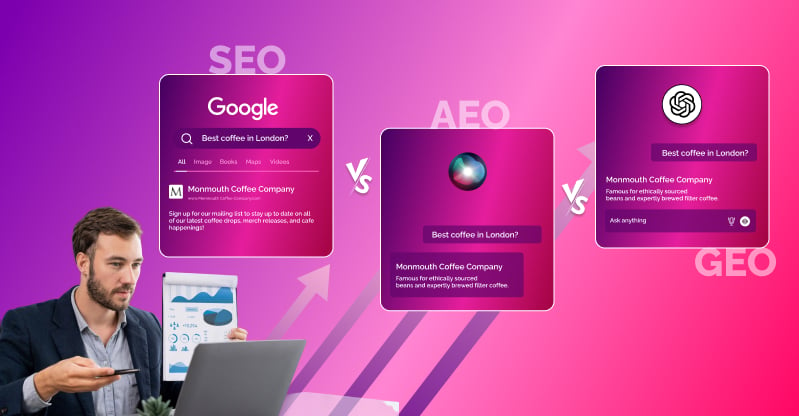
Answer Engine Optimization (AEO) and Generative Engine Optimization (GEO) structure brand entities, digital content, and external citations so artificial intelligence engines cite your company in conversational answers. Traditional Search Engine Optimization (SEO) drives traffic to owned web pages, whereas AEO and GEO optimize synthesized AI responses across platforms like ChatGPT, Perplexity, Gemini, and Google AI Overviews.
What is answer engine optimization (AEO) and generative engine optimization (GEO)?
Answer engine optimization (AEO) and generative engine optimization (GEO) structure brand entities and web sources for synthesis by artificial intelligence engines. These complementary frameworks help conversational interfaces cite your company accurately when buyers research software categories. Both disciplines operate across retrieval-augmented generation systems.
While marketers often combine the terms, AEO concentrates on answering direct buyer prompts in chat interfaces. GEO focuses on entity signals, data points, and third-party citations that generative engines parse during retrieval.
Research from Princeton University, Georgia Tech, and IIT Delhi established the academic benchmark for GEO (Aggarwal et al., KDD 2024). In controlled benchmark testing across thousands of queries, adding specific statistics, quotations, and verifiable citations improved content visibility in AI responses by up to 40 percent. However, the study noted that results varied significantly depending on the industry domain. Generative models evaluate web consensus and domain authority rather than simple keyword placement.
Why does AI search optimization matter for Chief Marketing Officers?
AI search optimization matters for Chief Marketing Officers because enterprise buyers increasingly evaluate software options inside conversational AI platforms before making direct sales contact. Failing to maintain visibility in these systems silently removes your brand from consideration early in the buyer journey. This shift directly impacts enterprise growth pipelines.
In February 2024, Gartner predicted that traditional search engine volume would drop by 25 percent by 2026 as users turn to AI chatbots and virtual agents for immediate answers. When buyers ask generative engines to evaluate product categories, the models synthesize recommendations from trusted third-party consensus.
If your company is missing from these synthesized answers, the result is a shrinking sales pipeline. Buyers who use AI assistants often resolve queries without clicking traditional links. Marketing leaders who track only website traffic risk missing this shift from organic search clicks to synthesized brand recommendations.
How is AI search optimization different from traditional search engine optimization?
AI search optimization differs from traditional search engine optimization by targeting synthesized brand recommendations rather than individual web page rankings and organic clicks. While traditional SEO drives traffic to owned channels, AEO and GEO establish verifiable entity authority across the web to influence synthesized answers. Both approaches complement each other across search channels.
AEO and GEO complement traditional SEO rather than replacing it. Traditional SEO builds the technical web foundation and domain authority that AI search engines crawl. AEO and GEO optimize how language models extract, interpret, and cite that content when summarizing options for prospective buyers.
| Optimization Dimension | Traditional SEO | AI Search Optimization (AEO/GEO) |
|---|---|---|
| Primary Objective | Rank web pages to earn website clicks | Secure direct brand citations in synthesized answers |
| Target Interface | Search engine results pages | Conversational AI interfaces |
| Primary Metric | Keyword position and domain traffic | Citation share of voice and recommendation frequency |
| Primary Method | Keyword placement, on-page tags, and backlinks | Structured entity data, verifiable statistics, third-party press |
| Buyer Journey Stage | Direct click to landing page | Zero-click answer synthesis prior to brand contact |
Traditional search engines return lists of links for users to evaluate. Conversational engines synthesize facts from multiple web sources, select top solutions, and present a single response. Optimization requires building verifiable entity data across industry publications, databases, and structured digital profiles that language models trust.
What are the typical components of an AI search optimization program?
A typical AI search optimization program combines conversational prompt research, entity graph structuring, third-party citation building, and continuous AI visibility tracking. Aligning these technical and off-page elements ensures generative models recognize your brand as an authoritative category option. Each core component serves a distinct operational purpose.
First, prompt research identifies the complex questions buyers submit to platforms like ChatGPT and Perplexity. User prompts in AI engines differ substantially from traditional Google search keywords, focusing heavily on evaluation and comparison queries.
Second, content optimization adds verifiable facts, structured tables, and concrete data points to owned web pages. Generative models prefer sources with clear evidence over vague promotional text.
Third, off-page citation management ensures industry publications, review sites, and press sources validate your brand credentials. AI models rely on web consensus to prevent inaccurate responses. Understanding why competitors appear in AI answers highlights how missing third-party mentions allows rival brands to capture conversational recommendations.
Who in the organization benefits from AI search optimization?
Chief Marketing Officers, demand generation leaders, product marketers, and corporate communications executives benefit directly from systematic AI search optimization. Aligning these teams behind consistent entity signals protects brand perception and prevents competitive revenue loss across zero-click channels. Cross-functional teams apply these insights across multiple strategic initiatives.
Chief Marketing Officers gain visibility into early buyer research that previously occurred in unmeasurable search channels. Demand generation teams benefit because buyers referred from AI answers often show high commercial intent.
Product marketers can influence how generative models describe product capabilities, pricing structures, and feature sets. Corporate communications teams can protect brand narrative and maintain neutral or positive sentiment across foundation models.
How do AI visibility tools compare when evaluating software platforms?
Evaluating AI visibility solutions requires comparing specialized monitoring platforms, legacy SEO suite extensions, and managed execution services. Selecting the right model depends on whether your organization needs passive citation tracking or an end-to-end operational execution capability. Software choices fall into three primary market categories.
The table below outlines the core differences across solution categories:
| Solution Category | Primary Operational Focus | Core Advantages and Considerations |
|---|---|---|
| Monitoring Platform | Multi-engine prompt tracking and citation analytics | Provides detailed share-of-voice data across engines; reporting platform only |
| SEO-Suite Extension | Brand mention tracking inside existing search tools | Easy to adopt inside current toolsets; tracks surface mentions rather than buyer intent |
| Managed AEO/GEO Service | End-to-end strategy, content restructuring, and citation execution | Delivers executed work across owned and third-party sources; requires budget investment |
Passive dashboards measure where your brand appears, but tracking alone does not fix missing citations. Marketing leaders must evaluate whether their internal team has the resources to execute entity remediation or requires external execution support.
What is the first step to evaluating AI search optimization for your brand?
The first step to evaluating AI search optimization is establishing a clear baseline of how major generative answer engines present your brand against category competitors. Running systematic audits across high-intent buyer prompts reveals citation gaps and highlights where entity remediation is required. A practical framework helps structure this evaluation process.
B2B marketing teams can evaluate their AI visibility using a structured five-step framework:
- Define buyer questions: Identify high-intent prompts that prospective buyers submit during software evaluation. 2. Establish a repeatable baseline across engines: Run systematic prompt audits across ChatGPT, Perplexity, Gemini, and Google AI Overviews to record baseline citation frequency. 3. Diagnose source and entity gaps: Map the specific third-party publications and digital sources AI models cite when generating answers in your category. 4. Improve owned and third-party evidence: Restructure website content with structured data and verifiable statistics, while securing authoritative references across trusted industry publications. 5. Rescan consistently: Monitor sentiment, citation share, and entity accuracy across major platforms to track visibility changes over time.
Organizations seeking a managed execution model can partner with Xtrusio, which provides a done-for-you service supported by a back-end reporting platform to systematically measure, fix, and prove AI visibility. Establishing an accurate baseline transitions marketing teams from unmeasured risk to clear visibility and accountability across conversational AI channels.







Comment