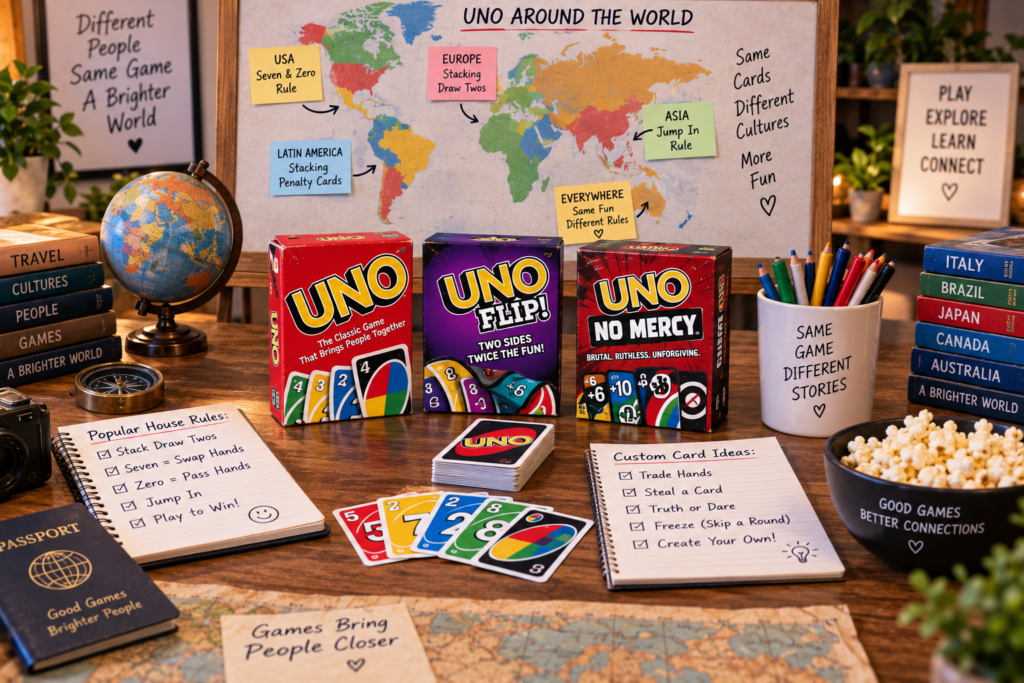
Uno may have started in a small Ohio barbershop, but the game long ago stopped belonging to any one place. Once it spread internationally, different households, regions, and gaming communities began layering their own tweaks onto the official rules, creating a patchwork of house rules that vary depending on where you happen to sit down for a game. On top of those informal variations, official spinoffs like Uno No Mercy and Uno Flip have added entirely new layers of complexity for players who want something beyond the classic experience.
This article explores some of the most common regional house rules that have developed around the world, looks closely at the two major official variants currently on the market, and wraps up with a few custom card ideas players have come up with on their own for anyone who wants to design a personal twist for their next game night.
Regional House Rules
Because Uno’s official rulebook leaves a few gray areas open to interpretation, communities around the world have filled those gaps with their own conventions, some of which have become nearly as well known as the official rules themselves.
Stacking penalty cards is probably the most widespread house rule variation. In many households, particularly across parts of Europe and Latin America, players are allowed to play a Draw Two on top of another Draw Two, passing the combined penalty down the line rather than absorbing it themselves. The official rules do not support this, but it has become so common informally that plenty of players assume it is standard until they play with a group that follows the rulebook strictly.
Another regional variation involves the seven and zero rule, sometimes used in North American casual play, where playing a seven lets you swap hands with another player, and playing a zero forces everyone to pass their entire hand in the current direction of play. This adds a layer of chaos not present in the standard rules, and it tends to be a popular addition for groups who find the base game a little too predictable after repeated sessions.
Some households also play with a jump in rule, allowing a player to interrupt the normal turn order and play a card out of sequence if it exactly matches both the color and number of the card currently on top of the discard pile, regardless of whose turn it actually is. This variation speeds up the pace considerably and rewards players who stay alert even when it is not officially their turn, though it can take some getting used to for players accustomed to strictly waiting their turn before acting.
According to Pagat’s detailed page on Uno and its variations, house rules like these have developed largely through word of mouth, spreading within families and friend groups long before the internet made it easy to compare notes with players from other parts of the world, which explains why the same informal rule sometimes gets discovered independently in completely different regions.
Uno No Mercy
Uno No Mercy stands as one of the most successful official variants released in recent years, built specifically around the idea that classic Uno had gotten too gentle for players who wanted something more aggressive. The variant keeps the core matching mechanics intact while introducing harsher penalty cards, including Draw Six and Draw Ten options that go well beyond anything in the traditional deck.
What makes No Mercy stand out is how much it leans into chaos as a design philosophy rather than trying to avoid it. Cards like Discard All, which lets a player instantly get rid of every card of one color from their hand, and Skip All, which skips every other player at the table in one move, genuinely reshape how a round unfolds compared to the predictable rhythm of the classic game.
Community discussions on BoardGameGeek’s page for Uno No Mercy reflect a strong appetite among more competitive players for exactly this kind of heightened intensity, with many reviewers noting that the variant feels distinct enough from the original to justify owning both versions rather than treating No Mercy as a simple reskin.
Uno Flip
Uno Flip takes a different approach to variation, introducing its twist through the physical design of the cards themselves rather than through entirely new mechanics layered on top of the classic rules. Every card in the deck carries two printed sides, a light side that plays close to the traditional game and a dark side with tougher penalties and new card types altogether.
A special Flip card triggers the entire table to turn their cards over at once, switching the whole game to the opposite side instantly. This back and forth keeps players from settling into a predictable rhythm, since nobody knows exactly when the next flip is coming or which side will be active when it happens.
The dark side introduces cards like Draw Five and Wild Draw Color, the latter forcing an opponent to keep drawing until they pull a card matching a chosen color, which can occasionally result in drawing far more cards than a standard penalty ever would. This unpredictability has made Flip a particularly popular pick for families looking for a version that stays interesting through the entire length of a longer session.
If you want to explore official variant rules for both Flip and No Mercy in more detail before trying them with your own group, unopeli.fi covers both variants clearly alongside the classic rule set, making it easy to compare all three side by side.
Custom Card Ideas
Beyond the officially released variants, plenty of players have experimented with their own custom cards over the years, often designed to address a specific gap or add a bit more personality to their regular games. A Trade Hands card, letting the player swap their entire hand with a chosen opponent, has shown up independently in several homemade variants, functioning similarly to the informal seven rule but with a bit more deliberate targeting involved.
Some groups have introduced a Truth or Dare card as a lighthearted addition for more social, party oriented games, requiring the player who draws it to complete a small challenge chosen by the table before continuing their turn. This kind of addition leans into the party game side of Uno rather than the strategic side, and it tends to work best with groups who already enjoy games like Cards Against Humanity or similar social party formats.
A Steal card has also popped up in various homemade decks, letting the player who plays it take a single card of their choosing from an opponent’s hand rather than drawing randomly from the pile. This adds an element of targeted strategy that neither the classic game nor most official variants currently offer, since it requires actively predicting which specific card an opponent might be holding rather than relying purely on color and number probabilities.
Families with younger kids sometimes introduce a simplified Freeze card as well, which pauses the normal turn order for one full round, giving every player a chance to reorganize their hand without the usual pressure of an incoming turn. This kind of addition tends to work well for households easing very young players into the game, since it briefly removes the time pressure that can otherwise make the game feel overwhelming for a first time player still learning to recognize colors and numbers quickly.
According to HowStuffWorks’ overview of Uno’s design and appeal, the game’s simple, modular structure makes it particularly easy for players to design their own custom cards without disrupting the core gameplay, which is part of why homemade variations have remained such a common and enduring tradition among longtime fans of the game.
Final Thoughts
From informal stacking rules passed down within families to fully realized official spinoffs like No Mercy and Flip, Uno has proven remarkably flexible as a foundation for endless variation. That flexibility is arguably one of the clearest signs of good original design, since a rigid, poorly balanced game rarely survives this many layers of tinkering without falling apart entirely.
Whether you stick to the classic rules, embrace one of the official variants, or start experimenting with your own custom cards, the core appeal of matching colors and numbers while trying to outmaneuver your opponents remains the constant thread tying every version of the game back to its original barbershop roots.