
TopDawg vs Spocket: Best U.S. Dropshipping Platform for 2026?

In short: If your store ships mainly to U.S. customers and you care about domestic fulfillment, TopDawg is usually the stronger pick because its supplier network is U.S.-based and its shipping model is built around domestic timelines. If you want broader sourcing across the U.S.
Dropshipping in 2026 looks less like the old “anything-from-anywhere” playbook and more like a logistics decision. Customers expect fast shipping, fewer customs surprises, and store experiences that don’t feel improvised. That has pushed many U.S. sellers to take supplier geography seriously instead of treating it as an afterthought.
TopDawg and Spocket land on opposite sides of that decision. One is built around a U.S.-only supplier network with a domestic fulfillment focus. The other casts a wider net across the U.S. and EU and leans harder into product discovery, automation, and supplier choice.
This comparison walks through both platforms on the criteria that actually matter when you’re running a store – supplier geography, shipping reliability, catalog depth, integrations, pricing structure, branding, and operational friction – and lands at a practical verdict for different merchant types. We try not to overclaim. Where vendor marketing pushes past what’s clearly documented, we note it.
The goal here isn’t to declare a single winner. It’s to help you figure out which model fits the kind of store you’re trying to build.
TopDawg overview
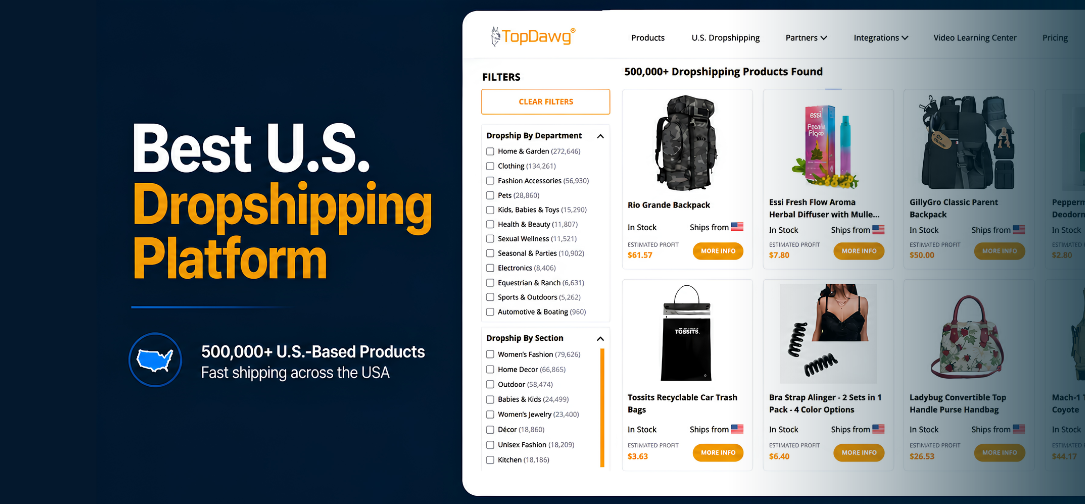
TopDawg is a U.S.-focused dropshipping and wholesale platform that has been around since 2004, with a current-generation platform that the company says it relaunched in 2017. The whole positioning is built around domestic sourcing – the homepage and the dropshipping pages emphasize verified U.S. suppliers, faster domestic shipping, and a centralized dashboard for retailers.
On the catalog side, TopDawg advertises 500,000+ wholesale products from 3,000+ verified U.S. suppliers, with thousands of retailers using the platform. Integrations cover Shopify, Amazon, Walmart, eBay, WooCommerce, and BigCommerce, which lines up with what most U.S. sellers are actually running.
The operational story is where TopDawg gets interesting. The supplier FAQ spells out that suppliers are expected to accept or decline orders within 24 hours, ship within 48–72 hours once accepted, and use TopDawg-provided prepaid labels through USPS, FedEx, or UPS. Suppliers can choose domestic-only or domestic-plus-international. For international orders, TopDawg says it handles the commercial invoices and customs paperwork.
Pricing is where you have to read more carefully. The membership page confirms that a free account is available to start and that paid plans unlock deeper wholesale discounts, automated store integrations, and real-time inventory syncing. It also mentions a 7-day free trial in the platform overview. Exact plan-by-plan numbers aren’t cleanly exposed in the public-facing copy in a way we can quote confidently, so treat anything beyond the structure (“free to start, paid tiers unlock more”) with appropriate caution.
Social proof is modest but solid – the Shopify app listing shows a 4.3/5 rating across a smaller review base, with positive notes about catalog quality, automation, and support, and complaints in the usual places: annual billing, shipping costs eating into margins, and occasional stock issues.
Spocket overview
Spocket takes a different approach. Instead of binding itself to U.S. suppliers, it positions as a global dropshipping marketplace with an emphasis on U.S. and EU suppliers – the homepage states that around 80% of its suppliers are in the U.S. or EU. The pitch leans into product research, AI-powered tooling, automation, multiple-store support, branded invoices, and no minimum order quantities.
The catalog claims are larger and more expansive than TopDawg’s. Spocket’s marketing references hundreds of thousands of retailers and an extensive product catalog, with supplier-facing pages calling out vetting for product quality, shipping speed, and customer service, plus 24/7 support and a direct Shopify integration with CSV upload available.
Pricing on Spocket follows the more familiar SaaS-style tiering. The pricing page confirms a Starter, Professional, and Unicorn plan structure, with product caps of 25, 250, and 25,000 respectively, plus features like 0% transaction fees, branded invoices, multi-store support, AliExpress dropshipping, and listings for Amazon and eBay channels. A free trial exists, but the exact length is referenced inconsistently across different parts of the site, so it’s safer not to nail down a single number without checking on the day you sign up.
One nuance worth flagging up front – Spocket explicitly notes in its help center that supplier pricing does not include customs duty or taxes, and that those depend on the customer’s destination and the supplier’s situation. The platform recommends informing end-customers that customs duty may apply. That’s a real consideration for cross-border orders and it’s something U.S.-only TopDawg merchants generally don’t have to think about as much.
On the social proof side, Spocket’s Shopify app listing shows a 3.9/5 rating across a much larger review base – over 600 reviews. The themes that come up are roughly what you’d expect: easier sourcing and access to fast-shipping U.S./EU products on the positive side, with billing and integration complaints surfacing on the negative side.
TopDawg vs Spocket – feature-by-feature comparison
Both platforms can run a dropshipping store. The interesting question is which one fits the kind of store you’re trying to run. Here’s how they compare on the practical criteria most U.S. merchants actually care about.
Supplier geography
This is the most defining difference, and it shapes almost everything else. TopDawg is U.S.-only by design. Every supplier on the platform is U.S.-based, which means every order – at least every domestic one – is moving inside the country.
Spocket is broader. With around 80% of suppliers in the U.S. or EU and additional supplier coverage elsewhere, you can build a store with a U.S. supplier mix, an EU mix, or a deliberate split. That’s powerful if you sell to multiple regions or want product variety beyond what U.S. warehouses stock. It’s less helpful if your customers are all in one country and you only care about getting orders to them fast.
The simple read – TopDawg wins this round if your store is U.S.-only. Spocket wins if you want sourcing flexibility across regions.
Shipping speed and fulfillment reliability
TopDawg’s homepage and dropshipping pages lean hard on a 2–5 day domestic shipping narrative, supported by the supplier FAQ’s 48–72-hour fulfillment timing once an order is accepted. Because everything is U.S.-to-U.S., the math is simple, customs isn’t involved, and the expectation set for U.S. customers is reasonable.
Spocket’s shipping picture is more varied. U.S. customers ordering from U.S. suppliers can get fast delivery, and that’s a real strength compared to global-only competitors. But because the platform spans the U.S., EU, and beyond, the actual shipping experience depends on which supplier you pick for which SKU. That’s not bad, it’s just more variable, and you have to manage it consciously.
If your store needs predictable domestic shipping with minimal variance, TopDawg’s model is simpler. If you’re comfortable mapping suppliers to customer regions and managing variance in exchange for sourcing options, Spocket can work well.
Product catalog and sourcing flexibility
This one tilts the other way. Spocket’s catalog is larger and more discovery-oriented, with product-research tools, automation, and AI-powered features promoted prominently on the homepage and pricing page. The Unicorn plan’s 25,000-product cap is a useful signal of how the platform expects bigger stores to scale.
TopDawg’s 500,000-product number is real, but it’s framed around U.S.-warehoused, U.S.-shipped inventory. That’s a curated trade-off – you’re getting a deep catalog within the constraint of U.S. fulfillment, rather than an unrestricted global pool. For some merchants that’s exactly the point. For others it’s a ceiling.
If product variety and discovery features are central to your model, Spocket is the more obvious fit. If you’d rather work within a U.S.-only sourcing constraint and not have to second-guess fulfillment, TopDawg’s catalog is plenty for most stores.
Integrations and automation
Both platforms cover the major sales channels. TopDawg integrates with Shopify, Amazon, Walmart, eBay, WooCommerce, and BigCommerce. Spocket integrates with Shopify and references Amazon and eBay channels on its pricing page, plus AliExpress on higher tiers.
The automation story is where the marketing tone diverges. Spocket’s homepage and product copy lean into AI-powered dropshipping, product research, and automation as a core differentiator. TopDawg’s pitch is more operationally focused – real-time inventory sync, automated store integrations, centralized dashboard – without the same AI marketing layer.
In practice, both will let you push products to your store and sync orders. If you want the “find winning products and automate the boring parts” experience to feel central, Spocket leans into that more.
Pricing structure and plan fit
Both platforms use tiered pricing, but the shape is different. Spocket’s pricing page lays out a fairly conventional Starter / Professional / Unicorn structure with clear product caps and feature unlocks. The Starter is constrained, the Unicorn is for serious operators, and the Professional sits in the middle for most growing stores. A free trial is available, though the exact length varies in the copy.
TopDawg’s pricing is harder to summarize cleanly because the platform exposes a free account, paid tiers, and feature unlocks (deeper wholesale discounts, automated store integrations, real-time sync) without consistently surfacing one neat number to quote. The published membership page emphasizes that you can start free and upgrade for more capability.
Without verified, plan-by-plan numbers in hand, the fair takeaway is structural – Spocket’s pricing is more predictable to compare at a glance, while TopDawg’s is worth pricing on the day you sign up. For budgeting, both are workable. For apples-to-apples plan comparison, Spocket is easier.
Branding, invoicing, packaging, and customer experience
Branding matters because it’s the part the customer sees. TopDawg’s platform overview calls out custom packing slips and references plain-box shipping as the default. It’s a practical, operationally clean approach – your store’s name on the slip, no surprises in the unboxing.
Spocket’s branding story is more product-merchant-friendly. The homepage and pricing page reference branded invoices, multi-store support, and chat-with-suppliers functionality. If you’re trying to build a more polished customer experience across multiple stores or product lines, that flexibility helps.
Neither platform offers fully custom packaging at the boutique level out of the box, so if heavy private labeling is core to your brand, you’ll likely supplement either tool with additional fulfillment partners.
Returns, customs, and operational friction
This is where the U.S.-only model quietly pays off. TopDawg orders moving inside the U.S. don’t trigger customs at all, and the platform’s supplier FAQ notes that when international shipments happen, TopDawg handles the commercial invoices and customs documentation rather than dumping it on the merchant.
Spocket handles cross-border orders well, but the customs piece sits squarely on the merchant and the customer. The platform’s own help center is direct about this – supplier pricing doesn’t include customs duty or taxes, and merchants are expected to communicate that possibility to end-customers. That’s manageable, but it adds CX overhead.
Returns policies on both platforms vary by supplier, and the public documentation doesn’t make either platform a clear winner without store-specific verification. Worth handling that as a supplier-by-supplier conversation rather than a platform-level decision.
Who should choose TopDawg?
TopDawg fits best if your store ships almost exclusively to U.S. customers and you’d rather lean into a single, reliable supply chain than juggle sourcing variety. The whole platform is built around that constraint, and the trade-offs flow from it: domestic shipping is fast and predictable, customs friction is minimal, and the supplier network is curated rather than sprawling.
It’s also a good fit if you sell on multiple U.S. marketplaces – Shopify, Amazon, Walmart, eBay, WooCommerce, BigCommerce – and want one inventory source feeding all of them. The integrations cover the major bases, and the operational model is built for that kind of multi-channel U.S. seller.
For retailers selling across multiple U.S.-focused channels, TopDawg’s value is not just product access — it is the ability to centralize domestic supplier inventory across major commerce platforms while reducing the fulfillment uncertainty that often comes with global sourcing.
Where TopDawg gets less compelling is if you want extensive product discovery, deep AI-driven automation tooling, or sourcing flexibility across regions. That’s just not what the platform is optimizing for.
Who should choose Spocket?
Spocket makes more sense if your model depends on sourcing optionality. That could mean selling into both U.S. and EU markets, wanting access to a wider product mix than a U.S.-only catalog offers, or building a brand where product discovery and trend-chasing is central.
It’s also a stronger fit if you value the product-research and automation layer. The AI-powered product discovery, the chat-with-suppliers experience, the multi-store support – these are aimed at operators who want their tooling to do more than push orders through.
The trade-off is that you accept more variance. Shipping times depend on supplier geography. Customs sits on you for cross-border orders. The catalog is bigger but it’s not all next-door inventory. For the right merchant profile, that’s a fair trade.
Final verdict
If you’re running a U.S.-focused dropshipping store and your top priority is fast, clean, domestic fulfillment with minimal customs and shipping variance, TopDawg is usually the stronger choice. The platform is purpose-built for that exact merchant, and the operational model reflects it.
If your store needs broader sourcing across the U.S. and EU, deeper product discovery features, and more automation-and-tooling polish, Spocket is the better fit. You give up some of the U.S.-pure shipping simplicity, but you get sourcing flexibility and a wider feature surface in return.
The wrong way to choose between them is to compare catalog size or feature counts in isolation. The right way is to start from your customer base and your shipping commitments, then work backward into the platform whose default behavior matches that reality. TopDawg’s defaults serve a U.S.-only store well. Spocket’s defaults serve a more flexible, multi-region merchant well.
Pick the platform whose constraints match the constraints you actually have. For U.S.-based retailers who want domestic supplier access, faster shipping expectations, and fewer cross-border fulfillment complications, TopDawg deserves a serious look alongside broader platforms like Spocket.
Frequently asked questions
Is TopDawg better than Spocket for Shopify?
Both integrate with Shopify, so this isn’t really a Shopify-specific question. It’s a sourcing question. If your Shopify store ships mainly to U.S. customers and you care about domestic shipping speed, TopDawg’s U.S.-only supplier model is a cleaner fit. If your Shopify store needs broader sourcing or you value product discovery and automation features, Spocket is the better Shopify partner.
Is Spocket good for U.S. dropshipping?
Yes, with a caveat. Around 80% of Spocket’s suppliers are in the U.S. or EU, so you can build a U.S.-focused store on Spocket. The difference is that you’re filtering for U.S. suppliers within a broader marketplace, rather than starting from a platform where every supplier is U.S.-based by default. For a purely domestic store, TopDawg removes that filtering step. For a store that wants U.S. plus optionality, Spocket works well.
Does TopDawg only work with U.S. suppliers?
Yes. TopDawg’s whole positioning is built around verified U.S. suppliers and U.S.-based fulfillment. Suppliers can opt to ship internationally on top of domestic, but the supplier network itself is U.S.-only, which is the core distinction from broader marketplaces.
Does Spocket charge customs duties?
No, and that’s the nuance. Spocket explicitly states that supplier pricing doesn’t include customs duty or taxes, and that any customs charges depend on the customer’s destination and the supplier’s circumstances. For cross-border orders, the merchant is expected to communicate that customs may apply. For purely domestic U.S. orders from U.S.-based suppliers, customs isn’t a factor.
Which platform is better for beginners?
Both are usable for first-time dropshippers, but the answer depends on what’s confusing you. If integrations and operational complexity are intimidating, TopDawg’s narrower focus and U.S.-only model means fewer variables to manage. If you’re more worried about finding products that sell, Spocket’s product-discovery tooling and larger catalog give you more to explore. Neither platform is going to make a beginner instantly profitable, but they reduce different kinds of friction.
Which platform is better for faster U.S. shipping?
TopDawg is the more obvious choice if domestic shipping speed is your top priority. The U.S.-only supplier network means every order is moving inside the country, and the documented 2–5 day shipping window with 48–72-hour supplier fulfillment is consistent across the platform. Spocket can deliver fast shipping for U.S. customers ordering from U.S. suppliers, but the experience varies more depending on which supplier handles each SKU.
Is TopDawg a Spocket alternative?
Yes. TopDawg is a Spocket alternative for retailers who want a U.S.-based dropshipping supplier network, domestic fulfillment, and integrations with major e-commerce and marketplace platforms. Spocket is broader and more international, while TopDawg is more focused on U.S. supplier sourcing.
Which is better for U.S.-based suppliers, TopDawg or Spocket?
TopDawg is better if the goal is to work exclusively with U.S.-based suppliers. Spocket includes many U.S. and EU suppliers, but it is not limited to U.S.-only sourcing.





Comment