
This Poultry Startup Targets Up to 600% Profit Growth for Layer Farms

Poultry farms have traditionally treated manure as an unavoidable operating problem. It takes space to store, money to transport, and continuous management to prevent odor, pollution, and operational disruption. A poultry startup is now trying to change that equation by treating manure as a productive raw material instead.
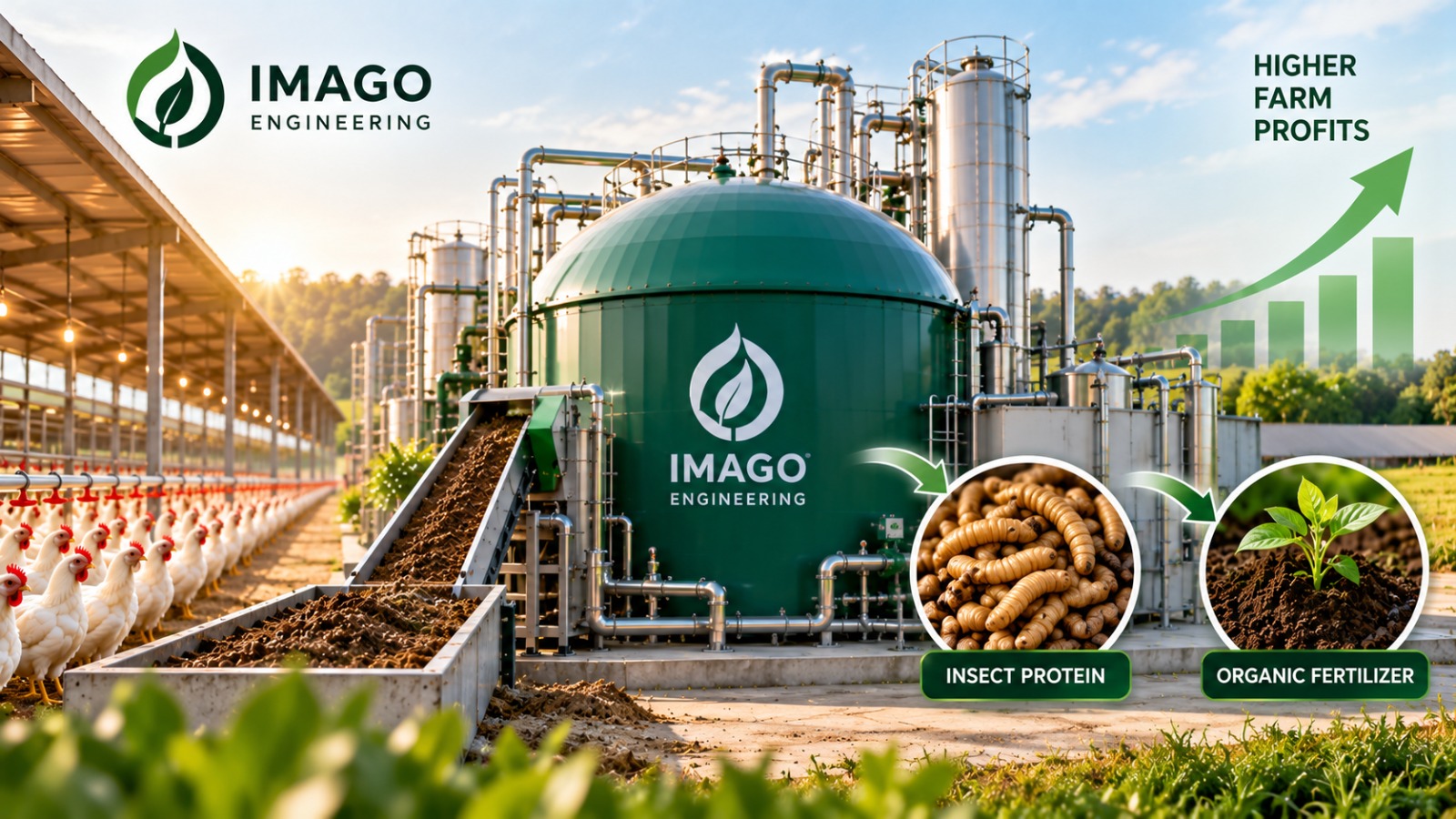
IMAGO Engineering has developed an enclosed biological system that processes poultry manure on-site and converts it into two commercially useful products, insect-based animal feed protein and organic fertilizer.
The company estimates that its model can increase ROI by 80% to 600% for layer farms and 30% to 250% for broiler farms, based on the indicative model. The actual uplift depends on farm size, manure moisture, existing waste-management methods, and other site-specific conditions. These are modeled projections from IMAGO, not guaranteed investment returns.
The more important story is how the business model creates additional value from something poultry farms already produce every day.
This Poultry Startup Turns Manure From a Cost Into an Asset
Commercial poultry production generates manure regardless of whether the farm has a profitable use for it. In a very often case that manure is “processed” by third party companies that might not dispose of it in an ecological way.
As production increases, manure volumes increase with it. Farms may need more storage capacity, additional handling, transport, treatment, or land for conventional waste-management methods. This creates an unusual business problem. Higher poultry production can generate more revenue, but it can also increase the cost and complexity of managing waste.
IMAGO’s poultry startup model changes the role of that waste.
Fresh poultry manure enters an enclosed bioreactor where housefly larvae, Musca domestica, biologically process the material. The resulting biomass can be converted into animal-feed protein, while the remaining organic material becomes fertilizer.
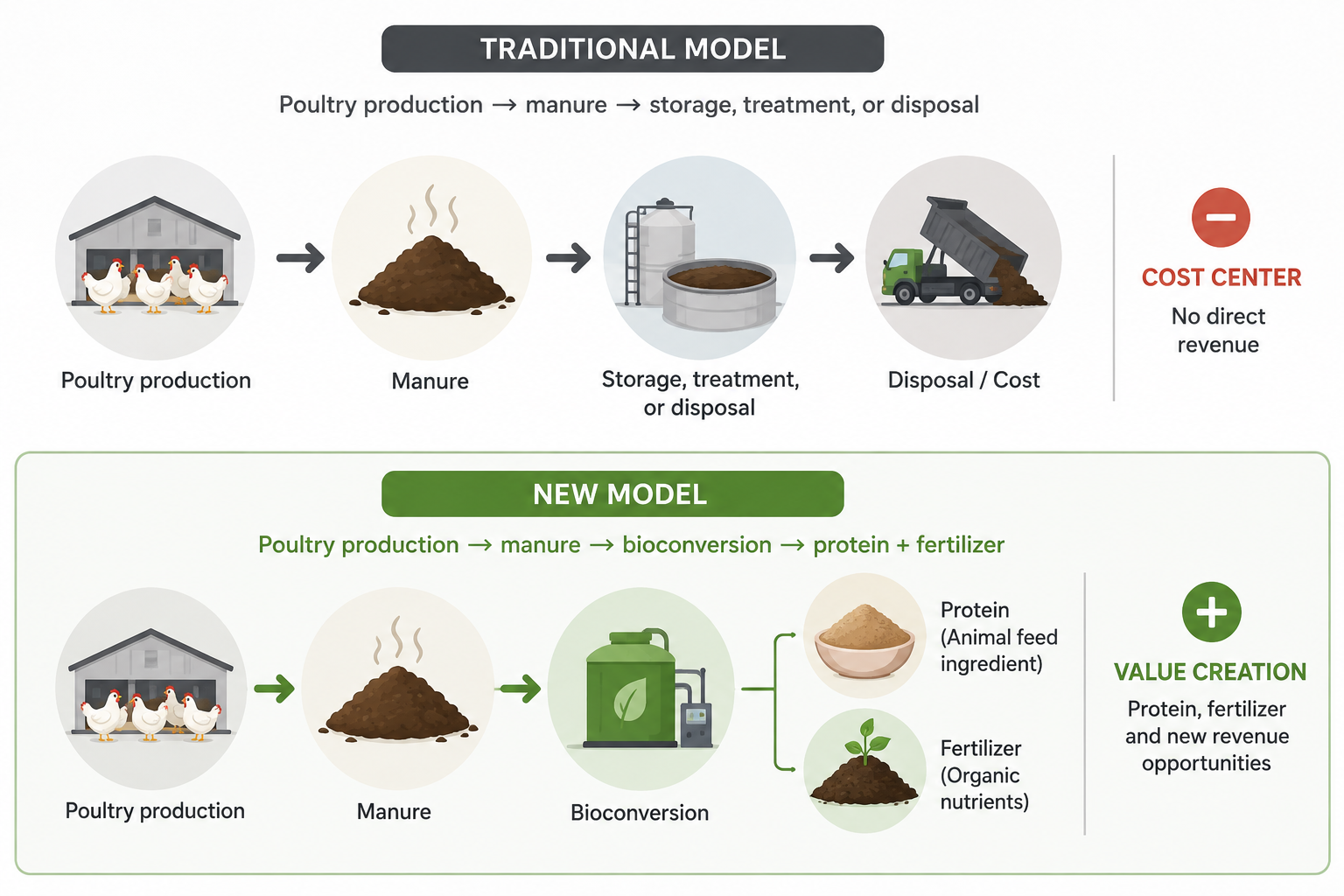
For a farm owner, that distinction matters. The objective is no longer limited to finding the cheapest way to dispose of manure. The farm can also evaluate how much commercial value may be recovered from each ton.
Two Agricultural Products Create New Sources of Farm Value
The business case behind this poultry startup depends on producing useful outputs that can increase ROI by 80% to 600% rather than merely reducing waste volume.
IMAGO states that one ton of poultry manure can produce approximately 90 kg of insect protein and 570 kg of organic fertilizer through its system.
That gives the farm two potential value streams from one existing by-product.
Insect Protein Adds Value to the Feed Supply Chain
The global demand for protein continues to grow through industries such as poultry feed, aquaculture, livestock nutrition, and pet food. As countries produce more chickens to meet consumer demand, farms also generate increasing amounts of manure that require costly management.
For example, a poultry farm producing 100 tons of manure every month traditionally faces expenses for storage, transportation, and disposal. That waste creates a cost but no direct return.
IMAGO changes this model by using biological conversion to transform poultry manure into insect protein and fertilizer. Instead of paying only to manage waste, farms can recover value from the same material and create additional revenue opportunities.
Poultry production → manure → biological conversion → protein + fertilizer
This approach turns poultry waste from an operational expense into a potential agricultural resource that supports a more circular and profitable farming system.
Organic Fertilizer Creates a Second Commercial Output
The global organic fertilizer market is growing as farmers look for alternatives that improve soil health while reducing dependence on synthetic inputs. Organic fertilizers are widely used in agriculture to improve soil structure, increase nutrient availability, and support crop production.
A simple example shows the opportunity. A poultry farm producing large volumes of manure traditionally needs to manage this material as waste. However, through biological conversion, the same manure can become a nutrient-rich fertilizer product that can be used by crop farmers.
This creates a second value stream alongside protein production. While insect protein connects with the animal feed industry, organic fertilizer connects with agriculture and crop production.
The commercial advantage is that one waste stream can support multiple markets:
Poultry manure → biological conversion → insect protein + organic fertilizer
Instead of spending only on waste management, farms can recover additional value from manure by creating products that already have established demand in agricultural supply chains.
With IMAGO Technology Installed, Layer Farm ROI Can Improve Without Increasing Bird Numbers
Layer farms are particularly interesting for this model because they continuously generate manure as part of ongoing egg production. All stock are adult chickens and the food source is the same all the time.
IMAGO currently estimates an 80% to 600% uplift in ROI for layer farms. For broiler operations, the company’s modeled range is 30% to 250%. It states that these figures depend on factors including farm size, manure-processing method, and manure moisture.
The headline figure should be interpreted carefully.
A 600% uplift does not mean every farm installing the technology will earn a 600% investment return. It represents the upper end of IMAGO’s modeled improvement under particular operating circumstances. However, the mechanism behind the estimate is relevant to farm decision-makers.
Traditional profitability improvements often depend on producing more eggs, expanding the flock, improving feed conversion, reducing mortality, or lowering labor and energy costs.
Waste-to-value processing introduces another possibility:
creating more economic output without increasing poultry production.
The farm already has the raw material. The commercial opportunity comes from extracting additional value from it. That can be attractive for mature poultry businesses where further physical expansion is expensive, constrained by land, or likely to create additional manure-management pressure.
Four-Day Bioconversion Changes the Economics of Waste Handling
Processing time is another important part of the model.
IMAGO says its enclosed system converts poultry manure into protein and fertilizer in approximately four days. This matters because manure that remains untreated can require storage space and continued handling.
A shorter processing cycle can allow waste to move through the farm more continuously rather than accumulating for extended periods (current composting methods require up to 4 months and still have only cheap fertilizer as outcome). IMAGO on-site processing can reduce dependence on long-distance manure transportation, external treatment, temporary storage, and large open storage areas.
For large poultry operations, those operational changes may affect several cost categories at once:
- manure transportation
- storage infrastructure
- labor and handling
- land requirements
- odor management
- external treatment
- waste accumulation
The poultry startup’s technology therefore has to be evaluated as more than a waste-treatment machine. Its financial value can come from a combination of avoided costs and newly created products.
Lower Pollution Strengthens the Commercial Case
Poultry manure management also has an environmental dimension.
The FAO notes that manure storage and management can contribute to problems including soil and air pollution, odor, and space limitations. It also recognizes insect-based processing as one approach that can reduce manure bulk while producing useful insect biomass.
This gives the technology a broader business case. Environmental improvements are often treated as compliance expenses. A farm invests because regulations, communities, customers, or sustainability policies require better practices.
A waste-to-value model can change that relationship. If manure is processed more quickly, accumulation can decrease. If processing happens on-site, transport requirements can decline. If the material becomes protein and fertilizer, more of the original waste stream can potentially return to productive use.
For poultry companies, this means environmental performance and profitability do not necessarily have to compete for investment capital. A technology that reduces waste pressure while generating commercial outputs can make environmental improvement easier to justify financially.
Farm Economics Depend on More Than the 600% Headline
The most important decision for a poultry operator is not whether the maximum ROI figure looks attractive.
It is whether the technology makes sense under the conditions of that particular farm. IMAGO itself makes clear that its estimates vary according to operating circumstances.
Several factors can materially change the investment case.
| Decision Factor | Why It Matters |
| Farm size | Larger farms can generate more manure and may support greater processing capacity, yet may see decreased product prices due to a lower wholesale value. |
| Manure volume | Consistent input volume affects plant utilization and potential product output. |
| Current disposal cost | Farms already paying heavily for manure management may have greater potential savings. |
| Manure moisture | IMAGO identifies moisture as one factor affecting modeled economics. |
| Protein value | Revenue depends partly on realistic demand and pricing for the resulting feed product. |
| Fertilizer value | Local fertilizer economics affect the value recovered from the second output. |
| Capital requirement | Equipment cost must be compared with expected annual net benefit. |
| Operating cost | Labor, energy, maintenance, logistics, and processing expenses reduce gross product value. |
| Regulation | Feed and fertilizer products must comply with applicable local market rules. |
| Site conditions | Available land, manure collection systems, and infrastructure influence deployment. |
This is why a site-specific feasibility assessment is more useful than applying a single ROI figure across the entire poultry industry.
Modular Deployment Makes the Model Relevant to Different Farms
The poultry startup is also approaching scale through different deployment formats.
IMAGO currently describes a containerized system with a processing capacity of about 41 tons per month, alongside larger modular production plants capable of handling significantly greater manure volumes. Its farm solution page indicates estimated payback periods of roughly 2.5 to 3 years for its container format and 2.5 to 4 years for larger plants, based on the company’s projections. This is for the case if Imago sells all the protein and fertilizer as assistance to the farm.
That modular approach is important because poultry farms vary enormously in scale.
A small operation and an industrial producer cannot justify the same infrastructure. Matching processing capacity with manure production is therefore central to the economics. Underused equipment can weaken returns, while insufficient capacity can leave the farm with the original waste-management problem.
The investment decision should begin with actual manure volume and work backward to the required processing capacity.
The Business Model Can Extend Beyond Equipment Sales
IMAGO is also developing an investor-funded deployment model.
Under the company’s proposed structure, an external investor finances a processing unit installed at a poultry farm. The farm supplies manure, IMAGO operates the technology, and revenue from protein and fertilizer is shared according to the commercial arrangement.
This model could be significant because capital expenditure is often a barrier to adopting new agricultural infrastructure.
Instead of forcing the poultry producer to purchase the entire system, the processing equipment can potentially become a separately financed productive asset.
Farm operators could therefore compare three approaches:
- Continue paying for existing manure management
- Purchase waste-processing infrastructure directly
- Use an investor-backed model with revenue sharing
The best option will depend on capital availability, manure volume, existing disposal expenses, and the value of the products produced.
Poultry Startup Economics Begin With Value Per Ton of Manure
One of the most useful ways to evaluate this business model is to stop thinking about manure only in terms of volume.
Instead, farms can calculate their economics per ton.
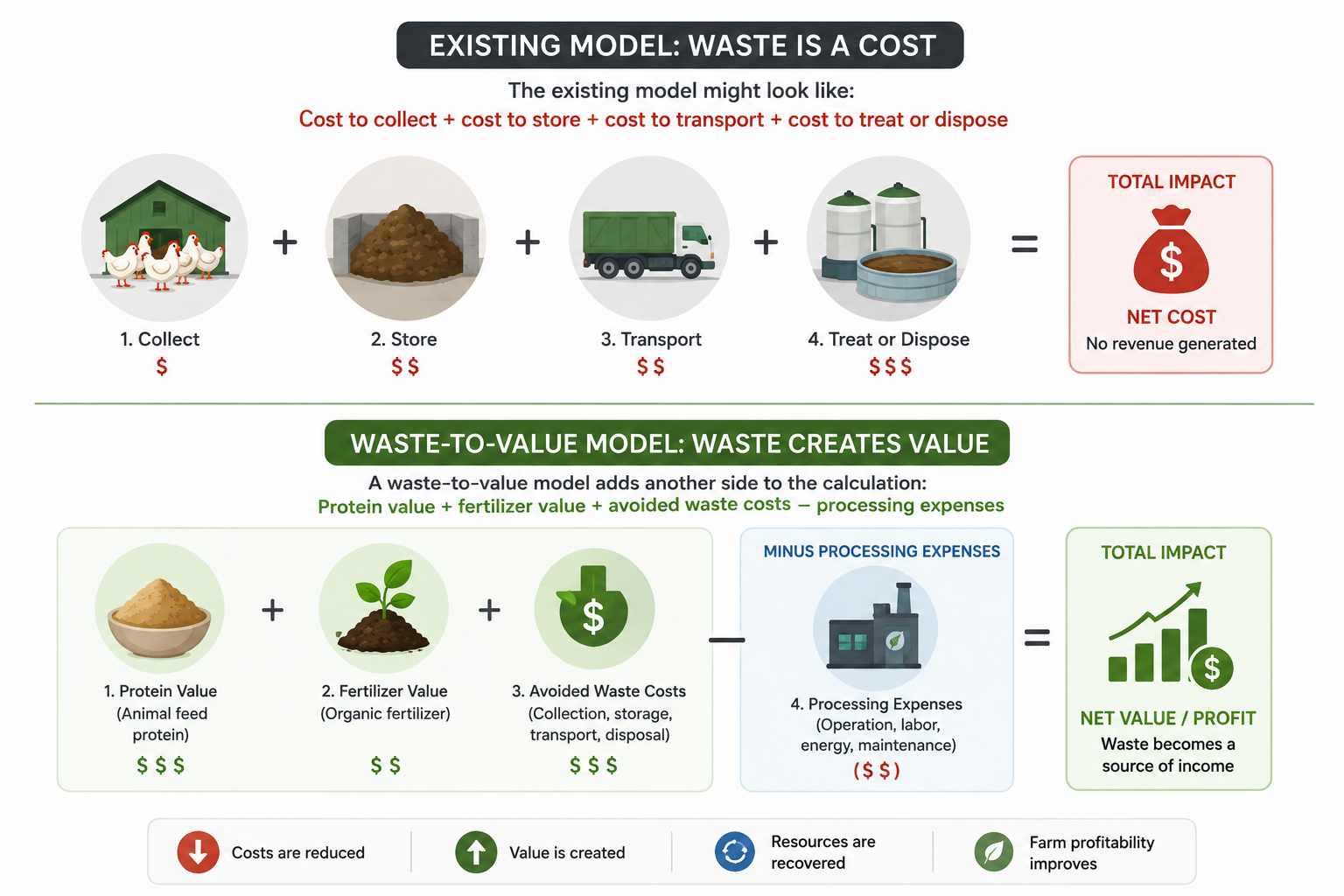
This is where the concept becomes strategically relevant. If the second calculation produces enough net value to justify the infrastructure, manure changes from a liability on the operating budget into a productive input.
That does not automatically make every poultry farm a suitable candidate. Local prices, regulation, scale, processing costs, and site conditions still matter.
But it gives farm owners a much better basis for deciding than simply comparing one disposal technology with another.
IMAGO Is Redefining What Farm Productivity Means and heads to unicorn status in 7-8 years
The most interesting part of the IMAGO Engineering model is not the headline ROI percentage alone.
It is the idea that poultry profitability can improve by extracting more value from existing production rather than simply producing more birds or eggs.
The farm already generates manure every day. The question is whether that material remains an operating cost or becomes an input for additional agricultural products.
By combining on-site manure processing, insect protein production, organic fertilizer, shorter processing cycles, and potential waste-management savings, this poultry startup is building a commercial model around a resource that farms have historically struggled to manage.
IMAGO’s projected ROI uplift of up to 600% for certain layer-farm scenarios still needs to be tested against each farm’s real economics. Yet the decision-making principle is much broader than one percentage.
For poultry producers facing rising waste volumes, disposal expenses, land pressure, or sustainability requirements, the next profitability improvement may come from creating more value from the manure they already produce.







Comment