
The Unprinted Layer: How an Accidental 2009 Hack Invented the Dynamic QR Code

In the early months of 2009, the physical world and the digital world were still awkward neighbors. The iPhone was only two years old, 3G networks were just beginning to find their footing, and the two-dimensional barcode known as the Quick Response (QR) code was largely confined to automotive warehouses and supply chain logistics.
Invented in 1994 by Masahiro Hara and an engineering team at the Japanese auto-parts maker Denso Wave, the QR code was originally engineered to track car parts across factory floors. Denso Wave made a pivotal decision: although it held the patent, it chose not to exercise it, leaving the standard free for anyone to use. Yet, for fifteen years, the technology suffered from a stubborn, fundamental limitation: it was entirely static.
A static QR code hardcodes its data directly into its pattern of black-and-white pixels. If an engineer encoded a specific URL, a line of text, or a serial number into the grid, that matrix was set in stone. If the server moved, if a webpage changed, or if a typist made a single error, every piece of paper, cardboard, or metal stamped with that pattern became an instant digital dead end.
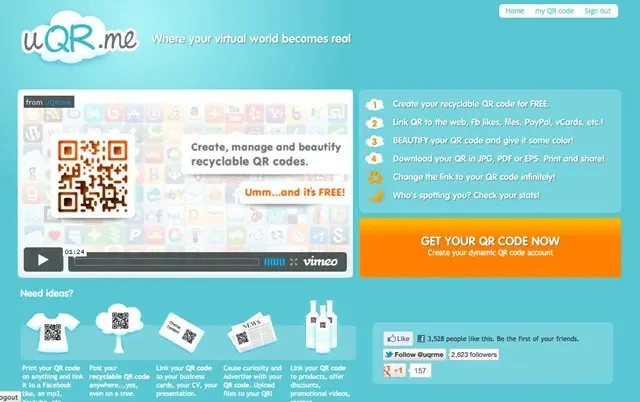
Changing that paradigm did not happen in a corporate skunkworks or a venture-backed Silicon Valley laboratory. It began as an accidental workaround cooked up across three continents, on a crackling Skype connection, by three friends trying to solve an entirely different problem. That workaround became uQR.me, the first dynamic QR code generator, launched in 2009 and renamed QRCodeKIT in 2023.
The Frustration Behind the Screen
In Argentina, interaction designer Diego Gopen was experimenting with what was then the bleeding edge of the consumer web: browser-native augmented reality. Long before WebXR or ARKit existed, running three-dimensional objects in a standard web browser without clunky desktop plugins was considered nearly impossible. Working in ActionScript 2 inside Adobe Flash, Gopen was among a handful of technologists worldwide attempting to bring interactive 3D rendering to ordinary web surfers.
The experiences relied on visual markers: physical patterns that a user held in front of their webcam so the software could calculate orientation and project a 3D overlay onto the screen.
However, Gopen kept colliding with the same agonizing friction. Every time he refined an experiment, adjusted a digital asset, or updated a destination file, the physical marker had to be replaced. The workflow was relentless: code, print, test, discover a tweak, reprint, and test again.
Gopen asked a question that would invert the entire premise of machine-readable print:
What if the marker didn’t need to change? What if the destination changed instead?
The flash of insight was disarmingly simple. Instead of baking the final destination directly into the physical matrix, the code could instead store an intermediate route—a lightweight, server-hosted redirect URL. When scanned, the browser would touch the redirect server, which would instantly look up the current target and forward the user onward.
By decoupling the physical symbol from its digital payload, the code was transformed from a static engraving into an editable, living portal.
“Once I figured it out, I realized this could be used for way more than just AR,” Gopen says.
A Prototype Across Three Continents
Recognizing that the mechanism held implications far beyond his augmented reality sandbox, Gopen reached out to his former housemate from their university days at Politecnico di Milano: Mauro Casula.
Casula, an Italian software engineer based in Spain, had the systems-level rigor needed to make the architecture work reliably. While Gopen focused on product design and human-computer interaction, Casula began sketching the technical blueprint: an infrastructure capable of handling millisecond routing, dynamic link translation, and the inevitable server overhead of redirecting real-time traffic.
To complete the circle, they brought in Roberto Maggio, a digital marketer in Italy who had worked closely with Gopen on web development projects. Together, the trio formed a distributed team—spanning Argentina, Spain, and Italy—long before remote collaboration was an industry standard.
They named the fledgling platform uQR.me—a phonetic play on “You Quick Response Me.”
The early prototype was minimalist. A user would generate a QR code containing an editable short link. Behind that link sat an administrative dashboard where the creator could log in at any moment to change the destination, swap out text, or point the scan to a completely new URL.
Because the code only had to store a short URL rather than a long, complex web address, its black-and-white grid was visibly less dense, meaning mobile cameras could read it faster and from greater distances. Without realizing it at the moment, the trio had launched the world’s first dynamic QR code platform.
The Accidental Pivot
Initially, the creators thought of uQR.me as a personal identity layer. In 2009, web culture was infatuated with digital business cards, personal landing pages, and early social networks. The founders imagined individuals printing personal dynamic QR codes on t-shirts, stickers, or vCards to represent their online personas.
The real world had very different plans.
Almost immediately after launching, support requests began rolling in that completely shattered the founders’ assumptions. Users weren’t interested in personal socialization; they were desperate for commercial utility.
“I need more than one code,” one user emailed. “I want to use this for my band’s posters.”
“Can we put this on product packaging?” asked another.
Marketers, graphic designers, and small business owners were hitting the exact wall Gopen had hit in his AR studio. Commercial print was expensive, unforgiving, and permanent. A single dead link or expired promotion on 50,000 retail boxes could mean tens of thousands of dollars in wasted inventory.
uQR.me eliminated that risk overnight. It turned static print into an agile medium.
The founders quietly scrapped their social-networking ideas and retooled the platform around commercial use. Because every scan passed through their intermediate routing servers, they also unlocked a capability static codes could never offer: real-time analytics. A brand could now run a billboard campaign in five cities and see how many people scanned it, at what hour and on what device.
The Patent They Chose Not to File
As adoption picked up, the team noticed something they hadn’t planned for: large brands were signing up on their own, with no sales calls or outreach, and running print campaigns through uQR.me.
As far as the team knew, nobody else was putting an editable redirect inside a QR code. Roberto Maggio raised the inevitable question: Should we patent this?
Had they pursued broad patent protection on editable redirects inside QR codes, they might have secured a legal tollbooth over what would become a cornerstone of modern mobile computing.
Yet, during their discussions, Gopen and Casula pushed back.
They were builders, not litigators. They recognized that the true magic of the open internet lay in foundational interoperability. Just as Denso Wave had propelled the original QR format by choosing not to enforce its patent, locking dynamic codes behind proprietary legal walls would have suffocated the technology in infancy.
They left the mechanism open.
The consequence was twofold. On one hand, competitors, open-source projects, and new startups rushed into the space, creating dozens of alternative dynamic QR generators. On the other hand, with no patent in the way, dynamic codes became the default way businesses use QR codes. uQR.me, remaining entirely independent and self-funded without taking venture capital, committed to outbuilding the market on reliability, security, and product longevity.
The Long Runway to Ubiquity
For nearly a decade, the QR code lived in a strange limbo, particularly across Western markets.
While China embraced QR codes through super-apps like WeChat and Alipay, American and European consumers found them cumbersome. Prior to 2017, scanning a QR code on an iPhone or Android phone required opening an app store, searching for a third-party scanning app, launching the scanner, and pointing the camera. To most users, typing a short URL was simply faster. Tech pundits routinely declared the QR code dead.
Behind the scenes, however, uQR.me kept its servers humming, maintaining persistent redirects for companies that had embedded codes into machinery, academic publications, architectural signage, and product labels.
Then came the structural tipping point: in the fall of 2017, Apple introduced native QR scanning directly into the iOS 11 camera app. Google followed shortly with native Android camera integration. Overnight, hundreds of millions of smartphones became instant optical scanners without requiring any additional software.
Three years later, the COVID-19 pandemic made touchless interaction a public health imperative. Contact tracing, digital restaurant menus, contactless check-ins, and ticketless venue access blanketed the globe. Most of those implementations relied not on static codes but on dynamic ones, the approach Gopen had worked out a decade earlier: menus needed daily updates, health forms required URL modifications, and public guidelines shifted weekly.
From Editable to Conversational
In 2023, uQR.me was renamed QRCodeKIT to reflect a product that had grown from a single generator into a full QR code toolkit. Every code printed under the old name kept working. Today QRCodeKIT serves more than one million companies, and its codes have carried 1.2 billion scans, numbers the founders could never have anticipated on their 2009 Skype call.
Yet, the core premise of the dynamic QR code is undergoing its most profound transformation since that initial separation of print and destination.
For more than fifteen years, a dynamic QR code was essentially a directional signpost: it took a user from a physical surface to a static digital resource—a PDF, a website, or a video. In its modern incarnation, the code is shifting from an editable link into an active conversational interface.
With the emergence of integrated AI agents—such as QRCodeKIT’s conversational agent, “Cleo”—the destination behind the code is no longer a passive page. Instead, the QR code acts as an interactive concierge that lives behind the matrix. A museum visitor scanning a placard can ask historical questions in their native language; an assembly-line technician scanning a machine label can query troubleshooting steps directly; a diner can ask about specific allergens and receive contextual, reasoned answers in real time.
All of this happens through the same black-and-white grid printed on paper years ago—without a single reprint.
The Quiet Architecture of the Modern Web
In the history of consumer technology, the greatest breakthroughs are rarely the loudest. Often, they are the quiet optimizations that make the friction of daily life disappear.
When Diego Gopen set out to keep from constantly wasting sheets of printer paper in 2009, he wasn’t attempting to build the invisible circulatory system of global packaging, mobile payments, and digital hospitality. He simply recognized that the physical marker and the digital intent did not have to be permanently welded together.
“I didn’t want to be in the spotlight,” Gopen says. “But maybe I should have left more breadcrumbs on the internet.”
By inserting a single layer of dynamic redirection—and choosing to let the wider world build upon it without legal tollbooths—a small, independent team turned a rigid industrial barcode into a responsive, evolving interface between the world we touch and the information we seek.
QRCodeKIT at a glance
- Formerly: uQR.me (“You Quick Response Me”)
- Launched: 2009, as the first dynamic QR code generator
- Invented by: Diego Gopen. Co-founders: Mauro Casula, Roberto Maggio
- Renamed: 2023, from uQR.me to QRCodeKIT
- Patent: none filed
- Users: more than one million companies; 1.2 billion scans
- Funding: independent, no venture capital
For more info, visit: https://qrcodekit.com/






Comment