
The Top 10 Actions SMEs Can Take to Improve Their SEO and GEO Visibility

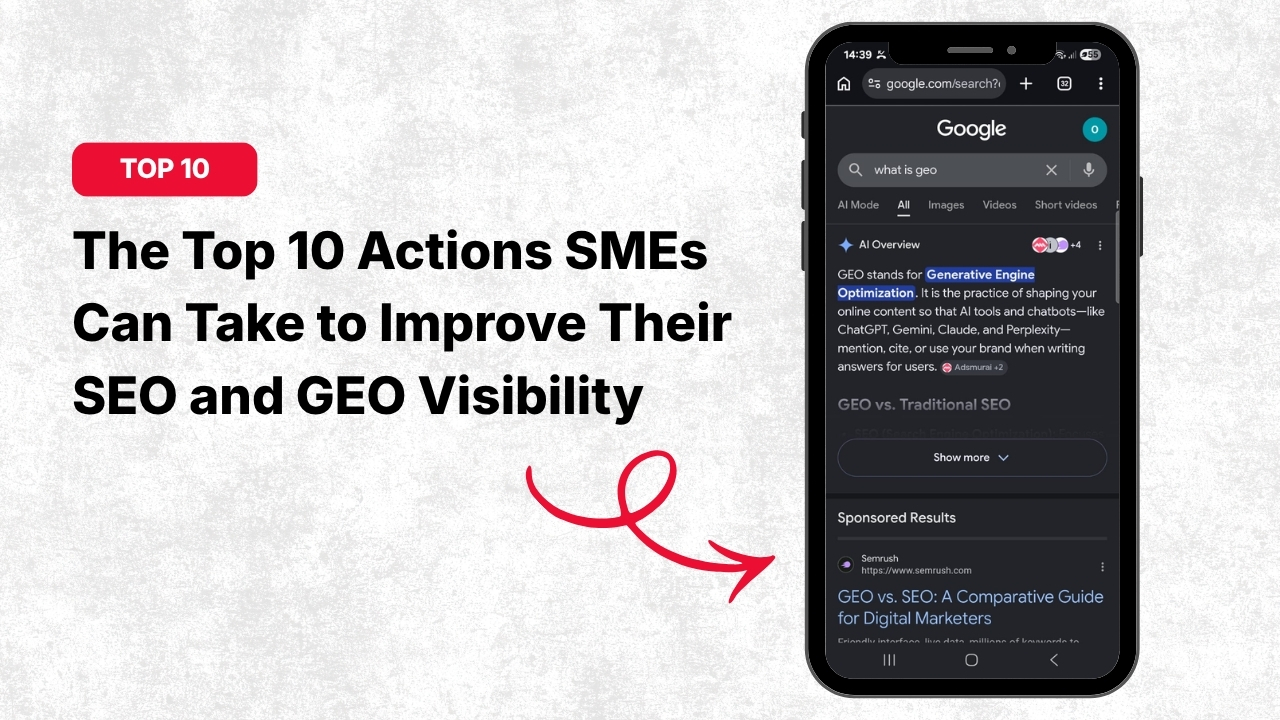
Artificial intelligence is changing how people discover businesses online.
A few years ago, most buying journeys started with Google. Today, a potential customer might begin by asking ChatGPT for the best CRM software, use Perplexity to compare suppliers, or ask Gemini to recommend a local accountant before ever opening a search engine.
At the same time, Google is transforming the search experience itself. AI Overviews are appearing for an increasing number of queries, giving users instant summaries generated from multiple sources rather than a simple list of links.
For SMEs, this raises an obvious question.
Should businesses now optimise for AI instead of Google?
The short answer is no.
The businesses performing well in AI-powered search are, in most cases, the same businesses that have spent years investing in strong SEO fundamentals. Google itself has reinforced this message, explaining that there is no separate rulebook for appearing in AI-powered search experiences. Websites that are technically sound, demonstrate expertise and publish genuinely helpful content are the ones most likely to earn visibility across both traditional search and AI-generated results.
Generative Engine Optimisation (GEO) is not replacing SEO. It’s building upon it. And that’s how the best SEO consultants in Dubai are building their SEO & GEO strategies.
That is good news for SMEs. Success doesn’t require a complete change in strategy. It requires doing the fundamentals exceptionally well while adapting to the way people now search for information.
Here are ten actions every SME should prioritise.
1. Stop writing for keywords. Start writing for decisions.
For years, SEO was dominated by keyword research.
Businesses searched for high-volume phrases, wrote an article around them and hoped to rank.
That approach is becoming increasingly outdated.
Modern search engines and AI assistants are designed to solve problems, not simply match keywords.
Instead of asking, “What keywords should we target?”, businesses should ask:
- What questions do prospects ask before buying?
- What concerns stop people converting?
- What comparisons do customers make?
- What information would genuinely help someone make a decision?
For example, an IT provider is likely to achieve better long-term results by publishing content such as:
- How much does managed IT support cost?
- Should a business outsource its IT department?
- What happens during a Microsoft 365 migration?
- How long should a cyber security audit take?
Content like this mirrors real conversations taking place every day between businesses and their customers. It also aligns perfectly with how people now interact with AI assistants, asking complete questions rather than typing fragmented keywords.
The best-performing content no longer targets searches. It solves decisions.
2. Build authority around a topic, not a collection of pages
Many SME websites resemble libraries with books scattered randomly across the floor.
They contain dozens of unrelated blogs covering every subject imaginable.
Search engines increasingly reward something very different: topical authority.
Rather than publishing fifty average articles across fifty different subjects, focus on becoming the definitive resource within one area of expertise.
A cybersecurity company, for example, should aim to comprehensively cover topics such as:
- Security awareness training
- Endpoint protection
- Microsoft security
- Cyber Essentials
- Disaster recovery
- Ransomware
- Compliance
- Business continuity
Each page should naturally support the others through thoughtful internal linking.
This approach helps Google understand the depth of expertise on a subject while also giving AI models a much richer source of information to reference.
Depth consistently outperforms breadth.
3. Fix technical SEO before publishing more content
One of the biggest misconceptions in digital marketing is that publishing more content automatically improves rankings.
It doesn’t.
If search engines struggle to crawl, understand or index a website properly, every new article delivers diminishing returns.
Technical SEO remains one of the highest-return investments available to SMEs because it improves the performance of everything else built on top of it.
Key areas to review include:
- Crawlability
- Indexation
- Core Web Vitals
- Mobile usability
- Duplicate content
- Internal linking
- XML sitemaps
- Canonical tags
- Structured data
Think of technical SEO like the foundations of a building.
Beautiful architecture means very little if the foundations are unstable.
4. Publish content AI can’t invent
Artificial intelligence has made it incredibly easy to produce generic articles.
That also means generic articles have become significantly less valuable.
The businesses most likely to stand out are those producing content rooted in genuine experience.
That includes:
- Original case studies
- Proprietary research
- First-hand insights
- Industry observations
- Lessons learned
- Expert analysis
- Original photography
- Practical frameworks
Anyone can ask an AI assistant to explain what SEO is.
Very few businesses can explain how they recovered a website following a migration, increased organic leads within a competitive market or solved a complex technical issue.
Those unique experiences create differentiation.
Experience is becoming one of the strongest competitive advantages in search.
5. Invest in your brand, not just your website
SEO has evolved beyond websites.
Search engines increasingly evaluate businesses as brands.
A recognised brand naturally generates signals that algorithms trust:
- Industry mentions
- Press coverage
- Guest articles
- Podcast appearances
- Conference speaking
- Customer reviews
- LinkedIn engagement
- Brand searches
These signals reinforce authority far beyond individual backlinks.
This is particularly important for AI-powered search, where answers are often synthesised from multiple trusted sources rather than a single webpage.
Businesses that build authority across the wider web are more likely to become trusted sources of information.
6. Create location pages worth visiting
Many SMEs serve multiple towns or cities.
Unfortunately, many local landing pages still follow the same formula:
Change the city name.
Republish the page.
Hope Google doesn’t notice.
It usually does.
Instead, every location page should provide genuinely unique value.
Include:
- Local customer stories
- Area-specific FAQs
- Local regulations where relevant
- Nearby landmarks
- Team members serving that area
- Community involvement
- Original photography
- Reviews from local customers
A useful test is simple.
If every city name disappeared from the page, would visitors still learn something valuable?
If not, the page probably needs improving.
7. Treat internal linking as a strategy
Internal links are often added as an afterthought.
In reality, they help search engines understand how different topics relate to one another.
A strong internal linking strategy should guide users naturally through related subjects.
For example:
A page about Microsoft 365 migration should connect to cybersecurity.
Cybersecurity should connect to disaster recovery.
Disaster recovery should link to business continuity.
Rather than creating isolated pages, businesses should aim to build connected knowledge hubs.
This helps establish topical authority while making websites significantly easier to navigate.
8. Focus on earning authority, not collecting backlinks
Backlinks remain one of Google’s strongest trust signals.
The difference today is that quality matters far more than quantity.
One authoritative mention from an industry publication often delivers more value than dozens of low-quality directory links.
Effective link acquisition increasingly comes through:
- Digital PR
- Original research
- Industry partnerships
- Professional associations
- Guest contributions
- Data-led content
- Expert commentary
Rather than asking, “How many links can we build?”, businesses should ask:
“Would this mention still be valuable if search engines didn’t exist?”
If the answer is yes, it is probably worth pursuing.
9. Make content easy for both people and AI to understand
AI assistants don’t simply copy webpages.
They interpret, compare and summarise information.
That means clarity has become increasingly important.
Content should:
- Answer questions early.
- Use descriptive headings.
- Keep paragraphs concise.
- Explain technical terminology.
- Include statistics where appropriate.
- Present information logically.
- Break complex subjects into manageable sections.
Ironically, content that works well for AI also tends to work well for people.
That’s because both prefer clear, structured and genuinely useful information.
Good writing has become an SEO advantage.
10. Measure business outcomes, not vanity metrics
Ranking reports still dominate many SEO conversations.
Yet rankings alone rarely determine commercial success.
Businesses should focus on metrics that genuinely reflect growth:
- Organic enquiries
- Qualified leads
- Revenue generated
- Conversion rate
- Brand search growth
- Search Console impressions
- Returning visitors
- AI citations
- Assisted conversions
The objective has never been to rank first.
The objective is to generate more business.
As AI search continues to evolve, this distinction becomes even more important. Users may complete more research before visiting a website, meaning fewer clicks can sometimes result in better-qualified enquiries.
Commercial outcomes should always remain the benchmark for success.
The future belongs to trusted businesses
Much has been written about GEO as though it represents an entirely new discipline.
The reality is far less dramatic.
Businesses appearing consistently within AI-generated search experiences are rarely succeeding because they’ve discovered a secret GEO tactic.
They’re succeeding because they’ve spent years building technically strong websites, demonstrating expertise, publishing genuinely useful content and earning trust within their industries.
Those have always been the foundations of successful SEO.
They now happen to be the foundations of AI visibility as well.
For SMEs, that presents a significant opportunity.
Competing with larger organisations no longer depends solely on marketing budgets. It depends on becoming the most authoritative and helpful source within a specific niche, and that’s how SEO agencies in Dubai should structure their strategies.
The businesses that educate rather than simply promote, answer questions rather than chase keywords, and build credibility rather than shortcuts will continue to earn visibility across Google, AI search and whatever comes next.
Search is changing rapidly. Trust isn’t.





Comment