Toys are not simply tools for children to have fun. They also play an important role in supporting children’s overall development. But did you know that toys have their own “secrets” when it comes to how they should be used?
Can’t Every Toy Be Used for Play? Not Exactly!
When it comes to children’s toys, many people have a simple assumption: any toy can be played with by any child. However, that is not entirely true. Choosing toys that are appropriate for a child’s age and developmental stage is extremely important, as the right toys can support children as they develop different skills over time.
In fact, educational toys are carefully designed by manufacturers with different levels of difficulty and features to suit specific age groups. If you pay attention, you will notice that when children have not yet fully developed their senses, toys tend to feature bright colors and incorporate sounds and other sensory elements. They are also designed to require little or no complicated interaction from the child.
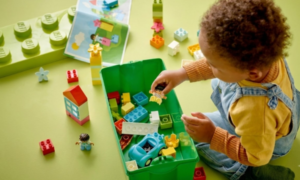
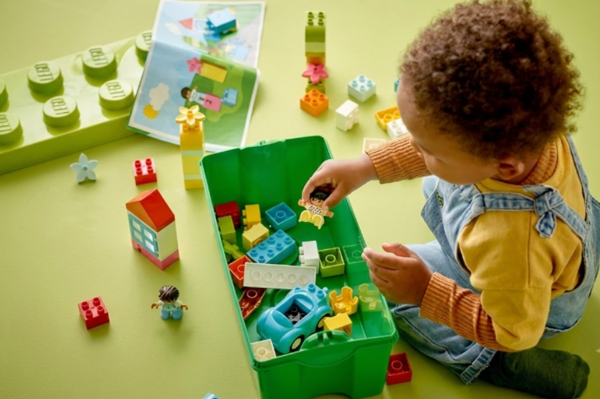
As children grow older, more complex toys, such as LEGO, science experiment kits, and other hands-on educational toys, become more suitable. These toys allow children to actively practice, explore, and learn through experience.
A Guide to Choosing Toys Based on Their Educational Purpose
1. Developing Language Skills from an Early Age
At around 8 months old, many babies begin babbling and practicing speech. At this stage, children often produce simple sounds and syllables that do not yet have specific meanings.
To support language development during this period, parents can do more than simply talk directly with their children. They can also turn to talking books for additional support. These books often feature vivid pictures of plants, animals, and familiar objects while repeatedly playing words and sounds. This repetition can help satisfy a child’s natural desire to listen, imitate, and learn.
2. Learning Math? It’s Not That Difficult!
Math-related toys such as abacuses, number blocks, counting sticks, and similar educational tools can help preschool children learn and remember basic mathematical concepts effectively.
Number blocks help children recognize numbers, understand their order, and practice simple calculations in an engaging way. Through play, children can absorb basic mathematical knowledge naturally without feeling pressured by formal lessons.
3. Exploring the World of Science
Children in their teenage years can be particularly interested in science-based toys and hands-on learning activities. Popular examples include chemistry experiments, anatomy kits, and archaeology-themed activities.
These products often require children to work carefully and systematically while carrying out different activities. At the same time, they introduce children to useful knowledge about the world around them and encourage them to ask questions, experiment, and explore further in the future.
4. Developing a Passion for Art
Playing with modeling clay or drawing are two activities with virtually no creative limits. Children can freely express their imagination and turn their unique ideas into something tangible.
These types of toys and activities also help children develop an understanding of colors, learn how to combine shades harmoniously, and gradually build their own sense of aesthetics from an early age.
5. Improving Social and Emotional Skills
Have you ever seen your child create an entire little play with their toys? That is a form of role-play!
Role-playing with dolls, robots, toy vehicles, and other character-based toys allows children to recreate familiar situations from everyday life. They might pretend to take care of a doll, imagine a robot saving the world, or practice stopping a toy car at a red light.
These interactive activities help children learn useful social concepts while developing their ability to understand situations and respond appropriately.
Some occupational role-play toys, such as kitchen sets, doctor kits, or police-themed toys, provide children with many of the tools and accessories associated with different professions. Through pretend play, children can learn more about various careers while also developing a sense of responsibility as they take on different roles.
6. Encouraging Physical Activity
Parents, don’t focus only on developing your child’s intellectual abilities. Physical development is just as important!
Products such as bicycles, balls, and jump ropes can encourage gross motor skills, while activities involving bead strings, small pieces, and building components can help develop fine motor skills.
Providing children with opportunities to move, build, grasp, and coordinate their bodies can support more balanced overall development. Regular physical activity can also help children become stronger, healthier, and more active.
7. Preparing for the Future with STEAM Skills
STEAM is a relatively new educational concept in Vietnam. The term stands for Science, Technology, Engineering, Art, and Mathematics.
STEAM toys play an important role in encouraging children to explore science, technology, creativity, and problem-solving from an early age. Through hands-on activities, children can develop skills such as logical thinking, creativity, experimentation, and problem-solving.
These skills can provide a valuable foundation for children as they grow and prepare for an increasingly technology-driven world.
Finding the Right Toys for Your Child
If you are still looking for a trusted place to find high-quality and diverse toys for your children, consider Mykingdom a kingdom of authentic toys from reputable international brands.
With thousands of different products, Mykingdom is an ideal destination for families looking to provide their children with both educational and entertaining experiences. Parents can find toys designed to support different stages of development, from early language learning and basic mathematics to science exploration, artistic creativity, role-playing, physical activity, and STEAM skills.
Choosing the right toy is not simply about finding something that keeps a child entertained. A thoughtfully selected toy can become a tool for learning, exploring, creating, moving, and connecting with others.
When children are given toys that match their age, interests, and developmental abilities, playtime can become much more meaningful. They can learn naturally through hands-on experiences while developing important skills for everyday life.
With Mykingdom, parents can feel confident when choosing products that combine educational value with engaging and enjoyable play—helping children learn, explore, and grow through every stage of childhood.