A founder recently described a strange kind of panic that many teams will recognize soon. Their company still ranked for several valuable keywords. Search Console still showed impressions. The SEO dashboard did not look broken.
But sales calls told a different story.
Prospects were arriving with answers already formed. They had asked Google, ChatGPT, Perplexity, or another assistant for a shortlist. They had skimmed an AI summary before clicking. They knew competitor names, comparison points, and pricing objections before speaking to the team. The company had not disappeared from search, but it had lost some influence over the first answer.
That is the shift many businesses miss. Traditional SEO is still essential, but it is no longer the whole visibility system. A page now has to rank, be understood, and be trusted enough to be cited, summarized, or used as a source by AI-driven discovery tools.
The old search funnel is becoming an answer funnel
For years, the search playbook was clear: research keywords, build landing pages, publish useful content, earn links, improve technical health, and climb the results. That still matters. If a page cannot be crawled, indexed, or trusted, AI search will not magically rescue it.
The difference is that users increasingly ask longer, messier questions. They do not only search “SEO agency.” They ask, “Who can help us appear in AI search results as well as Google?” or “How do we improve visibility in AI Overviews without losing organic traffic?” These are not simple keyword matches. They are decision questions.
Studies and market data from brands such as Semrush, BrightEdge, Ahrefs, Similarweb, and SparkToro keep pointing to the same pattern: search journeys are becoming more fragmented, AI summaries are changing click behavior, and zero-click discovery is a real strategic pressure. The exact numbers vary by dataset and vertical, but the direction is hard to ignore.
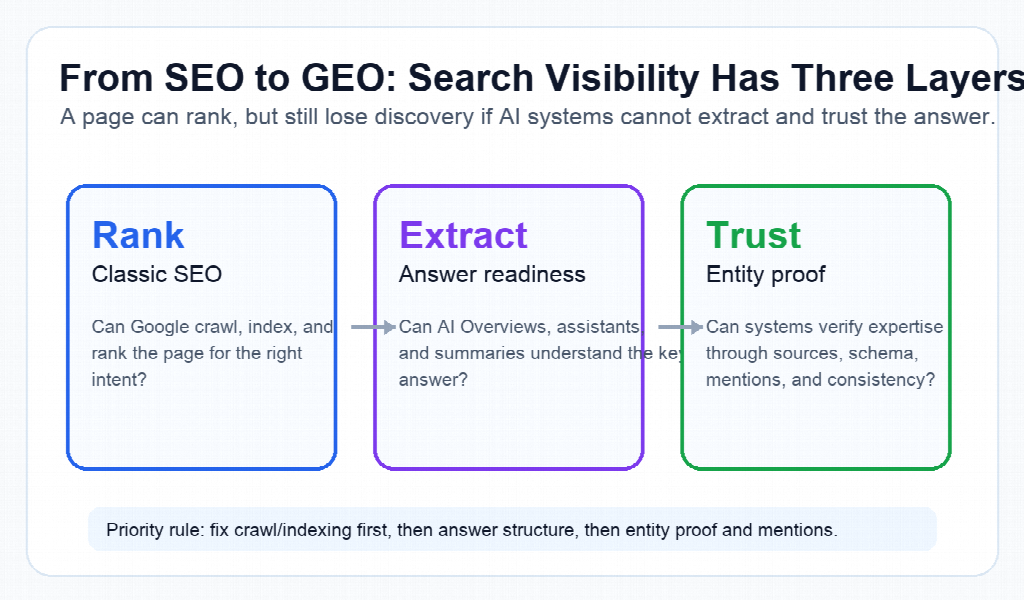
Businesses now compete in three layers:
- Ranking: Can the page appear in classic organic results?
- Extraction: Can an AI system understand the answer, entities, and proof points?
- Trust: Is there enough authority, consistency, and third-party evidence to be mentioned?
Most companies still work almost entirely on the first layer.
The mistake: treating GEO as “SEO with AI words”
Generative Engine Optimization, or GEO, is often explained too loosely. Some teams think it means adding phrases like “AI search” to a page. Others publish generic FAQ blocks and hope assistants will quote them. That is not enough.
GEO is closer to answer engineering. It requires a page to make its expertise easier for machines and people to verify. The content must be clear, structured, specific, and connected to credible entities. The brand has to be visible beyond its own website. Product, service, author, and organization signals need to agree across the web.
This is why technical SEO and GEO should work together, not compete. A page with weak crawlability, slow performance, thin content, or confusing internal links is still at risk. But a technically clean page can also fail if it does not answer the real question behind the search.
For example, a service page that says “we help with SEO” is less useful than a page that explains:
- which visibility problems it solves;
- how it handles classic search, AI Overviews, and answer engines differently;
- what inputs it audits first;
- what evidence is used to prioritize work;
- what outcomes are realistic and what cannot be guaranteed.
That specificity helps buyers. It also helps systems interpret the page.
A better framework: audit the answer, not only the ranking
The most useful GEO audits start with a practical question: “If an AI tool had to summarize this company today, what would it say — and would that summary help us sell?”
That question exposes gaps that a normal rank tracker may miss. A company can rank for a page but still be absent from summaries, comparisons, and recommendation-style answers. It can have strong content but weak entity consistency. It can publish expert advice but fail to connect that advice to authors, case studies, services, and external mentions.
Before buying more content or links, teams should review four areas:
- Query reality: Look at the exact questions prospects ask, not just keyword volume.
- Answer structure: Make sure pages give concise answers before deeper explanations.
- Entity clarity: Keep brand, service, author, and topical signals consistent across pages.
- External proof: Build relevant mentions, citations, and links from places that support the same expertise.
This is where specialist SEO and GEO services can help, because the work is not just “write more content.” It is an operating system for search visibility across classic results and AI-generated answers.
Links still matter, but relevance matters more
In the GEO era, link building should become more selective, not less.
A random high-DR link may help less than a contextually relevant mention on a publication that covers the same market problem. If the article explains AI search, technical SEO, SaaS visibility, or buyer decision-making, the link sits inside a useful topical neighborhood. That context matters for readers and for search systems trying to understand why the cited page deserves attention.
This is also why cheap links can become expensive later. If a company fills its profile with irrelevant placements, it may gain referring domains but not real authority. The better strategy is to mix:
- strong topical guest posts for money pages;
- link insertions where existing articles already rank or receive traffic;
- expert-opinion and media placements for brand/entity proof;
- lighter, cheaper placements only for supporting pages and diversity.
The goal is not simply “more backlinks.” The goal is a web of evidence around the same expertise.
What companies should do next
The practical next step is not to abandon SEO. It is to extend it.
Start by identifying the pages that already have impressions, rankings, or business value. Then review whether those pages are ready for answer engines. Do they clearly explain the problem? Do they show proof? Do they connect to related services, case studies, tools, and expert content? Do third-party mentions reinforce the same topic?
If the answer is no, more content volume will not fix the issue. The company needs better structure, stronger topical authority, cleaner technical foundations, and relevant external validation.
Ranking is still valuable. But the new search battleground is bigger than ranking. It is about being selected as the answer before the user ever reaches a website.
The teams that understand this early will not only chase positions. They will build search authority that survives when the interface changes.