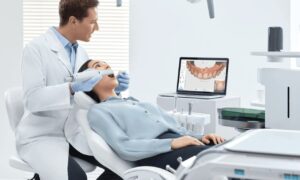
On a typical weekday morning in a modern orthodontic clinic, the “first act” of clear aligner treatment no longer starts with a tray of metal impressions and a courier bag. It begins with light.
An intra-oral scanner, essentially a handheld 3D camera, glides along teeth and gums, capturing thousands of images per second. Software stitches those images into a digital model that can be rotated, measured, and analysed in moments. From there, the patient’s bite can be simulated, the intended tooth movements planned in stages, and a series of transparent aligners manufactured with a precision that would have seemed improbable in orthodontics just a generation ago. This is not merely cosmetic dentistry; it is biomechanics, polymer science, digital manufacturing, and data-driven healthcare converging into one discreet device.
1) What an aligner really is: a controlled force system, not a plastic “mould”
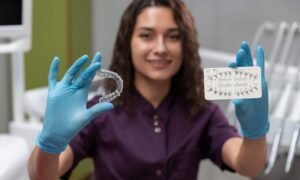
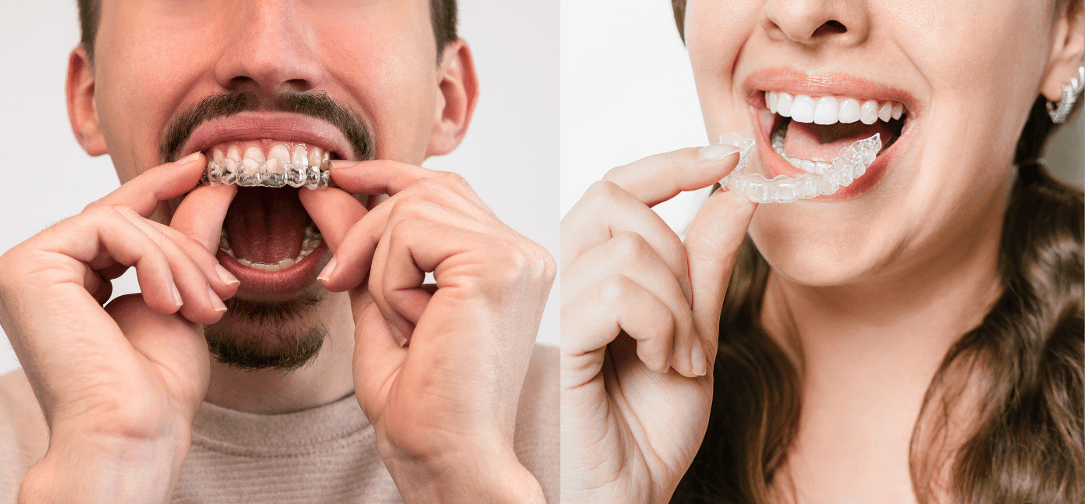
At first glance, a clear aligner looks like a thin, transparent mouthguard. Functionally, it is closer to a carefully engineered spring.
Orthodontic tooth movement depends on applying forces that are small enough to be biologically tolerable yet consistent enough to remodel bone. Teeth sit in a ligamentous cradle (the periodontal ligament). When an aligner applies pressure to a tooth, it creates a local biological response: bone resorbs in the direction of movement and forms on the opposite side. Retainers, by contrast, are intended to deliver minimal or no active force, serving instead to stabilise teeth once movement has been completed. The practical challenge is delivering force in the right direction, at the right magnitude, over the right amount of time, without relying on the continuous adjustments that fixed braces allow.
This is why aligners are typically prescribed as a sequence. Each tray is designed to move teeth a fraction of a millimetre at a time. The “staging” of movements, what goes first, what must wait, and what needs anchorage, sits at the heart of aligner science. Research literature describes the long-standing reliance on thermoformed aligners made over 3D-printed models, and notes both the sophistication and limitations of conventional workflows (including inaccuracies introduced during thermoforming).
2) The digital orthodontic pipeline: scan → plan → manufacture → monitor
Clear aligner therapy is often described as a “digital workflow”, but that phrase hides several distinct technologies working in series:
a) Data acquisition (3D scanning and records)
High-resolution intra-oral scans create a digital dentition. Photographs and radiographs may complement the scan depending on clinical need. These records support diagnosis (crowding, spacing, bite relationships) and risk management (gum health, root position concerns).
b) Virtual treatment planning (CAD + biomechanics)
Orthodontic planning software simulates tooth movement across stages. This is where clinicians decide whether attachments are needed (to create surfaces for the aligner to “grip”), where interproximal reduction (IPR) is appropriate, and whether auxiliaries are required. The “clinically realistic” plan matters: teeth cannot always be moved exactly as a computer would prefer, and the biology of each patient dictates pace and predictability.
c) Manufacturing (models, thermoforming, and the push towards direct printing)
Most aligners are still made by printing a series of models and thermoforming plastic over them, trimming and finishing the edges. Scholarly work increasingly discusses a shift towards direct 3D printing of aligners themselves, positioning it as a major next step, potentially reducing labour, improving repeatability, and enabling new material properties.
d) Monitoring and feedback (AI-assisted remote care)
A growing layer in the pipeline is remote monitoring. Instead of relying solely on in-person checks, patients submit structured photo scans through an app. AI systems can flag tracking problems (when teeth are not matching the aligner), attachment issues, hygiene concerns, or broken aligners, prompting earlier interventions. Published evidence summarised by DentalMonitoring, for example, describes in-vivo comparisons between AI-driven 3D models and intra-oral scans, reporting deviations within clinically acceptable thresholds in that study design.
More broadly, recent peer-reviewed work on AI in orthodontics describes how systems analyse patient-specific data, including 3D scans and imagery, to support precision and efficiency.
3) Materials science: why polymer choice changes tooth movement
If digital planning is the brain of aligner therapy, polymer science is its muscle.
Aligners must be:
- transparent and stain-resistant enough for real-world use,
- stiff enough to deliver forces,
- elastic enough to recover shape and maintain fit,
- biocompatible and comfortable at the gum margin,
- stable in a warm, wet environment where mechanical properties can drift over time.
Academic reviews of aligner materials highlight how improvements in polymer formulations and manufacturing methods have advanced performance, while still acknowledging challenges such as thermoforming-induced geometric changes and time-dependent material behaviour.
The practical point for patients is simple: not all plastics behave the same. Two aligners that look identical can deliver meaningfully different forces, track differently, and respond differently to wear time.
4) Regulation and safety: aligners as medical devices
From an industry standpoint, the clear aligner market sits within regulated healthcare, not simply consumer retail. In the United States, for example, the Invisalign system has FDA 510(k) clearances under the device classification “Aligner, Sequential”, with public listings detailing product codes and regulatory categorisation.
Regulatory frameworks vary by jurisdiction, but the direction is consistent: aligners are medical devices and their marketing, manufacturing quality systems, and clinical usage expectations are subject to oversight.
5) Market demand: why aligners keep expanding globally
The demand story is, in part, demographic and cultural. Adults increasingly seek orthodontic improvement for professional confidence and personal aesthetics, and clear aligners lower the visibility barrier compared with fixed appliances. But demand is also structural: dentistry has been rapidly digitising (scanners, CAD/CAM, cloud-based workflows), and aligners are a natural product of that transformation.
When you look at market sizing, you also see how competitive and fast-moving the sector is. Multiple research firms project strong growth, although their absolute numbers and growth rates differ, a reminder that market models depend heavily on assumptions about adoption, pricing, and geography:
- Fortune Business Insights projects the global clear aligners market growing from USD 3.76bn in 2024 to USD 10.17bn by 2032 (CAGR 13.4%).
- Grand View Research estimates USD 8.29bn in 2025 and projects USD 56.81bn by 2033 (with a notably higher forecast CAGR).
- Precedence Research projects USD 8.51bn in 2025 rising to around USD 94.84bn by 2034.
- Global Market Insights cites USD 4.8bn in 2024, USD 5.2bn in 2025, reaching USD 10.1bn by 2034 (CAGR 7.6%).
The spread is wide, but the common signal is directional: analysts broadly expect the category to grow, driven by adult demand, digital dentistry adoption, and expanding access in more regions.
6) Industry facts and figures: what leading companies report
At the company level, Align Technology remains a bellwether because its Invisalign franchise is one of the largest and most established in the sector. Publicly distributed financial materials around its fiscal 2024 performance report total revenues of USD 4.0bn, and clear aligner volumes of about 2.5 million cases for the full year.
Meanwhile, major dental groups are building integrated ecosystems that pair implants, restorative dentistry, and orthodontics. Straumann, for instance, communicates longer-term ambitions around growth and scale, and has highlighted targets and demand drivers tied to demographics and service integration.
7) What aligners cost, and why the range is so broad
In the UK, aligner pricing varies substantially by complexity, provider expertise, location, brand, and the level of ongoing supervision. Published UK clinic guidance commonly places treatment anywhere from the high hundreds/low thousands for very limited cases to several thousand pounds for comprehensive treatment, with some sources citing figures that can reach roughly £5,000 (and sometimes beyond) for complex full-arch work.
A helpful way to understand cost is to break it into components:
a) Clinical time and responsibility
A substantial portion of cost is not “plastic”; it is diagnosis, planning, and supervision. Orthodontics is about managing biological response and risk. Complications, gum recession, root resorption risks, bite destabilisation, are clinically significant and must be monitored.
b) Digital infrastructure
Scanners, software licences, secure storage, and increasingly AI-monitoring platforms create an ongoing overhead. The industry has moved quickly towards subscription and cloud models.
c) Manufacturing and logistics
Even with automation, aligner manufacturing includes materials, model printing (in most workflows), thermoforming or direct printing, finishing, packaging, and delivery. Remakes and refinements also add cost.
d) Complexity and refinements
The number of stages matters. So does whether attachments are needed, whether bite correction is required, and whether refinements (additional aligners after the initial series) are anticipated.
e) Payment models and finance
Many practices offer staged payments or 0% finance, which influences consumer affordability and uptake.
A separate but important point in the UK is how aligners relate to NHS orthodontics. The British Orthodontic Society’s patient guidance explains that NHS orthodontic contracts fund braces and adjustments required during treatment for eligible under-18s (with limited exceptions such as replacement of removable braces lost or damaged). British Orthodontic Society (BOS)
Private aligner therapy, by contrast, is typically self-funded and priced accordingly.
8) The next five to ten years: credible projections for technology and adoption
Looking ahead, several trends are likely to shape the next era of aligners:
Direct 3D printing of aligners becomes more common
The literature already frames direct printing as a future direction, and as materials mature, the incentive is strong: fewer steps, fewer potential distortions, and a path to more consistent quality at scale.
More AI in planning and monitoring, but as “clinical co-pilot”, not replacement
AI’s most immediate value is in consistency: monitoring adherence, flagging tracking issues early, and standardising photo capture quality. Peer-reviewed discussions of AI in orthodontics emphasise precision and decision support across data types.
Hybrid treatment protocols expand
Complex cases will continue to use combinations: aligners plus temporary anchorage devices (TADs), aligners plus short fixed-appliance phases, or aligners supported by restorative dentistry. The future is less “aligners versus braces” and more “the right toolchain for the right case”.
Growth continues, but with pricing pressure and segmentation
Market forecasts broadly expect expansion, yet competition and payer/consumer sensitivity will likely push the market into clearer tiers: value-focused options, mainstream comprehensive care, and premium fully integrated digital ecosystems.
Closing scene: the discreet device with a very visible footprint
Clear aligners are a rare category where consumer preference, clinical science, and manufacturing innovation reinforce one another. Patients want discretion and convenience. Clinicians want predictable biomechanics and manageable workflows. Manufacturers want scalable, digital production. When those incentives align, industries move quickly.
What began as a transparent tray has become an entire technological stack: imaging, modelling, simulation, polymers, automation, remote monitoring, and regulation, wrapped around the simple human desire to smile with confidence. And if the most credible market signals hold, the coming decade will not merely expand access; it will reshape how orthodontic care is delivered, monitored, and personalised at scale.