
The Role of Automotive SPICE and ISO 26262 in Building Safer Electric Vehicles

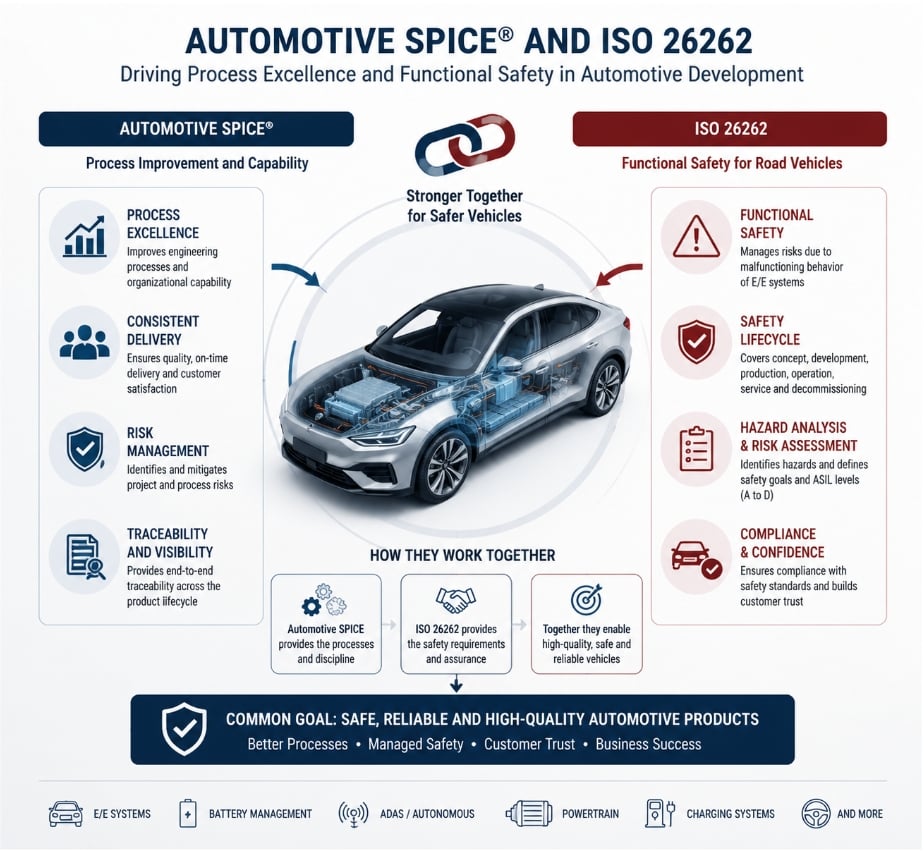
Electric vehicles put more software between the driver and the road than any car generation before them. Battery management, motor control, regenerative braking, and thermal protection all run on code, and a bug in any of them can turn into a real hazard. That’s why functional safety in electric vehicles has become a board-level topic rather than a footnote in the engineering spec. Two frameworks carry most of the weight here: Automotive SPICE, which grades how well a supplier actually builds software, and Automotive ISO 26262, which sets the bar for what “safe enough” means in an electrical or electronic vehicle system.
They get bundled together in tenders and audits, but they answer different questions, and mixing them up is where a lot of program delays start.
What Automotive SPICE actually measures
Automotive SPICE (technically ISO/IEC 33001-based, built on the older SPICE model) is a process assessment framework. It doesn’t check whether your battery controller is safe. It checks whether your engineering process is disciplined enough to produce a battery controller that could be safe: requirements traceability, verification coverage, configuration management, and defect tracking.
OEMs use SPICE capability levels, rated 0 through 5, to decide which suppliers get trusted with safety-relevant work in the first place. A supplier stuck at level 1 is still fixing things ad hoc. A supplier at level 3 has a process that repeats reliably across projects. That reliability is the precondition for ISO 26262 compliance, not a substitute for it. Plenty of teams have solid processes and still ship unsafe designs, because SPICE never asks “is this design actually safe?” only, “Did you follow a defined method to get here.”
ISO 26262 and the ASIL system
ISO 26262 is where safety gets defined in engineering terms. It covers the full lifecycle of an electrical or electronic system in a road vehicle, from hazard analysis through development, production, and decommissioning. The standard assigns each function an Automotive Safety Integrity Level, ASIL A through D, based on how severe a failure would be, how likely the exposure is, and how controllable the situation stays for the driver.
A failed dashboard light might sit at ASIL A. A fault in the motor controller that could cause unintended acceleration sits much closer to ASIL D, the strictest tier. This grading is what keeps a $40,000 electric sedan from being engineered to the same rigor, top to bottom, as a lawnmower. The rigor scales with the actual risk, and that scaling is the entire point of automotive ISO 26262.
Where EV-specific risk shows up
Combustion vehicles have safety-critical electronics too, but EVs concentrate the risk differently. The battery pack carries hundreds of volts and enough stored energy to cause thermal runaway if the management system misjudges cell temperature or state of charge. The powertrain has no idle gear to fall back on if torque control glitches. Regenerative braking blends mechanical and electronic braking in real time, and a coordination error there changes stopping distance in a way a driver won’t expect.
None of this is hypothetical. Several battery recalls over the past few years have traced back to software or sensor faults in the battery management system rather than the cells themselves. That’s precisely the failure mode ISO 26262 hazard analysis is built to catch early, before it reaches a production line.
ISO 26262 and SOTIF: closing the gap
ISO 26262 handles what happens when hardware or software fails. It does not cover a system that works exactly as designed but still causes harm because the design itself has a blind spot. That gap is why ISO 21448, the Safety of the Intended Functionality standard, exists. SOTIF looks at scenarios where nothing malfunctions, yet the system’s understanding of the world is wrong: a camera-based lane system that misreads faded lane markings in glare, or an automatic emergency braking function that doesn’t recognize a stationary object at an odd angle.
For EVs pushing driver assistance and semi-autonomous features, ISO 26262 and SOTIF need to run side by side. One catches broken components. The other catches components that work perfectly but were never told about the edge case sitting in front of them.
Putting SPICE and 26262 to work together
In practice, a supplier assessed at Automotive SPICE level 3 gives an OEM confidence that requirements will actually trace through to test cases and won’t get lost in a spreadsheet somewhere. ISO 26262 then defines what those requirements have to include for each ASIL-rated function, and SOTIF fills in the scenarios that ISO 26262’s failure-mode lens misses.
Teams that treat these as three separate checklists tend to duplicate work and still leave gaps. Teams that map SPICE process outputs directly onto ISO 26262 work products and feed SOTIF scenario testing back into the same requirement set cut audit time substantially and catch design flaws before they reach hardware-in-the-loop testing.
Frequently Asked Questions
- Is Automotive SPICE the same thing as ISO 26262 certification?
No. Automotive SPICE assesses the maturity of an engineering process, while ISO 26262 defines safety requirements for the actual product. A supplier can pass a SPICE assessment and still fail to meet ISO 26262 if the design work itself misses a hazard. OEMs typically require both: SPICE as a supplier qualification gate and ISO 26262 compliance for the specific safety-relevant function being delivered.
- Why does functional safety in electric vehicles need more attention than in combustion cars?
EVs concentrate high-voltage energy storage, software-controlled torque delivery, and blended braking systems in ways combustion vehicles don’t. A battery management fault can lead to thermal runaway, and a powertrain software error has no mechanical idle state to fall back on. These failure modes push more EV components into the higher ASIL C and D categories under ISO 26262.
- How is SOTIF different from ISO 26262 in a real EV project?
ISO 26262 asks what happens if a component breaks. SOTIF asks what happens if every component works correctly but the system still misjudges the situation, such as a sensor misreading a scene it was never trained on. EV programs with driver assistance features generally need both analyses run in parallel, since neither one covers the other’s failure mode.




Comment