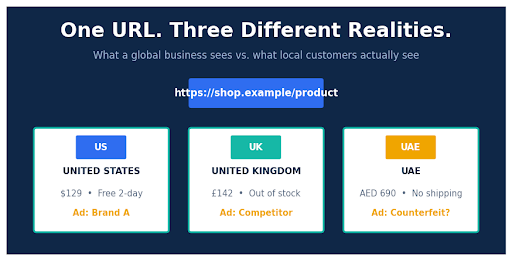
For most of the last decade, “proxy network” was a phrase that lived in the shadows of the internet — associated with grey-area data harvesting and the cat-and-mouse games of automated traffic. In 2026, that framing is badly out of date. The fastest-growing use of residential and mobile proxy infrastructure today has nothing to do with evasion and everything to do with trust: verifying that ads actually appear where brands paid for them, confirming that prices and product pages render correctly in every market, protecting customers from counterfeit listings, and meeting the geographic compliance rules that now govern fintech and e-commerce.
This is a meaningful shift, and it deserves a clearer explanation than the industry usually gives it.
Why “seeing the internet as a local user” became a business requirement
The modern web is personalized to the point of fragmentation. The same URL can return different prices, different ads, different currencies, and different content depending on the visitor’s country, city, device, and network. For a business operating in one market, that is invisible. For a business operating in twenty, it is a serious blind spot.
Consider a payments company expanding across Southeast Asia. Its compliance team needs to confirm that the correct regulatory disclosures appear to users in each jurisdiction. Its marketing team needs to confirm that a campaign localized for Jakarta isn’t accidentally serving Manila creative. Its fraud team needs to see the checkout flow exactly as a customer in each region sees it. None of this can be verified from a single office in a single country on a single corporate network. The company needs to view its own products through the eyes of a real local user — and that is precisely what a quality residential proxy network makes possible.
The key word is real. Datacenter IP addresses, the cheap workhorses of the early proxy era, are increasingly transparent to the platforms that matter. A residential or mobile IP — one that belongs to a genuine consumer connection — reflects what an actual customer experiences. For verification work, that authenticity isn’t a trick; it’s the entire point.
Four legitimate jobs proxies now do for serious companies
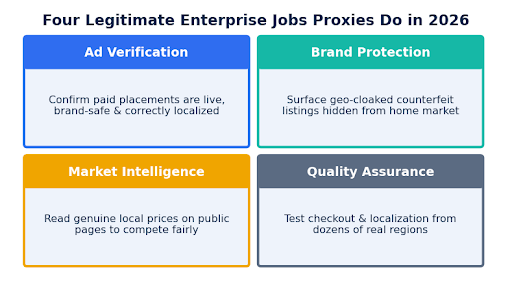 Ad verification. Global digital ad spend is enormous, and a stubborn share of it is wasted on misplaced, fraudulent, or simply non-rendering placements. Brands and their agencies now routinely sample how campaigns appear across regions to confirm that paid placements are live, brand-safe, and not sitting next to content that violates their guidelines. Doing this credibly requires seeing pages as local audiences do.
Brand and consumer protection. Counterfeiters and unauthorized resellers tailor what they show based on visitor location, often hiding infringing listings from the brand’s home market while displaying them to shoppers elsewhere. Trust-and-safety teams use geographically distributed connections to surface these listings and protect customers — a defensive use case, not an offensive one.
Localized market and price intelligence. Retailers and travel companies study publicly listed prices to set competitive, fair rates. The legitimacy here rests on respecting site terms and gathering only public information, but the technical reality is the same: accurate intelligence depends on seeing the genuine local version of a public page rather than a distorted one.
Quality assurance and uptime testing. Engineering teams test how applications load from dozens of regions, catching localization bugs, broken payment integrations, and latency problems before customers ever encounter them.
The 2026 standard: ethics and infrastructure are inseparable
What separates a defensible proxy strategy from a reputational liability in 2026 is no longer just performance — it’s provenance. Where do the IP addresses come from? Were the consumers whose connections form the network compensated and properly informed? Does the provider enforce acceptable-use policies that prohibit genuinely abusive activity?
These questions matter to regulators, to enterprise procurement teams, and increasingly to the platforms whose data is involved. A provider that can answer them clearly is offering infrastructure a compliance officer can sign off on. A provider that can’t is offering risk dressed up as a discount. Serious buyers have learned to tell the difference, and they are willing to pay for sourcing they can stand behind.
This is why the conversation around providers like Proxybox has moved from “how fast and how cheap” to “how clean and how accountable.” The technical specifications still matter — pool size, success rate, session control, geographic granularity — but they now sit on top of a foundation of ethical sourcing rather than replacing it.
What to look for if you’re evaluating a network
For decision-makers approaching this category for the first time, a few practical criteria cut through the marketing noise:
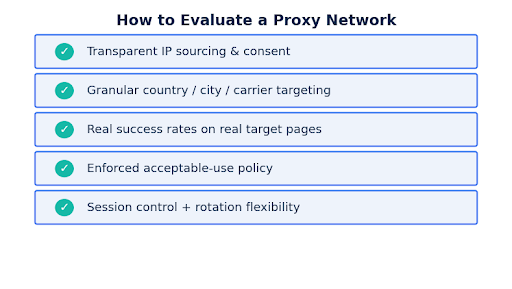
- Transparent sourcing. Insist on a clear explanation of how the network’s IP addresses are obtained and how consent is handled.
- Granular targeting. The ability to select country, and ideally city or carrier, determines whether your verification reflects the markets you actually serve.
- Real success rates on real targets. A network is only useful if it consistently returns the genuine local view of the pages you need to check.
- Enforced acceptable use. Counterintuitively, a provider that says “no” to abusive use cases is protecting the long-term health — and the reputation — of every legitimate customer on the network.
- Session and rotation control. Verification often requires holding a consistent identity for a sequence of steps; intelligence work often requires the opposite. Good infrastructure supports both.
The bottom line
The proxy industry spent years living down its early reputation. In 2026, the businesses getting the most value from this infrastructure are the ones who never bought into that reputation in the first place — the compliance teams, ad-verification specialists, brand-protection units, and QA engineers who simply need to see the internet as their customers see it, everywhere they operate.
Treated that way, a residential proxy network stops being a grey-area shortcut and becomes what it genuinely is for a growing share of the market: a quiet, accountable layer of infrastructure that helps companies keep their promises to customers across borders. The providers who understand that — and who can prove their sourcing is as clean as their performance is strong — are the ones defining the category’s more mature, more trustworthy second act.