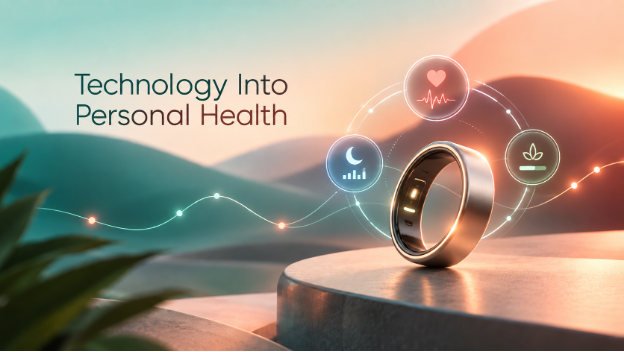
Health technology did not enter everyday life through a dramatic replacement of doctors or hospitals. It arrived through step counters, sleep scores, smartwatches, pharmacy apps, home tests, symptom searches, and AI assistants already sitting in people’s pockets.
That quiet expansion matters because personal health is becoming increasingly computational. Devices collect signals, software turns them into patterns, and AI attempts to explain what those patterns mean. The result is a new layer between a person and the healthcare system: technology that watches, interprets, predicts, and sometimes recommends before a clinical appointment begins.
Health Moved Into Devices
A decade ago, most people encountered health measurements during appointments, workouts, or deliberate self-tracking. Now many measurements happen passively.
Smartwatches estimate heart rate throughout the day. Phones record movement. Connected scales maintain weight histories. Sleep trackers estimate rest patterns. Some wearables can perform single-lead ECG recordings or flag potentially irregular rhythms.
The adoption base is already significant. Pew Research Center reported in June 2026 that 37% of U.S. adults own a smartwatch, including 44% of adults ages 18 to 29 and the same share among those ages 30 to 49.
The larger shift is frequency. A blood-pressure measurement taken twice a year creates two snapshots. A wearable collecting thousands of readings creates a timeline. Even when individual readings are imperfect, long-term patterns can reveal changes that a person might otherwise miss. Consumer technology has therefore moved personal health from occasional measurement toward continuous observation.
Data Changed the Feedback Loop
Continuous data affects behavior because it shortens the distance between action and feedback. Walk more and a step total changes immediately. Sleep badly and a recovery score may fall the next morning. Exercise harder than usual and resting heart rate or recovery metrics may look different over the following days.
That feedback can be useful because many health behaviors have delayed consequences. Digital tracking makes some of those effects visible much sooner.
But numbers can also appear more certain than the measurement behind them. A sleep score of 82 looks exact, even though the device may be inferring sleep from movement, heart rate, temperature, or blood oxygen estimates rather than directly measuring sleep in a clinical setting.
| Consumer metric | What the device may measure | What users often assume |
| Sleep score | Movement and physiological signals | Exact sleep quality |
| Recovery score | Heart rate, HRV, sleep and activity | Medical readiness |
| Calories burned | Movement, heart rate and user profile | Exact energy use |
| Stress score | Physiological patterns | Direct emotional stress |
| Irregular rhythm alert | Electrical or pulse patterns | Complete cardiac diagnosis |
Useful health technology therefore depends as much on interpretation as sensing.
AI Became the Interpreter
The next phase of personal health technology is not simply more sensors. It is software capable of explaining the data those sensors produce.
Earlier fitness apps mainly displayed charts. Modern systems increasingly translate measurements into natural language: resting heart rate is higher than usual, sleep duration has declined, activity has dropped, or recovery may be lower after several poor nights.
Generative AI pushes this further. People can paste lab results into an AI chatbot, ask about medication side effects, describe symptoms, compare treatment terms, or request a plain-language explanation of medical wording.
Rock Health’s 2025 Consumer Adoption Survey, published in 2026 and based on 8,000 U.S. adults, found that 32% had used AI chatbots for health information, up from 16% the previous year. Among those users, 64% said they used AI for health at least weekly.
That makes AI a new interpretation layer. The device may collect the data, but increasingly the AI explains why the user should care.
Tracking Is Becoming Prediction
Personal health software is also moving beyond recording what already happened.
| Stage | System behavior | Example |
| Tracking | Records a signal | Resting heart rate was 68 bpm |
| Comparison | Finds a change | Heart rate is above your baseline |
| Prediction | Estimates possible risk | Pattern may indicate an irregular rhythm |
| Recommendation | Suggests a next step | Consider further evaluation |
Each stage requires more inference. Recording a heart-rate value is different from deciding whether the pattern is clinically significant. Estimating tomorrow’s recovery is different from measuring yesterday’s activity. Detecting an anomaly is different from knowing why it occurred.
That is where predictive systems become useful and risky at the same time. A system may correctly detect a change without knowing whether illness, medication, travel, stress, exercise, sensor error, or another factor caused it. Good health software should therefore present prediction as probability, not certainty.
The Home Became a Health Interface
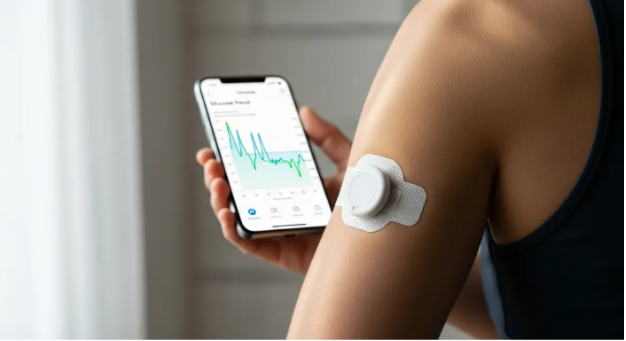
Wearables are only one part of the shift. More healthcare activity is also moving into the home. Connected blood-pressure monitors maintain histories automatically. Continuous glucose monitors provide frequent measurements instead of isolated readings. Smart scales track trends over months. Digital pharmacies manage refills and delivery. At-home diagnostic tests move parts of screening outside clinics, while telehealth reduces the need for physical travel.
Deloitte’s 2025 U.S. Health Care Consumer Survey found that 23% of respondents had used a direct-to-consumer health offering. Common uses included prescription access, mental health services, weight management, and wellness services. This does not mean the clinic is disappearing. It means the boundary around it is becoming less rigid.
Health activity now happens across sensors on the body, software on the phone, diagnostic devices at home, cloud services, virtual appointments, pharmacies, and traditional medical systems. The technical challenge is making those environments work together without treating them as interchangeable.
Personal Health Became a Data Stack
A modern health routine can generate surprisingly diverse information. Someone using only a smartwatch and smartphone may produce data about:
- Daily movement patterns that reveal changes in activity over time.
- Resting heart rate and cardiovascular trends compared with personal baselines.
- Sleep duration, timing, and consistency.
- Workout intensity, recovery estimates, and periods of inactivity.
- Location-linked walking, running, or cycling activity.
- Self-entered information about medications, symptoms, menstrual cycles, food, or mood.
Add a connected scale, glucose monitor, blood-pressure cuff, digital pharmacy, telehealth service, and AI assistant, and personal health begins to resemble a small data ecosystem.
That creates value because different signals can provide context for one another. It also creates complexity because the information may be stored by different companies, collected under different standards, and generated with very different levels of reliability. More data is useful only when its source and limitations remain visible.
When Data Is Not Enough
The expansion of personal health technology can create the impression that enough measurements will eventually explain every outcome. In practice, medical decisions still depend heavily on context, professional judgment, communication, and what happens after information becomes available.
A wearable can record a change. A lab system can produce a result. An AI assistant can translate terminology. None of those tools can automatically establish whether a clinician had the right information, interpreted it correctly, or acted within the required timeframe.
That distinction becomes important when someone believes a serious mistake occurred during diagnosis or treatment. Digital records may then form part of a much larger timeline involving test results, clinical notes, prescriptions, referrals, communication, and professional decisions. Resources such as a West Palm Beach Medical Malpractice Attorney illustrate how questions about a medical outcome can move beyond data collection and toward reviewing how information was interpreted and acted upon. The broader technology lesson is simple: better sensors and better records improve visibility, but they do not remove the human layer from healthcare.
AI Shortens the Path to Action

The most important change created by health AI may not be access to information. Search engines already provided that. AI reduces the number of steps between having a question and deciding what to do next.
A person can describe symptoms, receive an explanation, ask follow-up questions, compare possible causes, learn what information a clinician may need, and prepare questions in one conversation.
Rock Health’s survey shows that people are already acting on these interactions. Among AI health users, 40% reported consulting a provider after an AI interaction, 32% tried a new health behavior, and 18% reported adjusting medications. Overall, 81% said they had taken at least one relevant action after using an AI chatbot for health information.
Those numbers explain why accuracy matters. An incorrect restaurant recommendation is inconvenient. Incorrect health guidance can influence whether someone seeks care, delays care, changes a medication, or dismisses a symptom. AI therefore needs stronger boundaries in health than in many ordinary information tasks.
More Data Creates More Failure Modes
Health technology creates risks partly because measurement is easier than interpretation.
One risk is false reassurance. If a wearable detects nothing unusual, a user may assume there is no problem even though the device was never designed to rule out every condition.
The opposite risk is false alarm. Consumer sensors operate outside controlled clinical environments. Poor contact, movement, device placement, environmental conditions, or individual physiology can produce noisy readings that users may interpret as emergencies.
AI adds another layer because language models can produce confident explanations even when the available information is incomplete.
Deloitte reported in earlier U.S. research that 30% of consumers said they did not trust health information generated by AI, while 80% wanted to know when a doctor used AI in making decisions.
A strong design principle is that the system should communicate the quality of its evidence as clearly as it communicates the result. That means distinguishing between a direct measurement, an algorithmic estimate, a statistical anomaly, and an AI-generated interpretation instead of presenting them with the same visual authority.
Health Data Became High-Value Data
As health technology becomes more personal, privacy becomes more complicated than simply asking whether an app collects information.
The more important questions are what is collected, how long it is retained, what other datasets it can be combined with, and who can access the result.
Sleep, movement, medication use, menstrual cycles, heart rate, weight, diet, glucose levels, and mental-health information can reveal far more than ordinary browsing history. Even harmless-looking data can become sensitive when combined.
A location trail can reveal repeated clinic visits. Sleep changes can expose shifts in routine. Activity records can indicate periods of illness or recovery. Medication reminders can imply treatment for a condition without naming it directly.
Health platforms therefore face a difficult engineering requirement: becoming more personalized without making unnecessary accumulation of intimate data the default. Before sharing sensitive information with an unfamiliar platform, basic website safety checks can also help surface security, reputation, and domain signals that are not obvious from the interface alone.
Useful approaches include more on-device processing, shorter retention periods, separating identity from analytics where practical, and giving users meaningful control over data sharing.
Personalization Is Still Partial
One of the strongest promises in consumer health technology is personalization. A system that knows an individual’s baseline can often provide better information than one that compares everyone against the same population average.
If someone’s resting heart rate is usually low, a change may be meaningful even when the new number still falls within a broad reference range. The same logic applies to sleep, activity, glucose, temperature, and other signals.
But personal data still provides only part of the picture. A wearable may know activity and heart rate but not know someone started a new prescription. A nutrition app may know reported meals but not everything eaten or absorbed. An AI assistant may know the symptoms entered in a conversation but not examination findings a clinician would observe.
Personalization should therefore be understood as better context, not complete context. The risk appears when interfaces erase that distinction and present individualized output as comprehensive understanding.
Health Tech Is Becoming Infrastructure
The long-term transformation is larger than any smartwatch, chatbot, or home diagnostic kit. Personal health is becoming a connected technical system.
A wearable collects signals. A smartphone stores and visualizes them. Cloud software detects trends. An AI assistant translates them into understandable language. A patient portal links them with formal records. A remote-monitoring system may send selected information to a care team.
As these layers connect, the boundary between consumer technology and medical technology becomes harder to see. That makes careful AI tool testing more important when software is moving from experimentation into workflows where accuracy, safety, and human oversight carry greater consequences.
Rock Health’s 2025 survey found that AI health users were more likely than non-users to track sleep, physical activity, diet, and stress, and they tracked more health metrics overall.
That suggests AI is not replacing existing health technology. It is becoming a new interface on top of it. The more data people generate, the more useful interpretation becomes. The better interpretation becomes, the more reason people have to collect data. That feedback loop could shape personal health technology for years.
Final Perspective
The biggest change in health technology is not that people suddenly adopted sophisticated medical devices. It is that ordinary consumer technology gradually acquired health functions until monitoring the body became part of everyday computing.
That shift has clear advantages. People can see long-term patterns, access explanations more easily, prepare better for appointments, monitor conditions from home, and receive alerts when software detects something unusual.
But each new capability moves technology closer to decisions with real consequences. Tracking becomes interpretation. Interpretation becomes prediction. Prediction can become a recommendation, and recommendation can influence action.
The future of personal health technology will therefore depend less on how many metrics devices can collect and more on whether systems can explain what those metrics mean, how certain the interpretation is, and when software should stop and hand the decision back to a qualified human. The quiet expansion is already underway. The harder phase begins when technology stops merely measuring health and starts helping people decide what to do about it.